Calc1131W9T4 - Polar curves

Tuesday, 1 May 2018

8:30 PM

Machine generated alternative text:
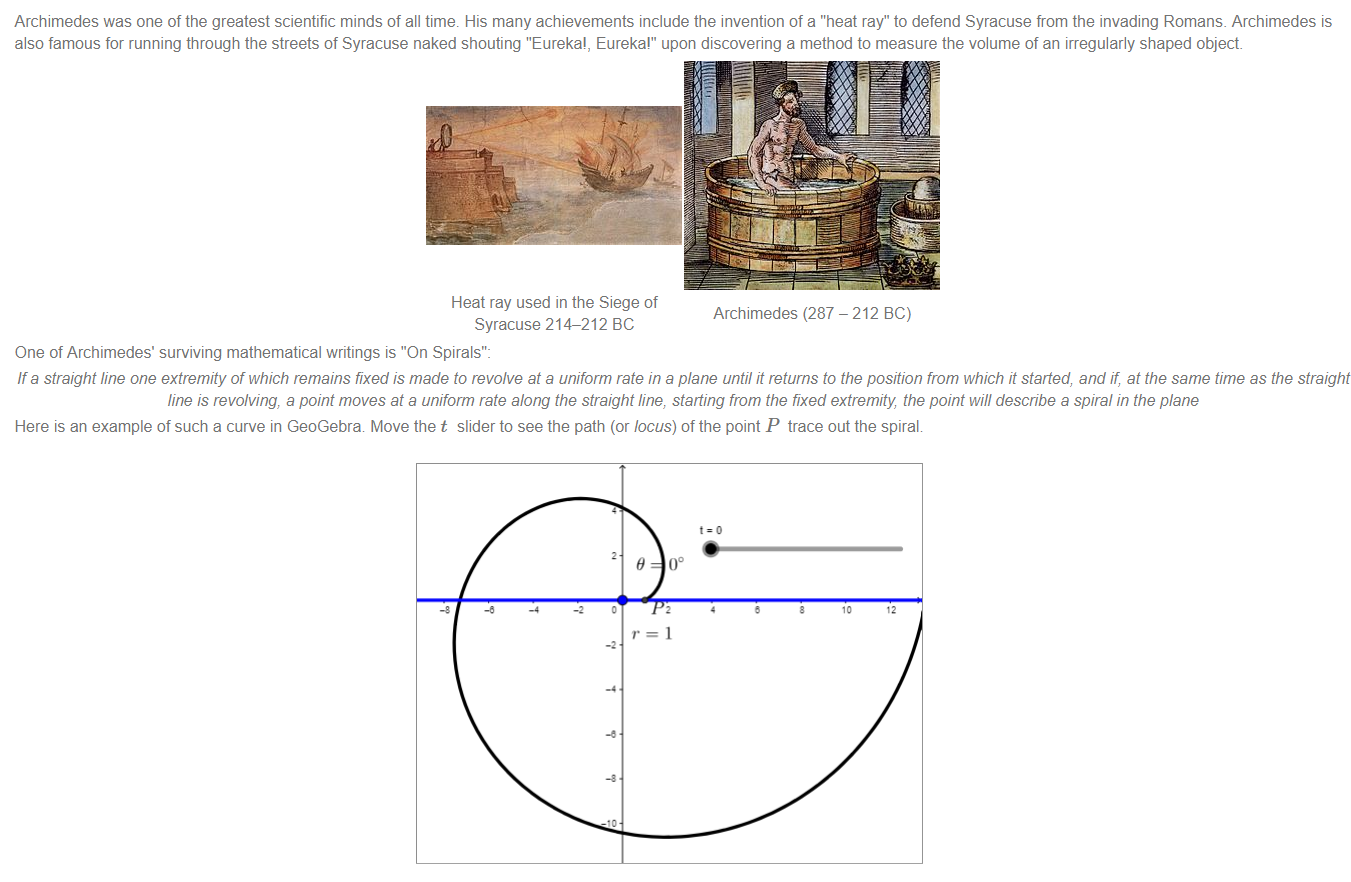
Archimedes was one of the greatest scientific minds of all time. His many achievements include the invention of a "heat ray" to defend Syracuse from the invading Romans. Archimedes is 
also famous for running through the streets of Syracuse naked shouting '"Eureka', Eureka!" upon discovering a method to measure the volume of an irregularly shaped object 
Heat ray used in the Siege of 
Syracuse 214-212 BC 
One of Archimedes' surviving mathematical writings is "'On Spirals": 
Archimedes (287 - 212 BC) 
If a straight line one extremity of which remains fixed is made to revolve at a uniform rate in a plane until it returns to the position from which it started, and if, at the same time as the straight 
line IS revolving, a point moves at a uniform rate along the straight line, starting from the fixed extremity, the point Will describe a spiral in the plane 
Here is an example of such a curve in GeoGebra Move the t slider to see the path (or locus) of the point P trace out the spiral 
00


Machine generated alternative text:
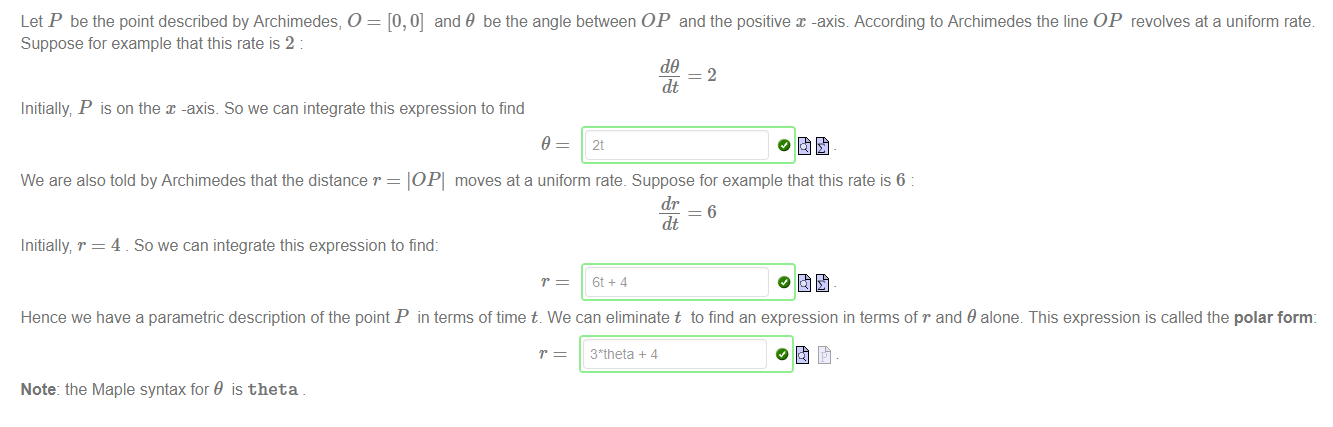
Let P be the point described by Archimedes, O = [0,0] and 9 be the angle between OP and the positive x -axis. According to Archimedes the line OP revolves at a uniform rate 
Suppose for example that this rate is 2 
dt 
Initially, P is on the x -axis. So we can integrate this expression to find 
9 
We are also told by Archimedes that the distance r = IOPI moves ata uniform rate. Suppose for example that this rate is 6 
dr 
dt 
Initially, r = 4 So we can integrate this expression to find: 
Hence we have a parametric description of the point P in terms of time t. We can eliminate t to find an expression in terms of r and 9 alone. This expression is called the polar form 
3*tneta + 4 
Note: the Maple syntax for 9 is theta


Machine generated alternative text:
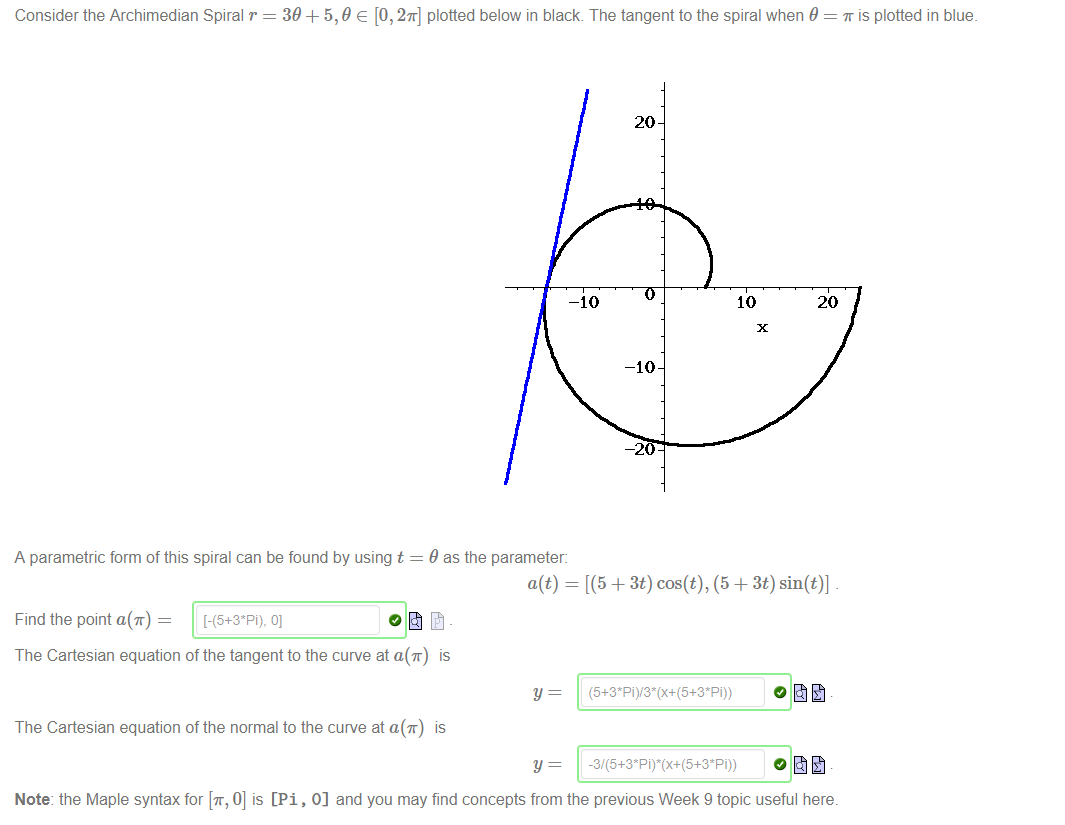
Consider the Archimedian Spiral r 
39 + 5,9 e [0, 2T] plotted below in black. The tangent to the spiral when 9 
is plotted in blue. 
20 
-10 
-10 
-2 
10 
20 
A parametric form of this spiral can be found by using t = 9 as the parameter: 
a(t) 
Find the point a(T) 
The Cartesian equation of the tangent to the curve at a(ff) is 
The Cartesian equation of the normal to the curve at a(T) is 
Note: the Maple syntax for [T, 0] is [Pi, O] and you may find concepts from the previous Week 9 topic useful here.


Machine generated alternative text:
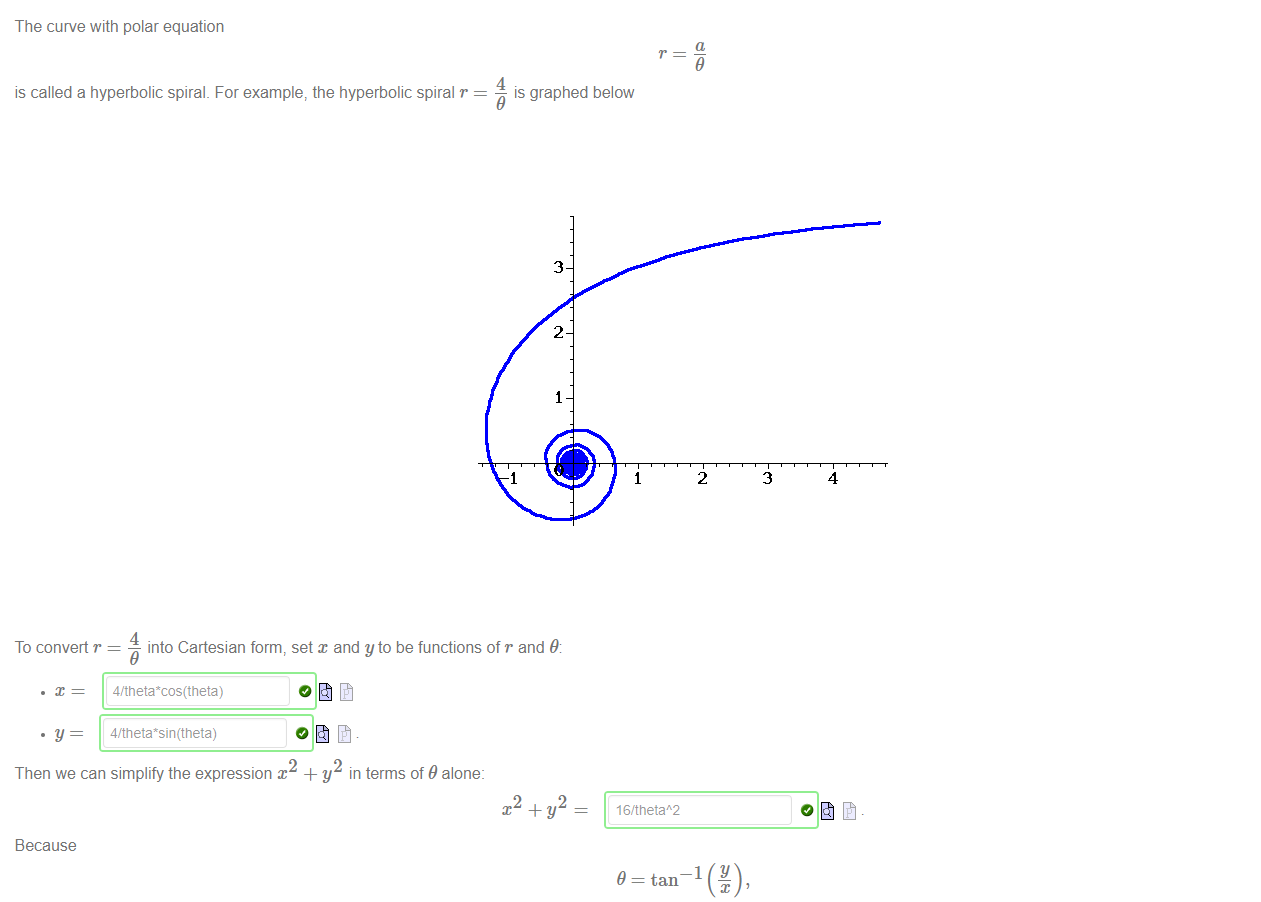
The curve with polar equation 
is called a hyperbolic spiral. For example, the hyperbolic spiral r 
4 
is graphed below 
3 
2 
2 
3 
4 
4 
To convert r 
into Cartesian form, set x and yto be functions of r and 9: 
Then we can simplify the expression 
Because 
+ y in terms of 9 alone: 
2 
16/tnetah2 
9


Machine generated alternative text:
we can eliminate 9 from the previous expression to obtain the Cartesian equation for the hyperbolic spiral: 
2 
(x2 + y2) (tan 
16 
Note: the Maple syntax for rtan(9) is r * tan (theta).


Machine generated alternative text:
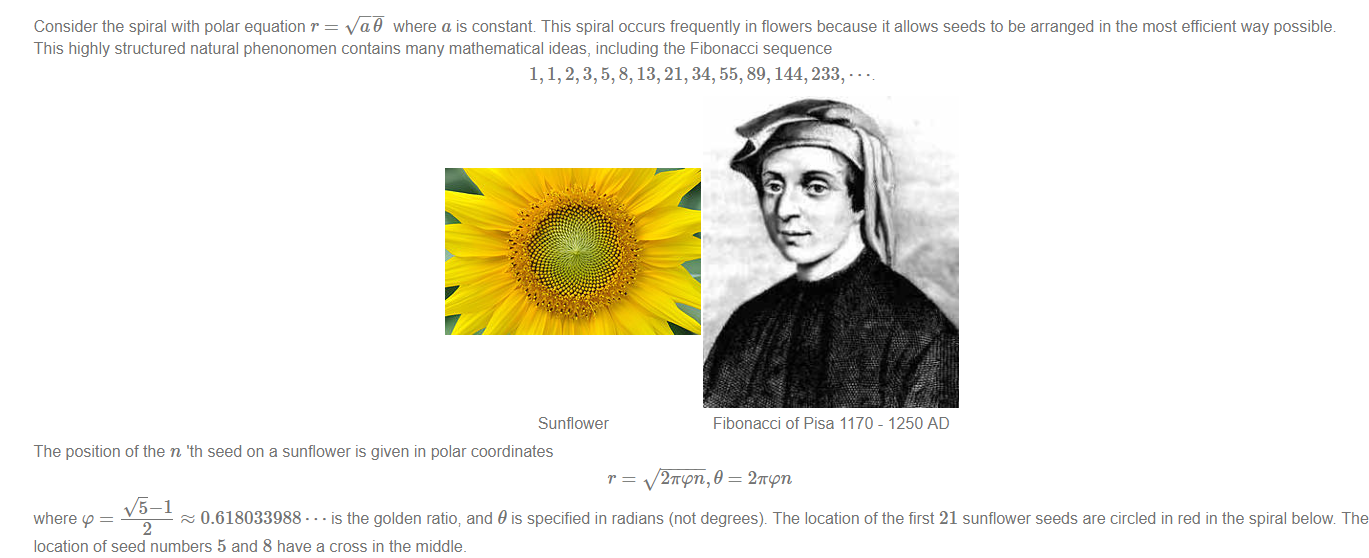
Consider the spiral with polar equation r = where a is constant This spiral occurs frequently in flowers because it allows seeds to be arranged in the most efficient way possible 
This highly structured natural phenonomen contains many mathematical ideas, including the Fibonacci sequence 
1, 1, 2, 3, 5, 8, 13, 21, 34, 55, 89, 144, 233, 
Sunflower 
The position of the n 'th seed on a sunflower is given in polar coordinates 
Fibonacci of Pisa 1170 - 1250 AD 
2mpn, 9 = 2mpn 
VS—I 
0.618033988 • • • is the golden ratio; and 9 is specified in radians (not degrees). The location of the first 21 sunflower seeds are circled in red in the spiral below The 
where p 
2 
location of seed numbers 5 and 8 have a cross in the middle.


Machine generated alternative text:
4 
2 
2 
Find the Cartesian coordinates (to two decimal places) for 
• seed number 5: 287] 
• seed number 8 
[5.24, -1 91] 
• seed number 610: [48.67: 0.22] 
In fact, all of the seeds corresponding to Fibonacci numbers (such as 5, 8 and 610) occur near the positive x-axis, which in polar form has the equation: 
9


Created with Microsoft OneNote 2016.