Calc1131W7T4 - L'Hopital's rule

Saturday, 21 April 2018

11:24 AM

Untitled picture.png Machine generated alternative text:
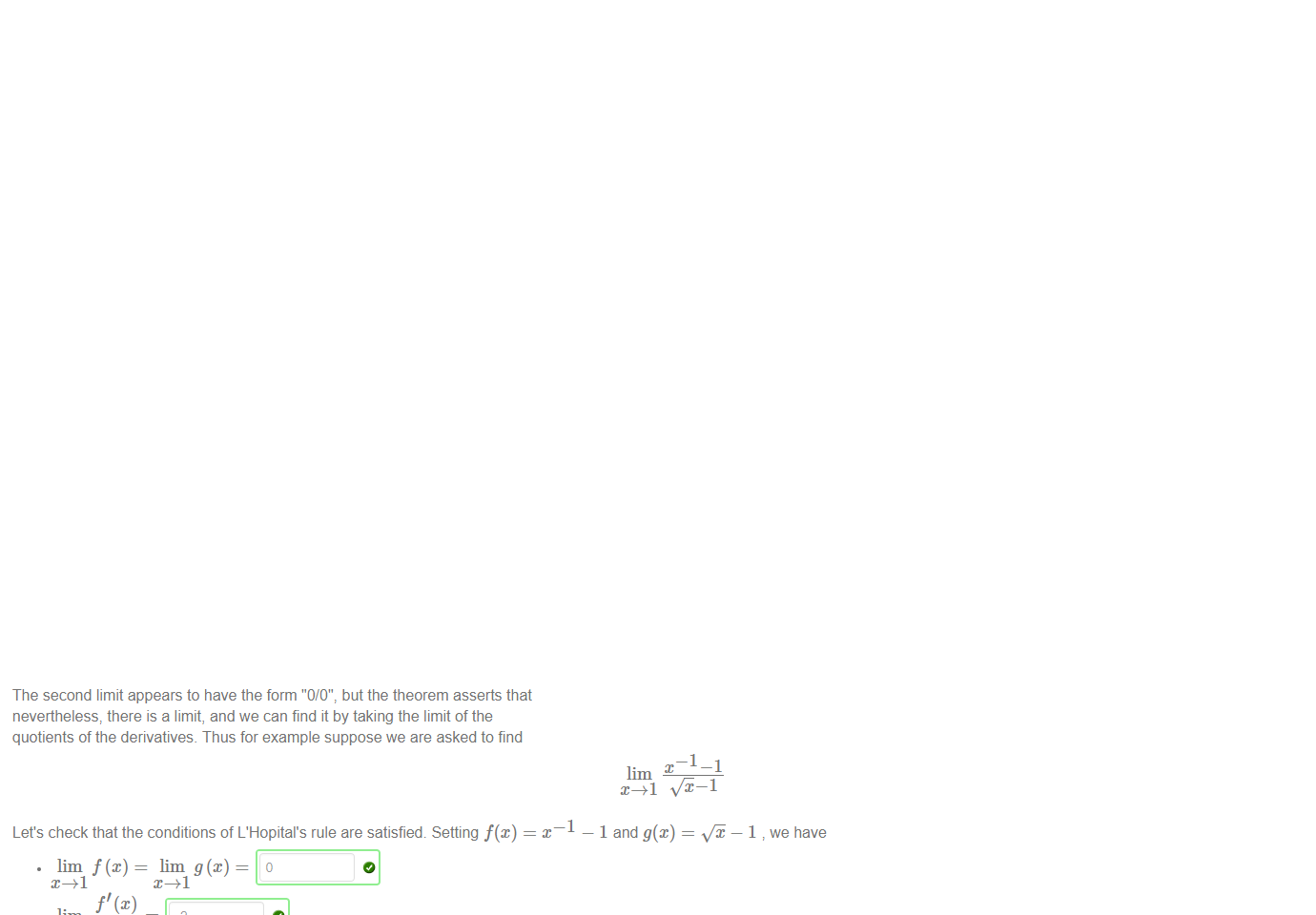
The second limit appears to have the form "0/0", but the theorem asserts that 
nevertheless, there is a limit, and we can find it by taking the limit of the 
quotients of the derivatives. Thus for example suppose we are asked to find 
Let's check that the conditions of L'Hopital's rule are satisfied. Setting f(x) 
lim f@) = lim g@) 
-2 
So by L'Hopital's rule: 
-1-1 
lim 
— 1 and g@) = 
—1 
—1 
-2 
1 we have 
This method also works when the functions approach oo or —oo_ For example consider the limit 
Ifwe let f@) = = ex then 
lim f (x) = lim — 
So by L'Hopital's Rule 
lim
Untitled picture.png Machine generated alternative text:
The second limit appears to have the form "0/0", but the theorem asserts that 
nevertheless, there is a limit, and we can find it by taking the limit of the 
quotients of the derivatives. Thus for example suppose we are asked to find 
Let's check that the conditions of L'Hopital's rule are satisfied. Setting f(x) 
lim f@) = lim g@) 
-2 
So by L'Hopital's rule: 
-1-1 
lim 
— 1 and g@) = 
—1 
—1 
-2 
1 we have 
This method also works when the functions approach oo or —oo_ For example consider the limit 
Ifwe let f@) = = ex then 
lim f (x) = lim — 
So by L'Hopital's Rule 
lim 

Untitled picture.png Machine generated alternative text:
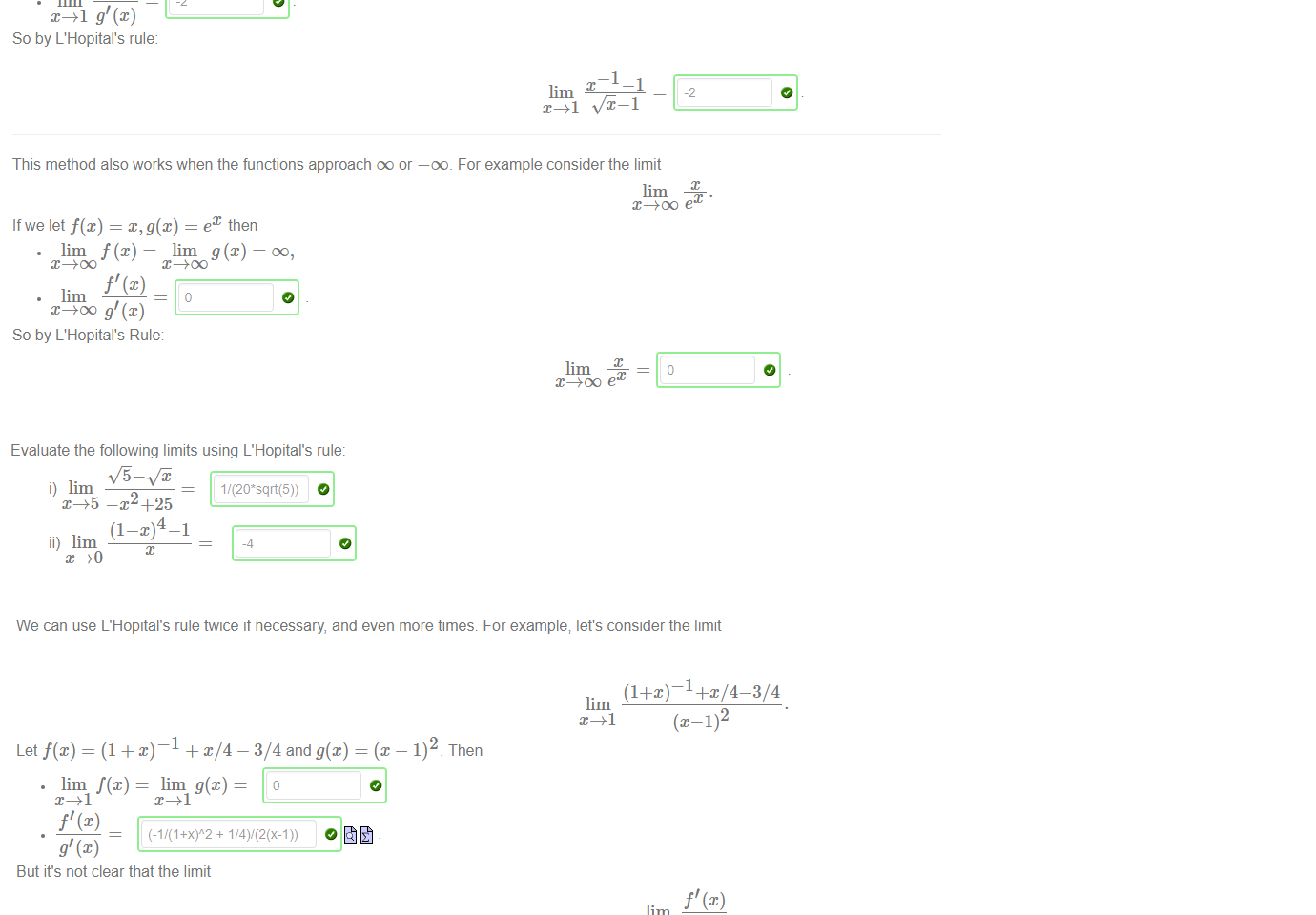
Evaluate the following limits using L'Hopital's rule: 
i) lim 
x_+5 —x2+25 
ii) lim 
-4 

Untitled picture.png Machine generated alternative text:
We can use L'Hopital's rule twice if necessary, and even more times. For example; let's consider the limit 
lim 
Then 
Let f(x) = (1 + x) — 
— 3/4 and g@) — 
(x 
lim = lim g@) — 
But it's not clear that the limit 
lim 
exists. Let's go deeper and apply L'Hopital's rule to investigate the limit (2). Again we check the conditions 
lim f' (x) lim g' (x) — 
(1+X)A-3 
Now we can easily evaluate 
L = lim 
Peeling back our innermost application of L'Hopital's rule shows that the limit (2) exists and equals L. We finally return to the limit (1) and conclude that it also exists and equals L.
Untitled picture.png Machine generated alternative text:
We can use L'Hopital's rule twice if necessary, and even more times. For example; let's consider the limit 
lim 
Then 
Let f(x) = (1 + x) — 
— 3/4 and g@) — 
(x 
lim = lim g@) — 
But it's not clear that the limit 
lim 
exists. Let's go deeper and apply L'Hopital's rule to investigate the limit (2). Again we check the conditions 
lim f' (x) lim g' (x) — 
(1+X)A-3 
Now we can easily evaluate 
L = lim 
Peeling back our innermost application of L'Hopital's rule shows that the limit (2) exists and equals L. We finally return to the limit (1) and conclude that it also exists and equals L. 

Untitled picture.png Machine generated alternative text:
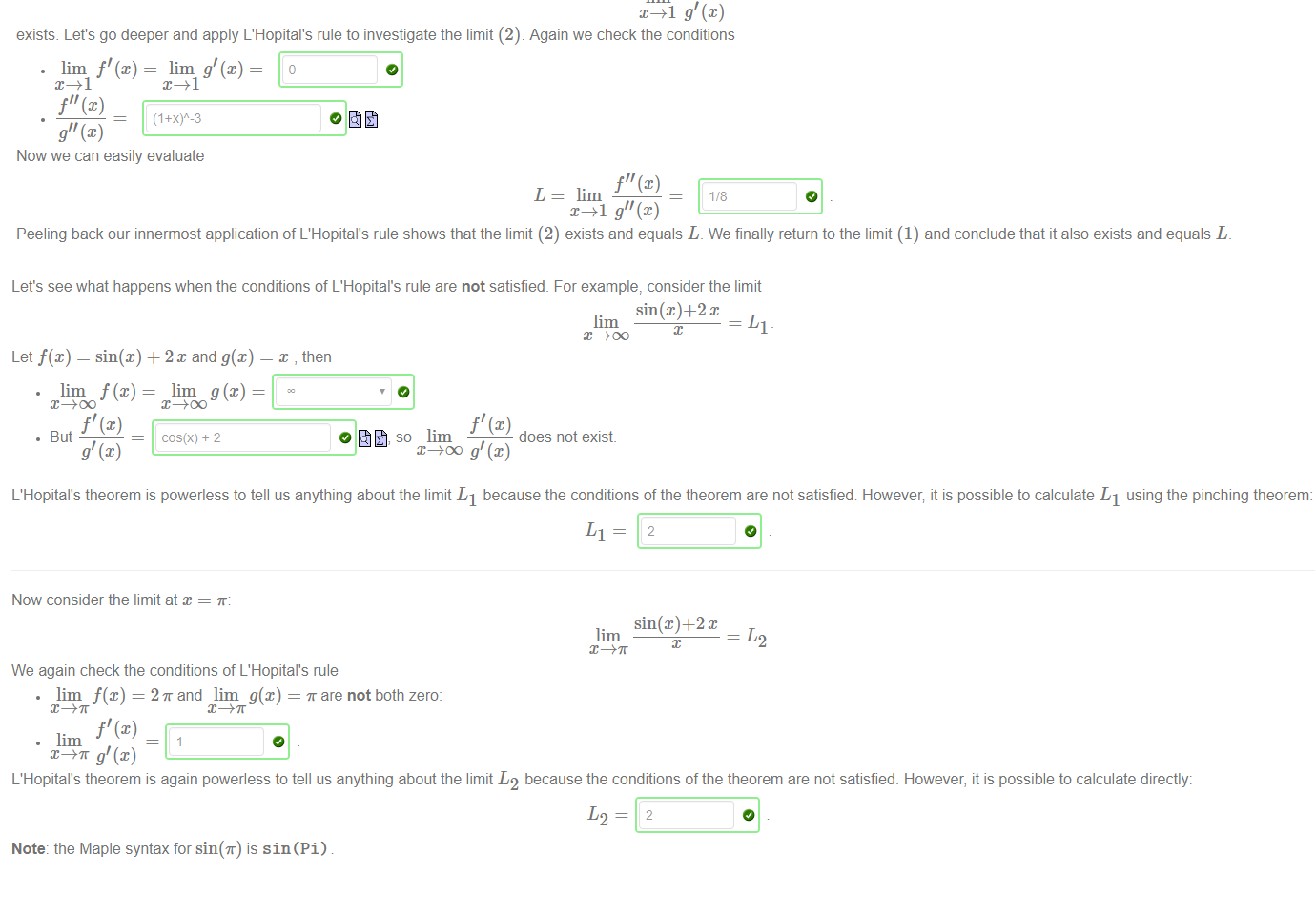
Let's see what happens when the conditions of L'Hopital's rule are not satisfied. For example, consider the limit 
Let f(x) = sin@) + 2m and g(x) 
x , then 
lim = lim g@) 
• But 
cos(x) + 2 
O lim 
does not exist. 
L'Hopital's theorem is powerless to tell us anything about the limit Ll because the conditions of the theorem are not satisfied However; it is possible to calculate Ll using the pinching theorem: 
2 
Now consider the limit at x 
We again check the conditions of L'Hopital's rule 
lim = 2K and lim g(x) 
7T are not both zero: 
L'Hopital's theorem is again powerless to tell us anything about the limit 142 because the conditions of the theorem are not satisfied. However, it is possible to calculate directly: 
2 
Note: the Maple syntax for sin(ff) is sin (Pi) 

Untitled picture.png Machine generated alternative text:
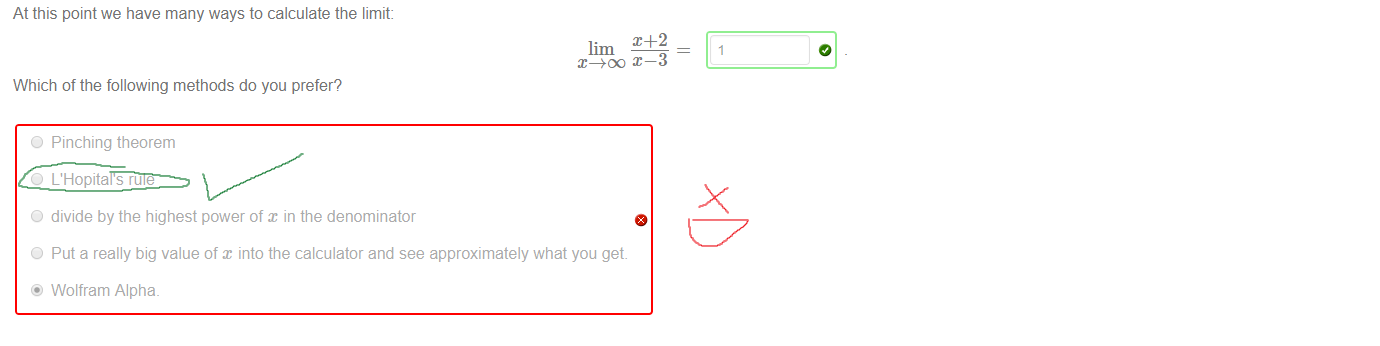
At this point we have many ways to calculate the limit: 
—3 
Which of the following methods do you prefer? 
O 
O 
O 
O 
Pinching theorem 
L'Hopital's rule 
divide by the highest power of in the denominator 
Put a really big value of x into the calculator and see approximately what you get. 
Wolfram Alpha.
Untitled picture.png Machine generated alternative text:
At this point we have many ways to calculate the limit: 
—3 
Which of the following methods do you prefer? 
O 
O 
O 
O 
Pinching theorem 
L'Hopital's rule 
divide by the highest power of in the denominator 
Put a really big value of x into the calculator and see approximately what you get. 
Wolfram Alpha. 

Ink Drawings
Ink Drawings
Ink Drawings
Ink Drawings
Ink Drawings


Created with Microsoft OneNote 2016.