Calc1131W7T2 - Antiderivatives

Saturday, 21 April 2018

11:24 AM

Machine generated alternative text:
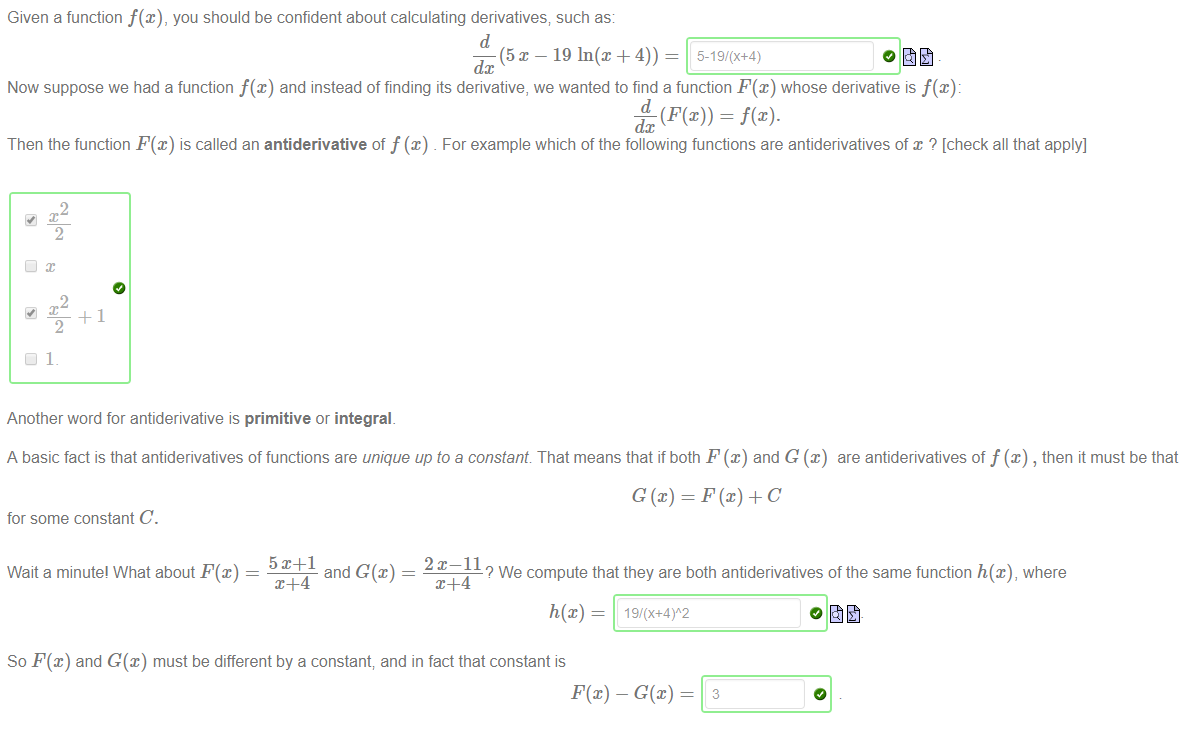
Given a function f@), you should be confident about calculating derivatives; such as: 
(5 x — 19 In@ + 4)) 
dc 
Now suppose we had a function f@) and instead of finding its derivative, we wanted to find a function F(x) whose derivative is f(x): 
dc 
Then the function F@) is called an antiderivative of f (x) For example which of the following functions are antiderivatives of x ? [check all that apply] 
2 
2 
Another word for antiderivative is primitive or integral. 
A basic fact is that antiderivatives of functions are unique upto a constant That means that if both F@) and G @) are antiderivatives off@) , then it must be that 
for some constant C. 
2x—11 
Wait a minutel What about F@) 
and G(x) 
? We compute that they are both antiderivatives of the same function h(x), where 
So F@) and G(x) must be different by a constant; and in fact that constant is


Machine generated alternative text:
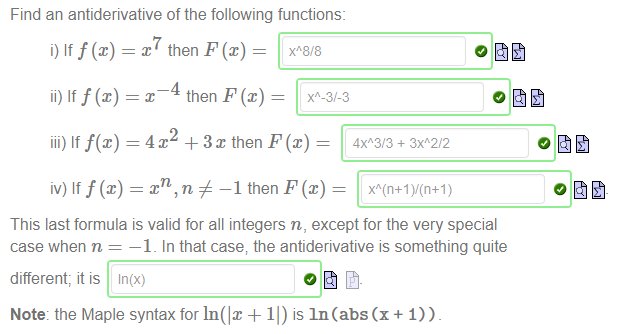
Find an antiderivative of the following functions: 
i) Iff@) 
ii) Iff@) 
then F@) 
iii) If f(x) = 4 + 3 x then F@) 
iv) Iff@) 
— n # —1 then F (c) ¯ 
This last formula is valid for all integers n, except for the very special 
case when n = —1 _ In that case; the antiderivative is something quite 
different; it is In(x) 
Note: the Maple syntax for In(lx + Il) is In (abs (x + 1))


Machine generated alternative text:
A particle moving along the vertical y - axis has velocity 
metres per second at time t e [0, 8.532] seconds. 
Initially y(O) = O; so the vertical displacement of the particle at t seconds is 
Vertical displacement as a function of time is plotted below. 
70 
60 
50 
30 
20 
10 
—P t 20 
EYEÜ:::::] 
2 
4 
6 
8 
The maximum vertical displacement is attained when t 
O At this point the particle has travelled a distance of 
425/6 
O 
metres_ 
When the particle returns to its original starting point, the total distance travelled is 425/3 
O metres.


Machine generated alternative text:
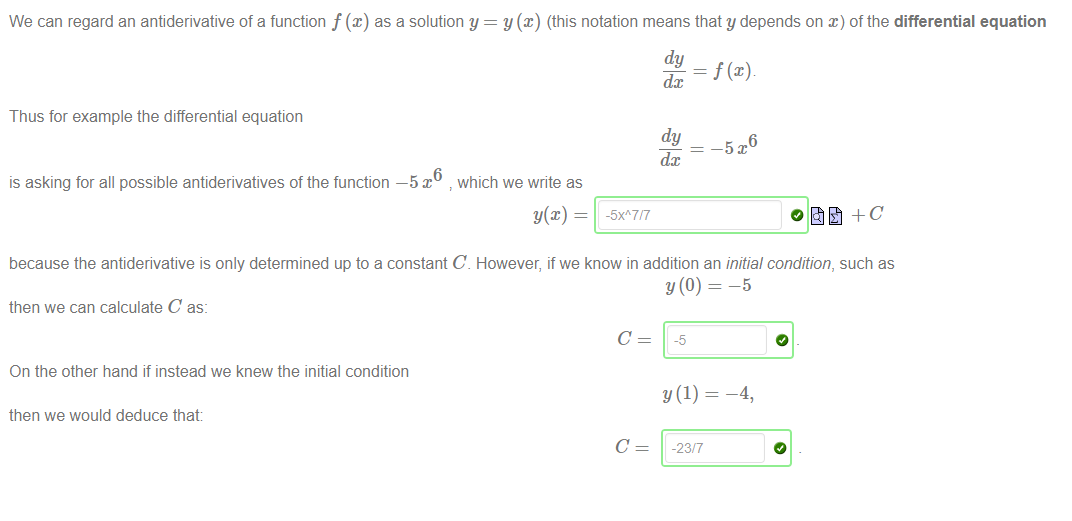
We can regard an antiderivative of a function f@) as a solution y 
y@) (this notation means that y depends on x) of the differential equation 
dy 
—5 
Thus for example the differential equation 
is asking for all possible antiderivatives of the function —5 x 
dc 
dy 
6 
which we write as 
because the antiderivative is only determined up to a constant C However, if we know in addition an initial condition, such as 
then we can calculate C as: 
C 
On the other hand if instead we knew the initial condition 
then we would deduce that: 
C 
-5 
-23/7


Machine generated alternative text:
A car is travelling along a straight road with velocity 3 metres per second at time t 
Since the derivative of velocity is acceleration, we see that the velocity t'(t) is the 
v(t) 
Now suppose in addition we know that the displacement s(t) of the car at time t 
0 and with a constant acceleration of a = 5 metres per second per second. 
O of acceleration It follows that we can calculate the exact velocity as a function of t: 
antiderivative , 
0 is s(0) = 60 . Because the 
derivative 
O of displacement is velocity we see that the displacement 
s(t) is the antiderivative of velocity. It follows that we can calculate the exact displacement as a function of t:


Created with Microsoft OneNote 2016.