Calc1131W5T4 - The chain rule

Friday, 30 March 2018

12:28 AM

Question One
Untitled picture.png Machine generated alternative text:
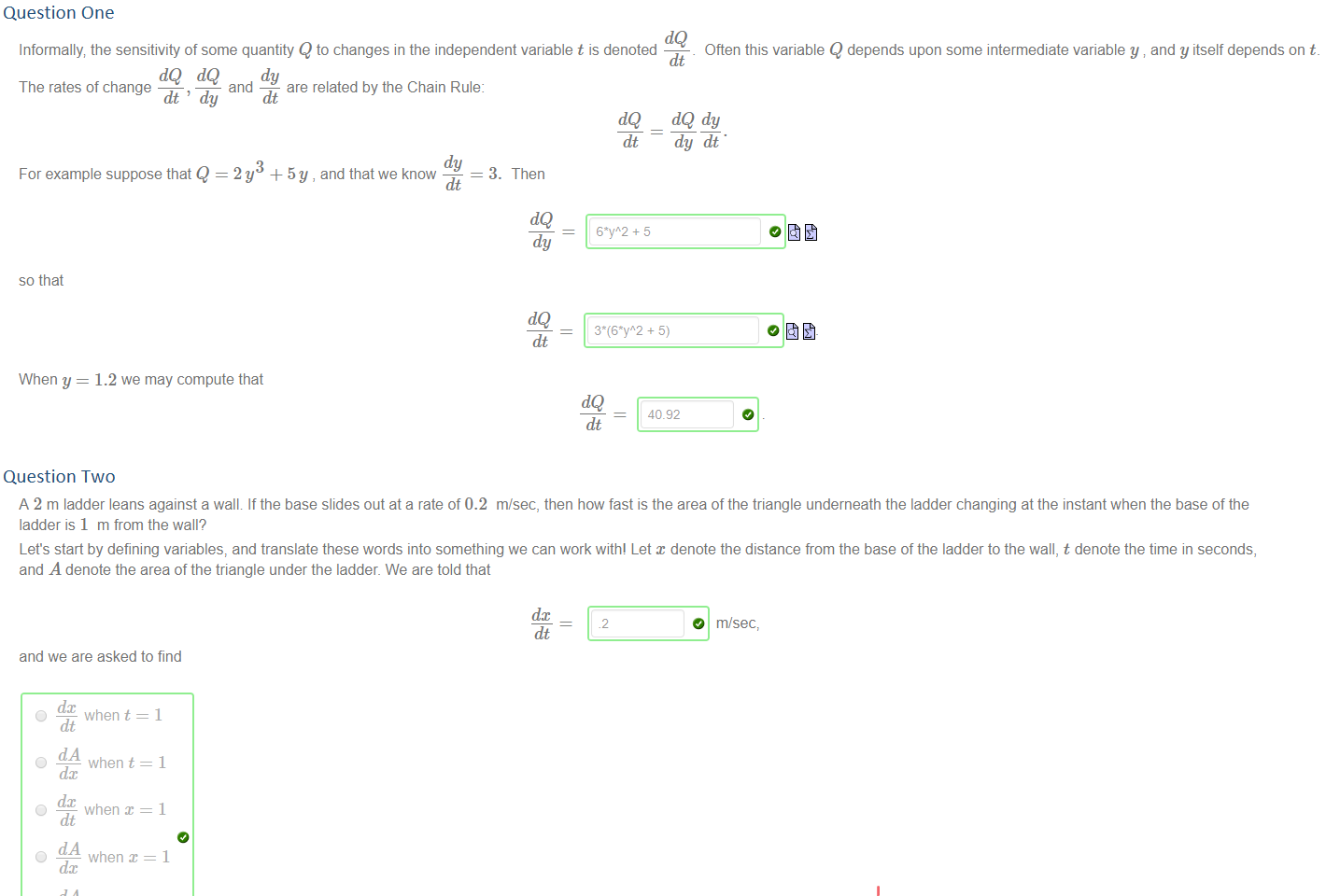
dQ 
Informally the sensitivity of some quantity Q to changes in the independent variable t is denoted 
Often this variable Q depends upon some intermediate variable y and y itself depends on t. 
dQ dQ and dy 
The rates of change 
are related by the Chain Rule: 
= 3. Then 
dt ' dy 
For example suppose that Q 
dt 
dy 
2y + .5y , and that we know 
dt 
dt 
dQ 
dy 
dy dt 
so that 
When y 
1.2 we may compute that 
dt 
dQ 
40.92 
Question Two
Untitled picture.png Machine generated alternative text:
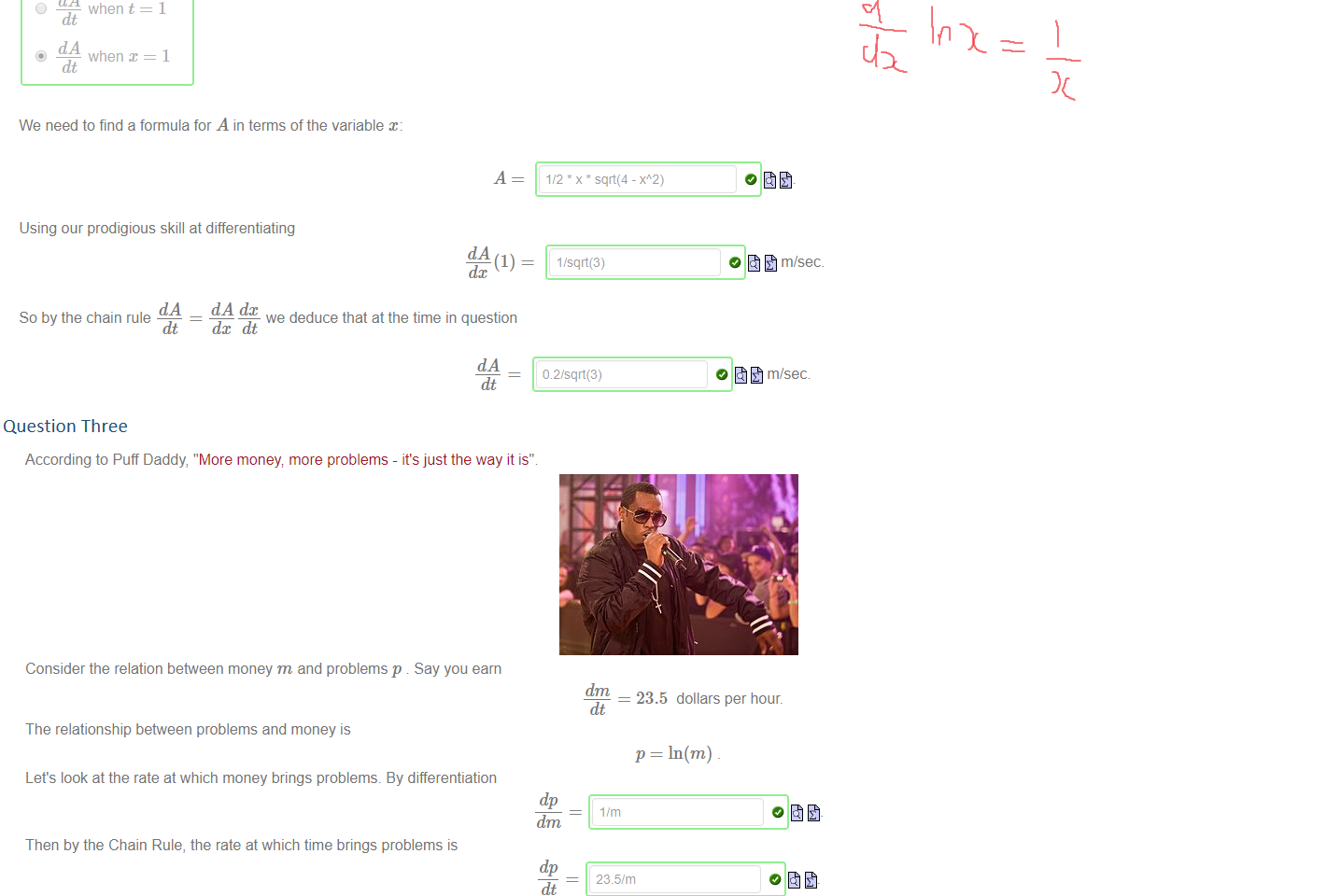
A 2 m ladder leans against a wall If the base slides out ata rate of 0.2 m/sec, then how fast is the area of the triangle underneath the ladder changing at the instant when the base of the 
ladder is 1 m from the wall? 
Let's start by defining variables, and translate these words into something we can work with! Let denote the distance from the base of the ladder to the wall, t denote the time in seconds, 
and A denote the area of the triangle under the ladder. We are told that 
and we are asked to find 
O — when t 
dt 
O 
when t 
O — when 
dt 
O 
when 
O 
when t 
dt 
when 
dt 
We need to find a formula for A in terms of the variable x: 
A 
Using our prodigious skill at differentiating 
.2 
dt 
1/2 x sqrt(4 - x*2) 
lisqä(3) 
dA 
So by the chain rule 
dt 
dc 
dA dx 
we deduce that at the time in question 
dx dt 
oasqä(3) 
dt 
O m}sec, 
0 m/sec_ 
0 m/sec 
Question Three
Untitled picture.png Machine generated alternative text:
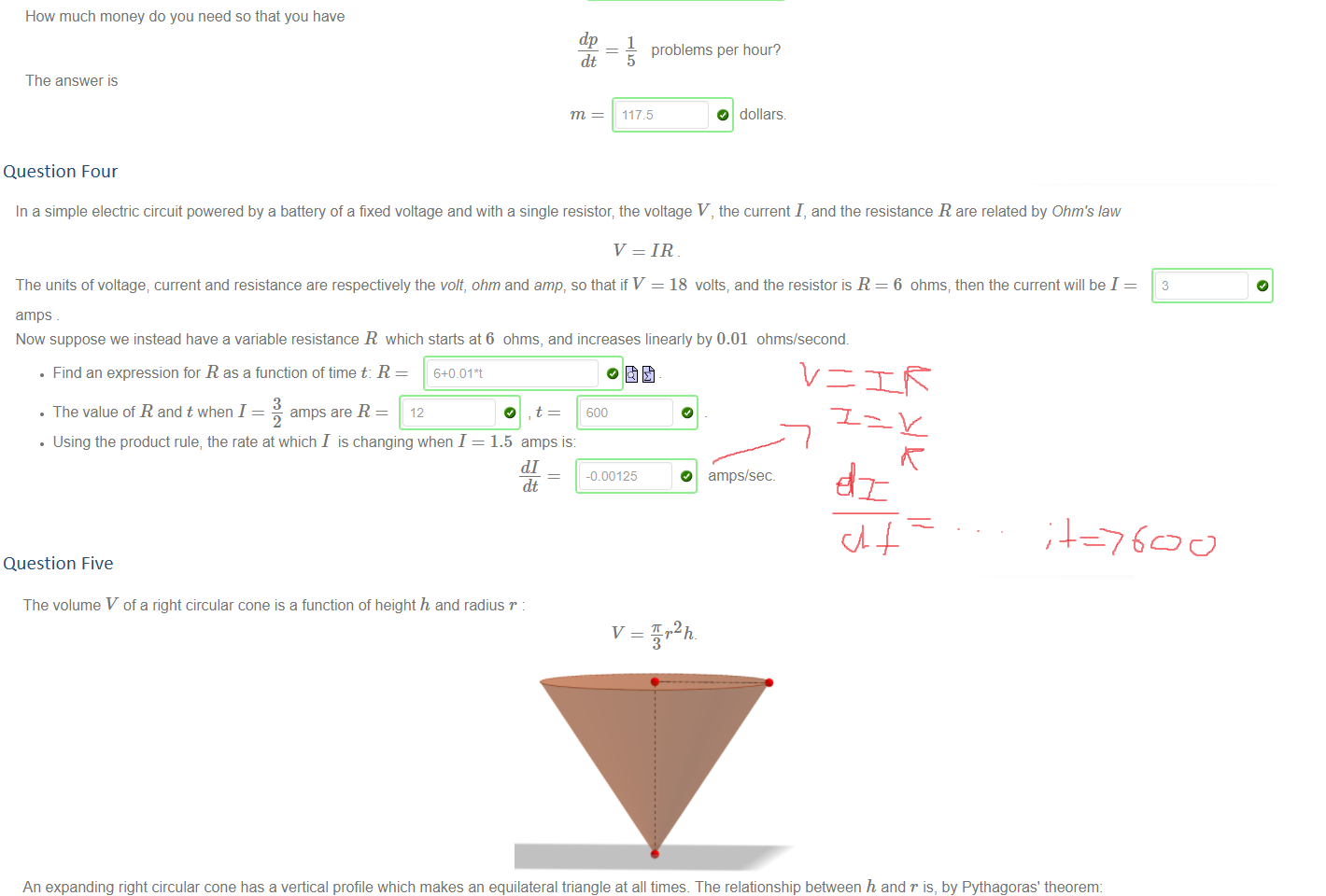
According to Puff Daddy, '"More money more problems - it's just the way it is" 
Consider the relation between money m and problems p . Say you earn 
dm 
23.5 dollars per hour. 
The relationship between problems and money is 
p = In(m) 
Let's look at the rate at which money brings problems. By differentiation 
dp 
dm 
Then by the Chain Rule, the rate at which time brings problems is 
dp 
23.51m 
How much money do you need so that you have 
dp 
The answer is 
1 
problems per hour? 
5 
O dollars 
Ink Drawings
Ink Drawings
Ink Drawings
Ink Drawings
Ink Drawings


Untitled picture.png Machine generated alternative text:
According to Puff Daddy, '"More money more problems - it's just the way it is" 
Consider the relation between money m and problems p . Say you earn 
dm 
23.5 dollars per hour. 
The relationship between problems and money is 
p = In(m) 
Let's look at the rate at which money brings problems. By differentiation 
dp 
dm 
Then by the Chain Rule, the rate at which time brings problems is 
dp 
23.51m 
How much money do you need so that you have 
dp 
The answer is 
1 
problems per hour? 
5 
O dollars 
Question Four
Untitled picture.png Machine generated alternative text:
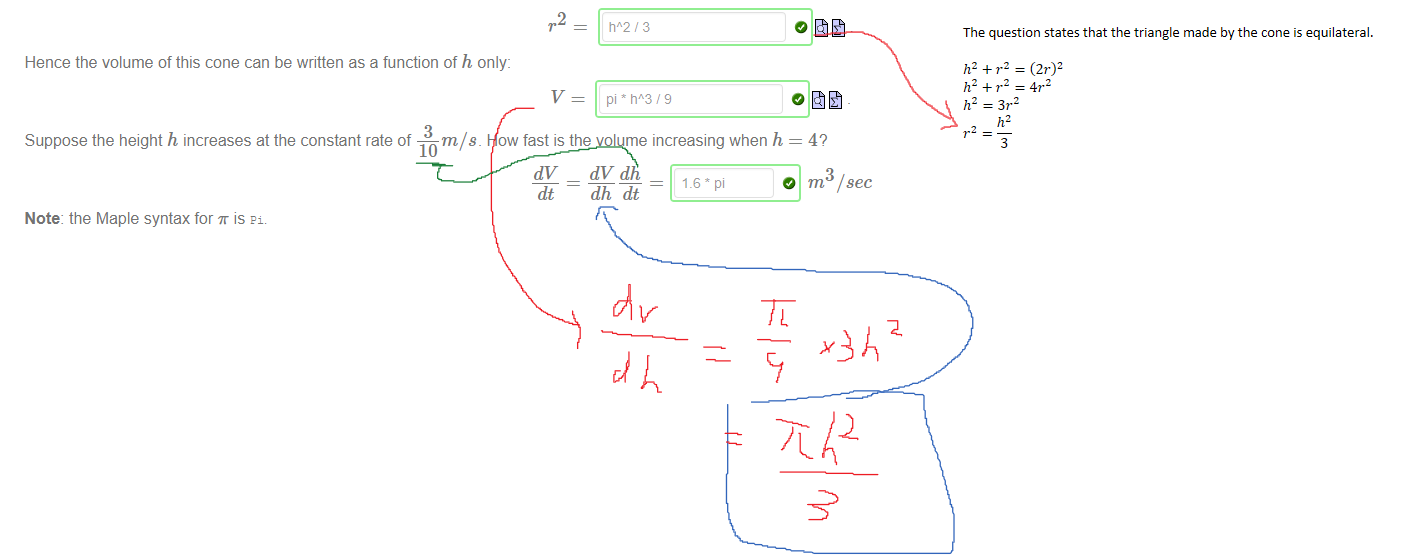
In a simple electric circuit powered by a battery of a fixed voltage and with a single resistor; the voltage V, the current I, and the resistance R are related by Ohm's law 
v = IR 
The units of voltage; current and resistance are respectively the volt, ohm and amp, so that if V = 18 volts, and the resistor is R 
amps 
Now suppose we instead have a variable resistance R which starts at6 ohms, and increases linearly by 0.01 ohms/second. 
• Find an expression for R as a function of time t: R = 6+0.01 •t 
3 
• The value of R and t when I 
amps are R = 12 
6 ohms, then the current will be I 
• Using the product rule, the rate at which I is changing when I = 1.5 amps is: 
-010125 
O amps/sec_ 

Question Five
Untitled picture.png Machine generated alternative text:
The volume V of a right circular cone is a function of height h and radius r . 
7.2 h 
An expanding right circular cone has a vertical profile which makes an equilateral triangle at all times. The relationship between h and r is, by Pythagoras' theorem: 
2 
13 
Hence the volume of this cone can be written as a function of h only: 
Suppose the height h increases at the constant rate of —m/ s. How fast is the volume increasing when h = 4? 
10 
dt - dhdt 
Note: the Maple syntax for is 
/ sec 
Ink Drawings
Ink Drawings
Ink Drawings

Ink Drawings
Ink Drawings
Ink Drawings
Ink Drawings


Untitled picture.png Machine generated alternative text:
The volume V of a right circular cone is a function of height h and radius r . 
7.2 h 
An expanding right circular cone has a vertical profile which makes an equilateral triangle at all times. The relationship between h and r is, by Pythagoras' theorem: 
2 
13 
Hence the volume of this cone can be written as a function of h only: 
Suppose the height h increases at the constant rate of —m/ s. How fast is the volume increasing when h = 4? 
10 
dt - dhdt 
Note: the Maple syntax for is 
/ sec 

The question states that the triangle made by the cone is equilateral.

﷐ℎ﷮2﷯+﷐𝑟﷮2﷯=﷐﷐2𝑟﷯﷮2﷯
﷐ℎ﷮2﷯+﷐𝑟﷮2﷯=4﷐𝑟﷮2﷯
﷐ℎ﷮2﷯=3﷐𝑟﷮2﷯
﷐𝑟﷮2﷯=﷐﷐ℎ﷮2﷯﷮3﷯
Ink Drawings
Ink Drawings
Ink Drawings
Ink Drawings
Ink Drawings
Ink Drawings
Ink Drawings


Created with Microsoft OneNote 2016.