Calc1131W5T3 - Linear approximation

Friday, 30 March 2018

12:28 AM

Question One
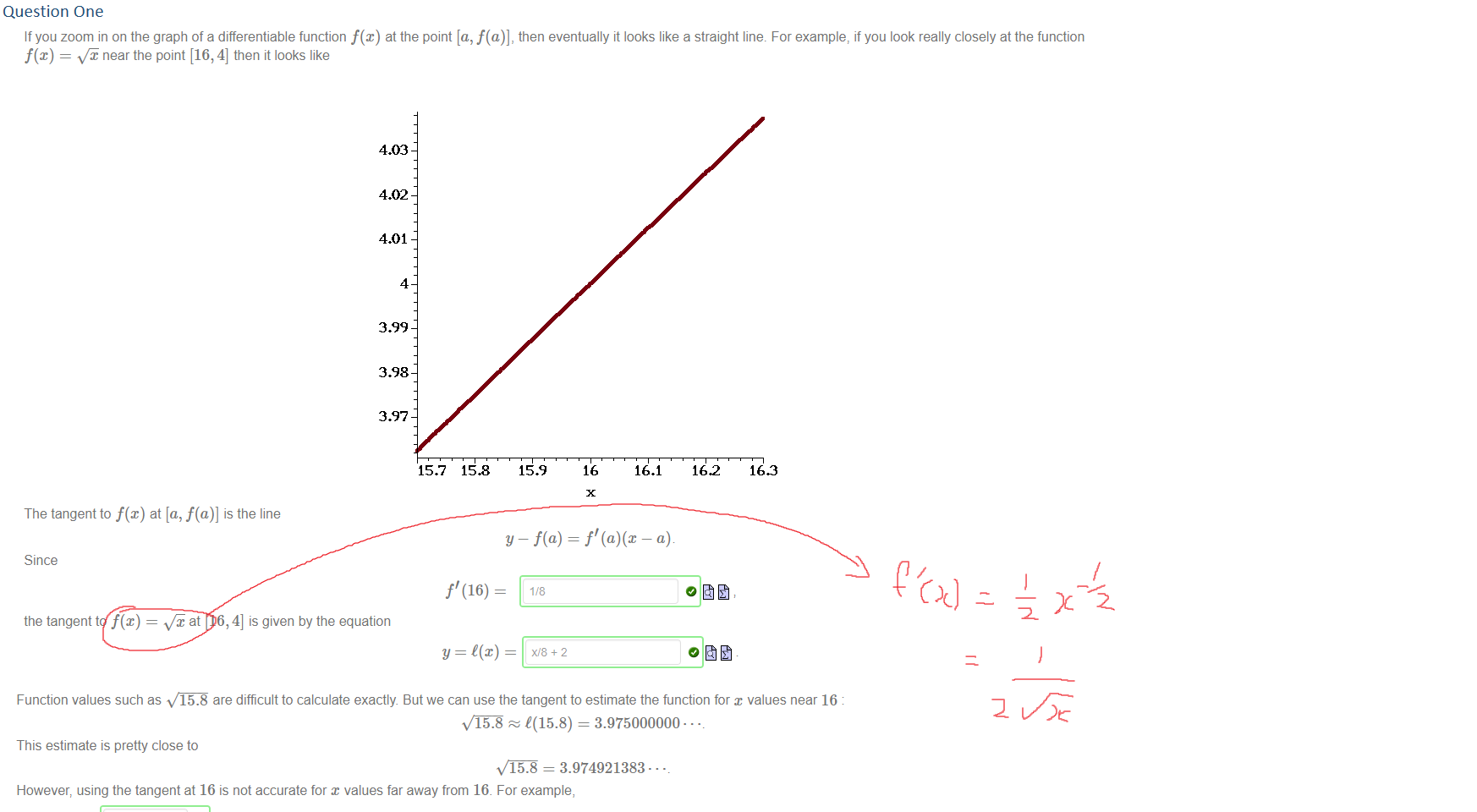
Untitled picture.png If you zoom in on the graph of a differentiable function f@) at the point [a, f(a)], then eventually it looks like a straight line. For example, if you look really closely at the function 
f@) = near the point [16, 4] then it looks like 
4.03 
4.02 
4.01 
4 
3.99 
3.98 
3.97 
15.7 
The tangent to f@) at [a, f(a)] is the line 
15.9 
16 
16.1 
16.2 
163 
y — f(a) = f' — a) 
Since 
the tangent to f(x) 
at [16, 4] is given by the equation 

Untitled picture.png Function values such as 15.8 are difficult to calculate exactly. But we can use the tangent to estimate the function for values near 16 
(15.8) = 3.975000000.. 
This estimate is pretty close to 
15.8 = 3.974921383 • • • 
However, using the tangent at 16 is not accurate for x values far away from 16. For example, 
. but 
Ink Drawings
Ink Drawings


Ink Drawings
Ink Drawings
Ink Drawings
Ink Drawings
Ink Drawings
Ink Drawings
Ink Drawings
Ink Drawings
Ink Drawings
Ink Drawings
Ink Drawings
Ink Drawings

Untitled picture.png Function values such as 15.8 are difficult to calculate exactly. But we can use the tangent to estimate the function for values near 16 
(15.8) = 3.975000000.. 
This estimate is pretty close to 
15.8 = 3.974921383 • • • 
However, using the tangent at 16 is not accurate for x values far away from 16. For example, 
. but 
Question Two
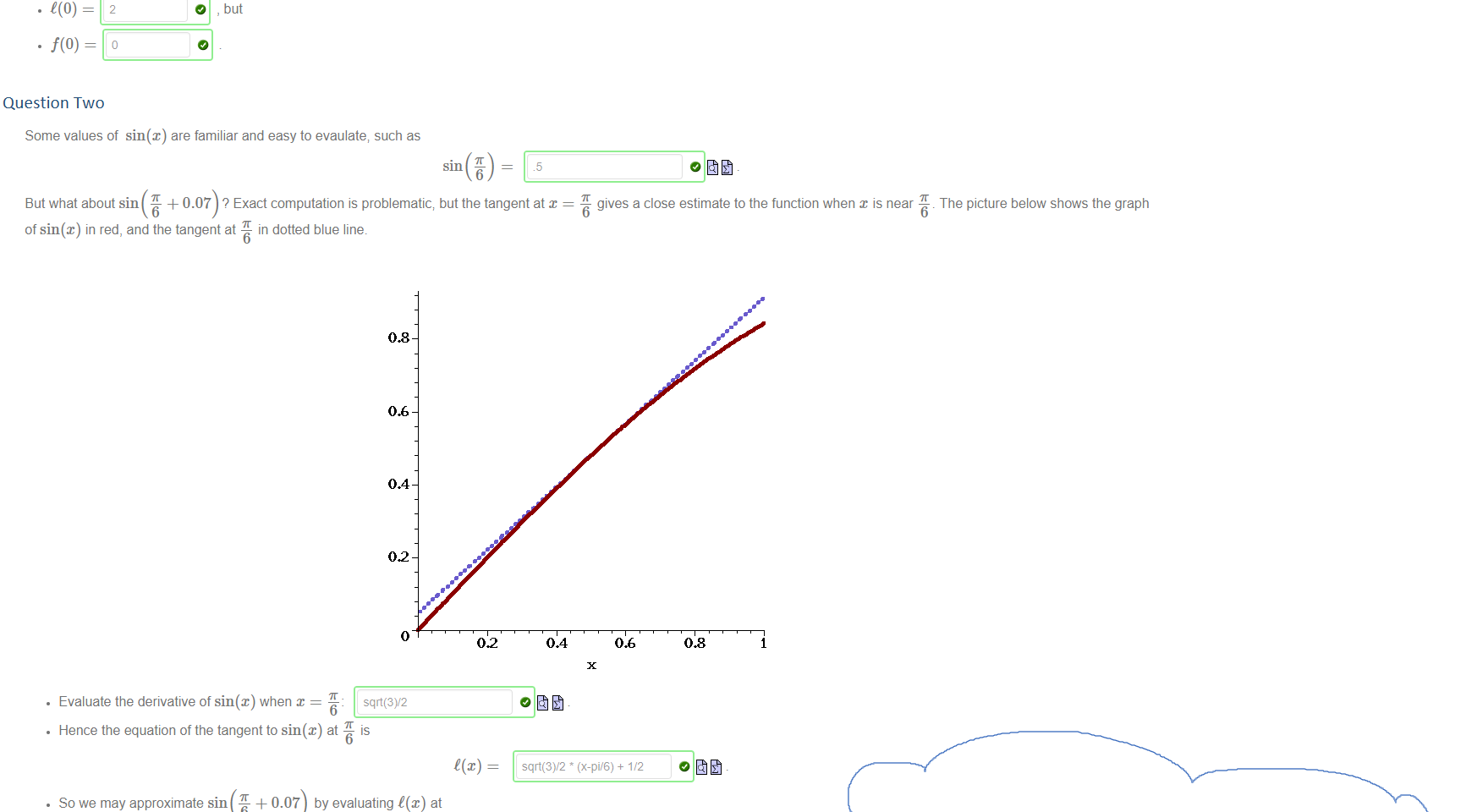
Untitled picture.png Some values of sin(x) are familiar and easy to evaulate; such as 
5 
But what about sin + 0.07 ? Exact computation is problematic; but the tangent at x 
of sin@) in red, and the tangent at 
in dotted blue line. 
0.4 
0.2 
gives a close estimate to the function when x is near 
The picture below shows the graph 
0.2 
(x) when 
• Evaluate the derivative of sin 
• Hence the equation of the tangent to sin(x) at 
• So we may approximate sin 
7T + 0.07 by evaluating I(x) at 
0.4 
* (x-pii6) + 1/2 
+ 0.07 

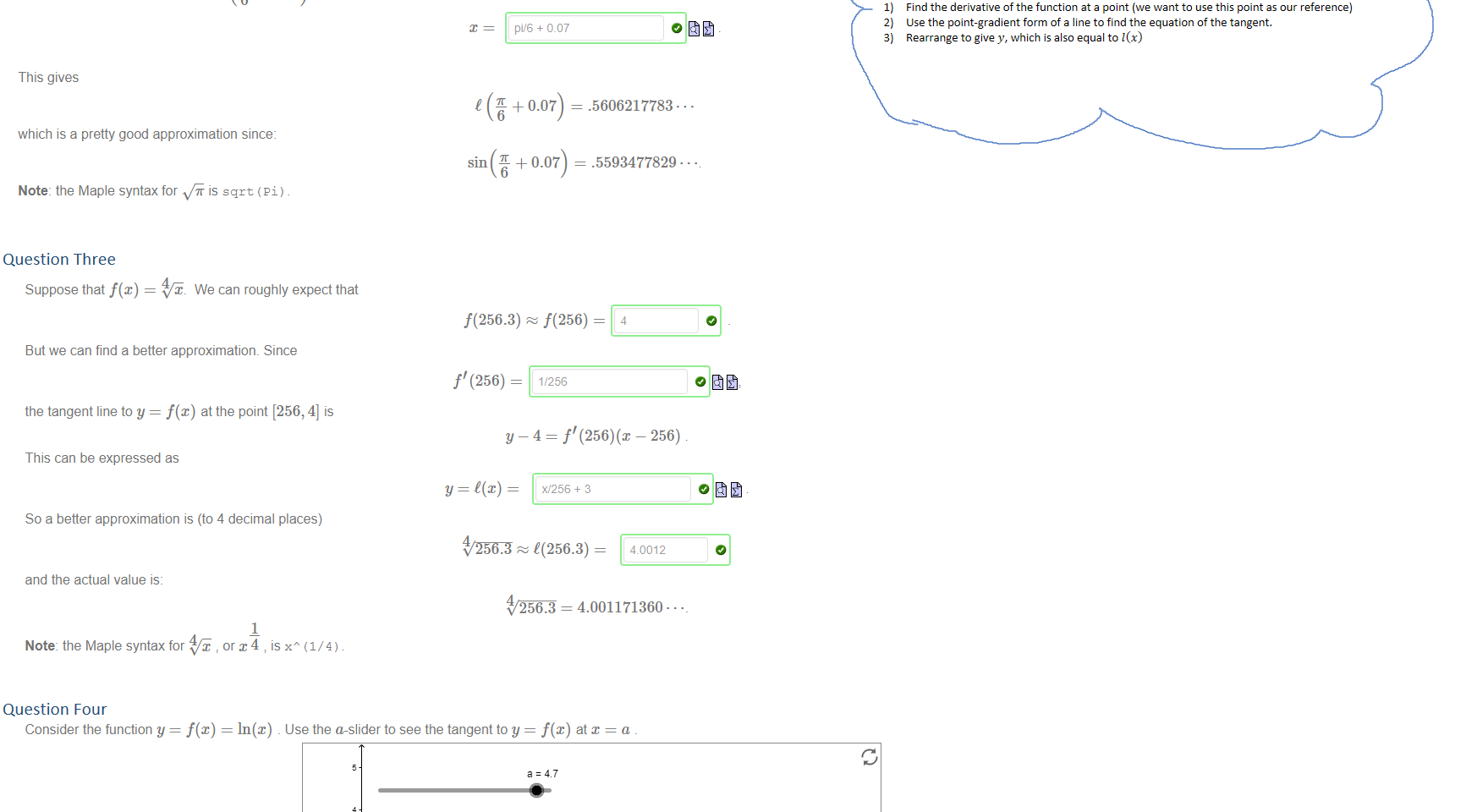
Untitled picture.png This gives 
which is a pretty good approximation since: 
Note: the Maple syntax for v,'7r is sqrt (Pi) 
+ 0.07 
+ 0.07 
.5606217783 • • • 
.5593477829 • • • 
Question Three
Untitled picture.png Machine generated alternative text:
But we can find a better approximatiom Since 
f' (256) 
the tangent line to y = f(x) at the point [256, 4] is 
This can be expressed as 
So a better approximation is (to 4 decimal places) 
and the actual value is: 
1 
Note: the Maple syntax for or x 4 
Suppose that f@) = We can roughly expect that 
f(256.3) f(256) ¯ 
(1/4) 
y -4 = — 256) 
4 
256.3 = 4.001171360 • • 
Question Four
Untitled picture.png Machine generated alternative text:
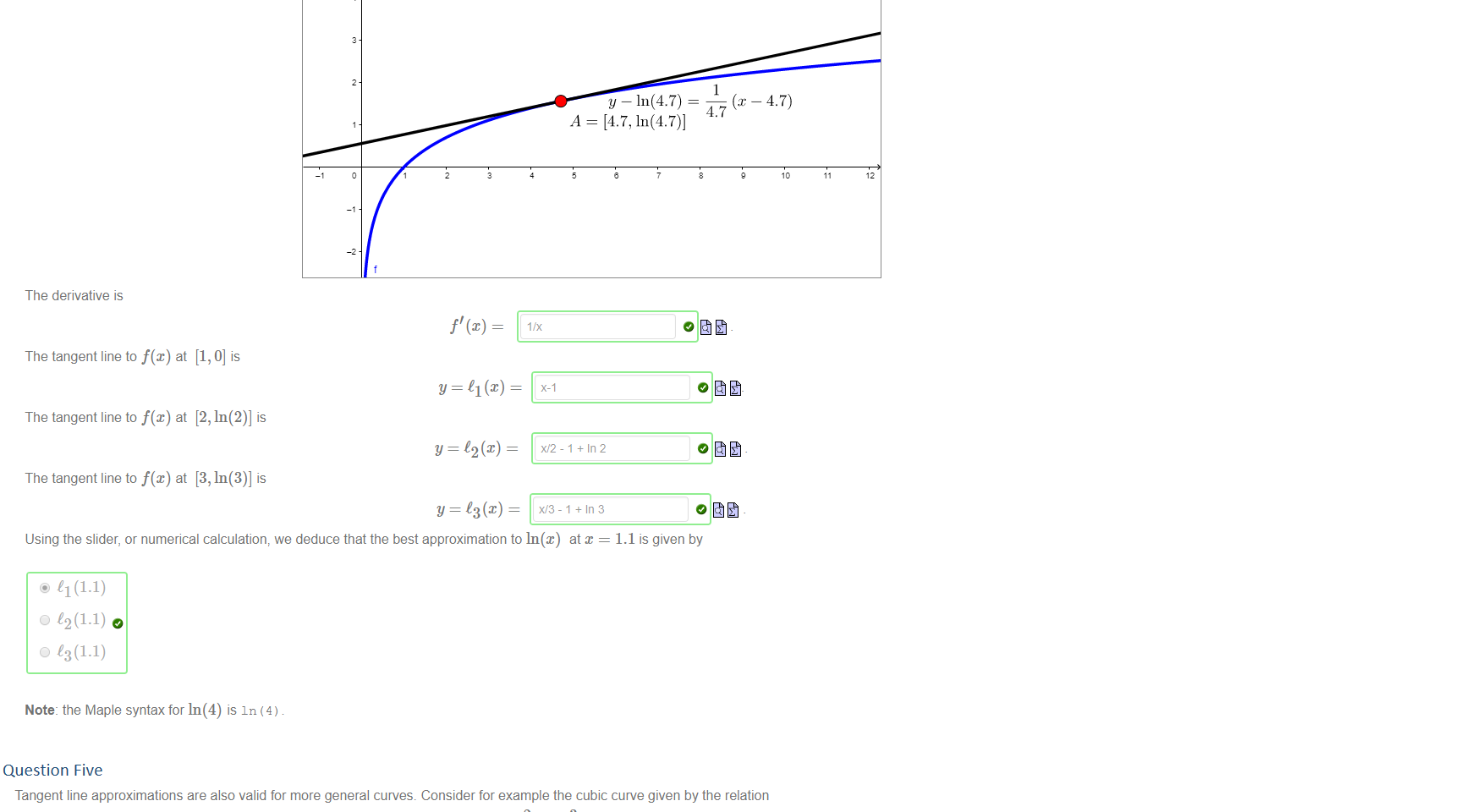
Consider the function y 
The derivative is 
ln@) _ Use the a-slider to see the tangent to y = f@) at x 
e = 47 
y — In(4.7) = 
4.7 
A = [4.7, In(4.7)] 
The tangent line to at [1, O] is 
The tangent line to at [2, In(2)] is 
The tangent line to at [3, In(3)] is 
Y = C3(x) — 
x,'3-1+Ir13 
Using the slider, or numerical calculation, we deduce that the best approximation to ln@) at x = 1.1 is given by 
@ 11 (1.1) 
0 12(1.1) 
0 13(1.1) 
Note: the Maple syntax for In(4) is In (4) 
Find the derivative of the function at a point (we want to use this point as our reference)
Use the point-gradient form of a line to find the equation of the tangent.
Rearrange to give 𝑦, which is also equal to 𝑙﷐𝑥﷯

Untitled picture.png Machine generated alternative text:
Consider the function y 
The derivative is 
ln@) _ Use the a-slider to see the tangent to y = f@) at x 
e = 47 
y — In(4.7) = 
4.7 
A = [4.7, In(4.7)] 
The tangent line to at [1, O] is 
The tangent line to at [2, In(2)] is 
The tangent line to at [3, In(3)] is 
Y = C3(x) — 
x,'3-1+Ir13 
Using the slider, or numerical calculation, we deduce that the best approximation to ln@) at x = 1.1 is given by 
@ 11 (1.1) 
0 12(1.1) 
0 13(1.1) 
Note: the Maple syntax for In(4) is In (4) 


Question Five
Untitled picture.png Machine generated alternative text:
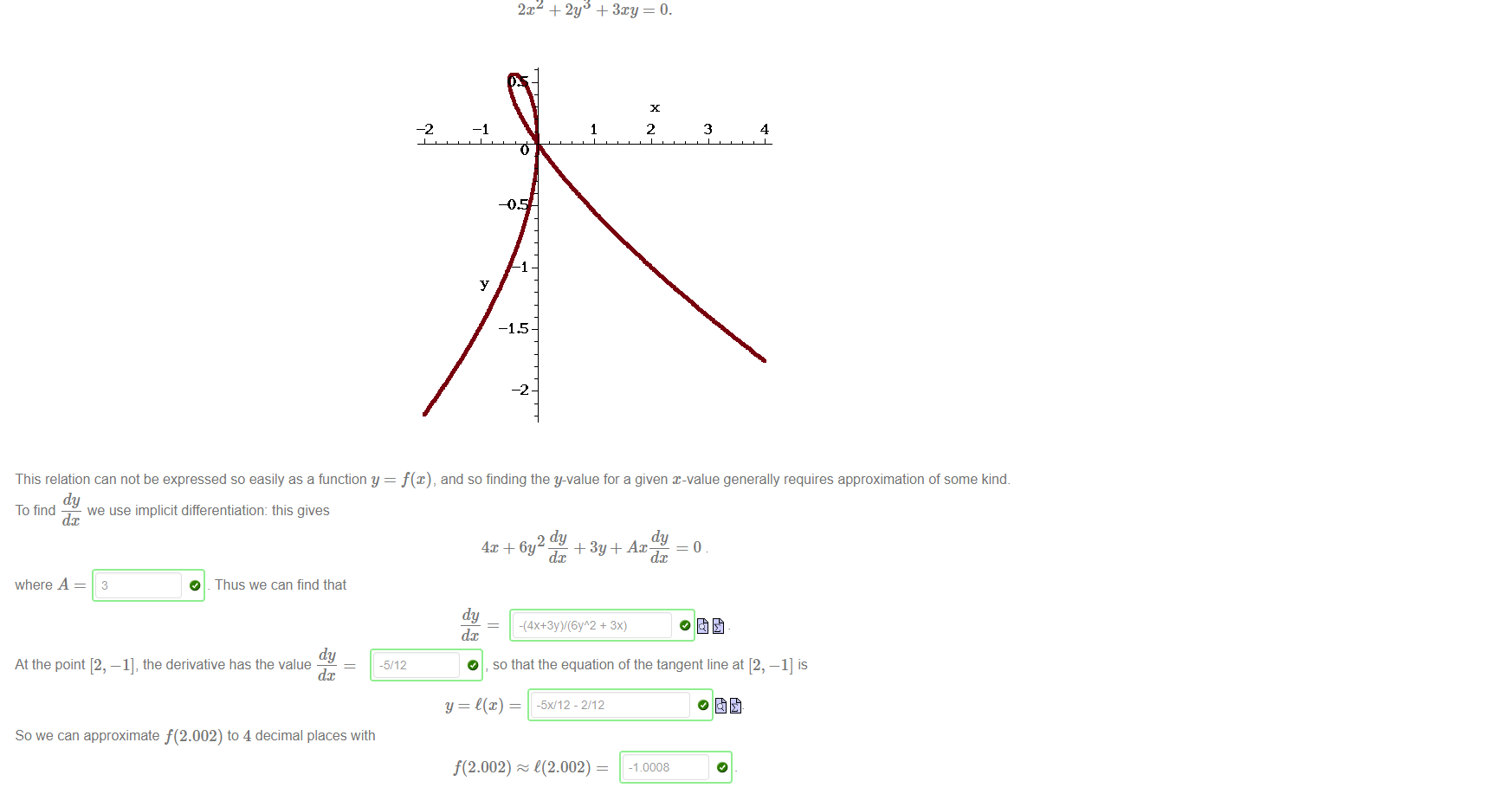
Tangent line approximations are also valid for more general curves. Consider for example the cubic curve given by the relation 
-2 
2 
3 
4 
This relation can not be expressed so easily as a function y 
dy 
To find — we use implicit differentiation: this gives 
where A 
O Thus we can find that 
dy 
-2 
f(x), and so finding the y-value for a given am-value generally requires approximation of some kind. 
dy 
dc 
dy 
dc 
At the point [2, —1], the derivative has the value 
dc 
So we can approximate f(2.002) to 4 decimal places with 
-5/12 
O , so that the equation of the tangent line at [2, —1] is 
-5X,'12 - 2/12 
f(2.002) 1(2.002) —


Created with Microsoft OneNote 2016.