Calc1131W5T2 - Implicit differentiation

Friday, 30 March 2018

12:24 AM

Question One
Untitled picture.png Machine generated alternative text:
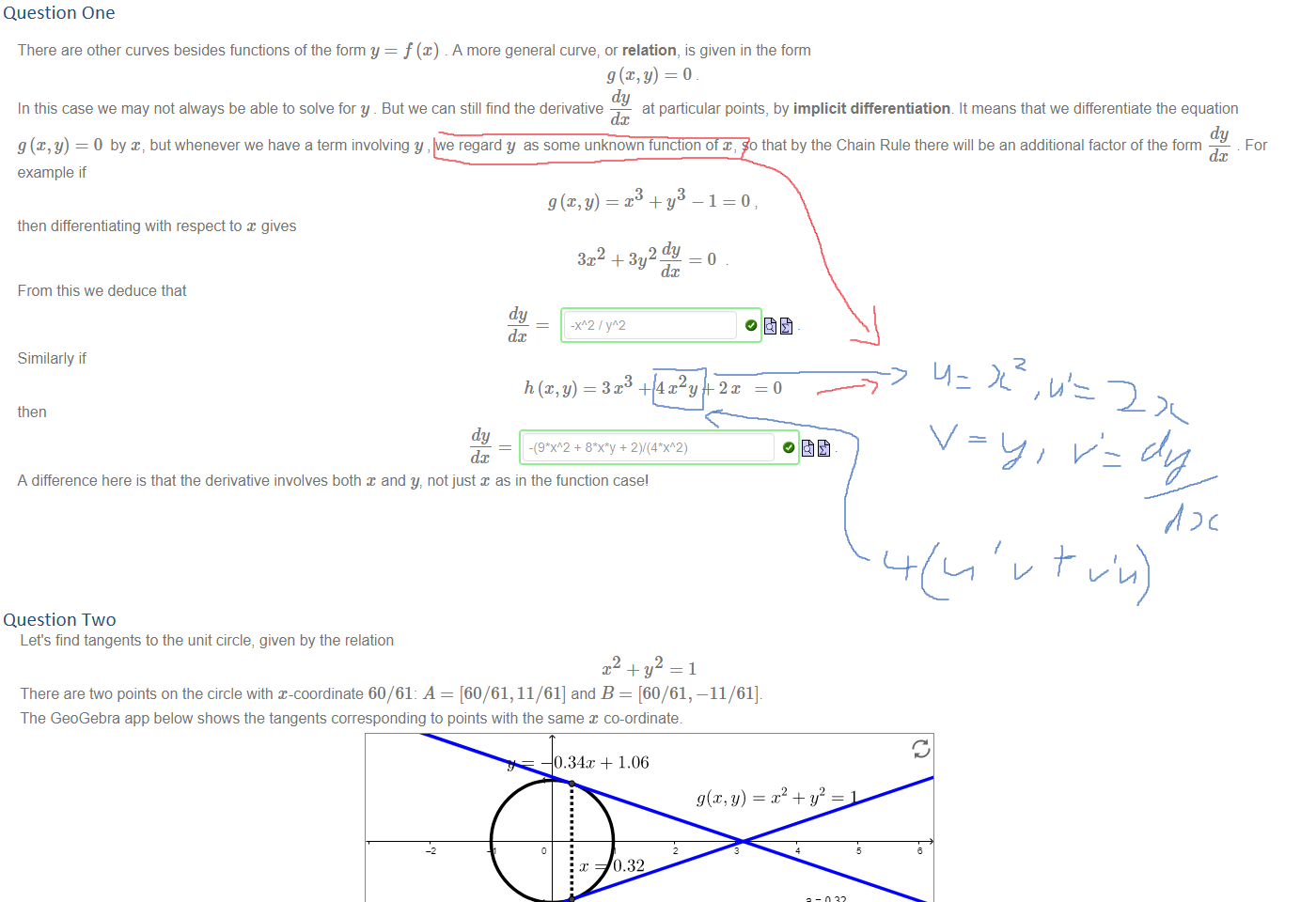
There are other curves besides functions of the form y = . A more general curve; or relation, is given in the form 
g@,y) = 0 
dy 
In this case we may not always be able to solve for y _ But we can still find the derivative 
at particular points, by implicit differentiatiorv It means that we differentiate the equation 
dc 
dy 
g (x, y) = 0 by but whenever we have a term involving y , we regard y as some unknown function of x, so that by the Chain Rule there will be an additional factor of the form 
For 
dc 
example if 
3 
—1=0 
then differentiating with respect to x gives 
3x2 + 
From this we deduce that 
dy 
dc 
Similarly if 
then 
dy 
-(9*XA2 + + 
dc 
A difference here is that the derivative involves both x and y, not just x as in the function case' 


Question Two
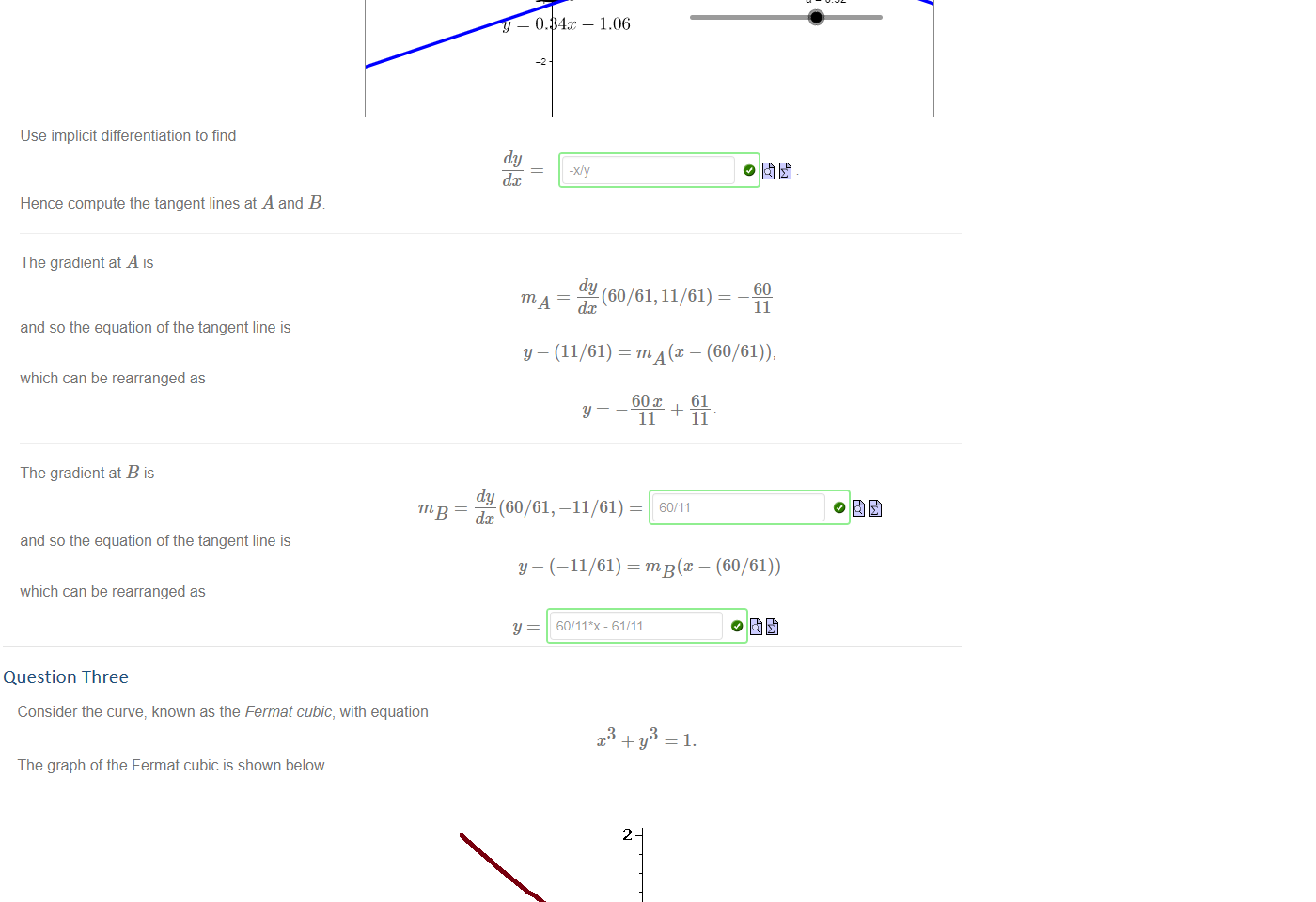
Untitled picture.png Let's find tangents to the unit circle, given by the relation 
2 
There are two points on the circle with x-coordinate 60/61: A = [60/61, 11/61] and B = [60/61, 
—11/61]. 
The GeoGebra app below shows the tangents corresponding to points with the same x co-ordinate. 
0.34x + 1.06 
0.32 
4x 1.06 
e = 032 
Use implicit differentiation to find 
Hence compute the tangent lines at A and B 
The gradient at A is 
and so the equation of the tangent line is 
which can be rearranged as 
The gradient at B is 
and so the equation of the tangent line is 
which can be rearranged as 
dy 
dc 
dy (60/61, 11/61) — 
60 
11 
y — (11/61) = m — (60/61)), 
60 
y 
11 
— du (60/61, -11/61) — 
dc 
61 
11 
y— (—11/61) = m — (60/61)) 
y 
60/11*x - 61/11 
Ink Drawings
Ink Drawings
Ink Drawings
Ink Drawings
Ink Drawings
Ink Drawings
Ink Drawings
Ink Drawings


Untitled picture.png Let's find tangents to the unit circle, given by the relation 
2 
There are two points on the circle with x-coordinate 60/61: A = [60/61, 11/61] and B = [60/61, 
—11/61]. 
The GeoGebra app below shows the tangents corresponding to points with the same x co-ordinate. 
0.34x + 1.06 
0.32 
4x 1.06 
e = 032 
Use implicit differentiation to find 
Hence compute the tangent lines at A and B 
The gradient at A is 
and so the equation of the tangent line is 
which can be rearranged as 
The gradient at B is 
and so the equation of the tangent line is 
which can be rearranged as 
dy 
dc 
dy (60/61, 11/61) — 
60 
11 
y — (11/61) = m — (60/61)), 
60 
y 
11 
— du (60/61, -11/61) — 
dc 
61 
11 
y— (—11/61) = m — (60/61)) 
y 
60/11*x - 61/11 

Question Three
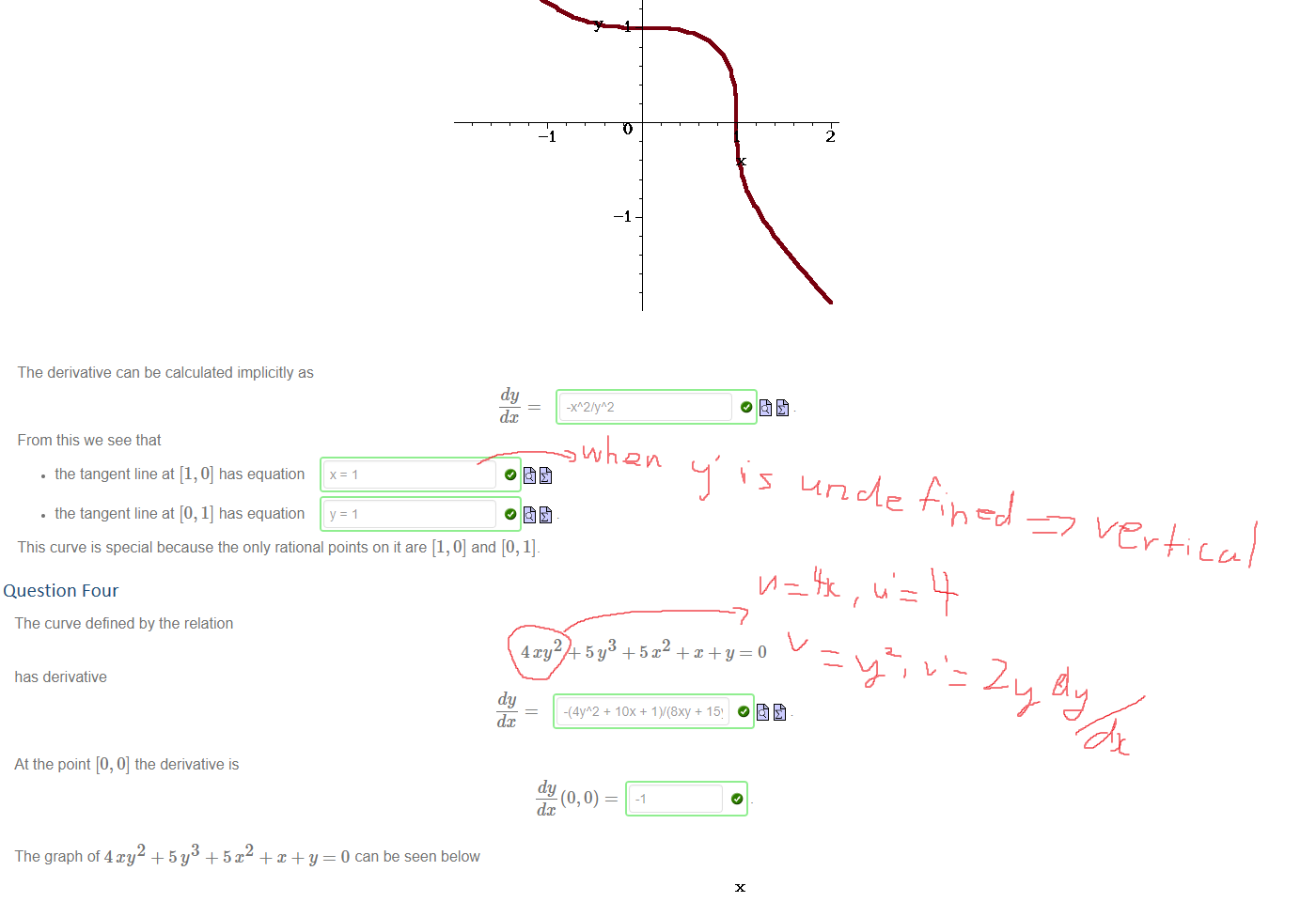
Untitled picture.png Consider the curve, known as the Fermat cubic, with equation 
3 
—1. 
The graph of the Fermat cubic is shown below. 
2 
The derivative can be calculated implicitly as 
dy 
dc 
From this we see that 
• the tangent line at [1, 0] has equation 1 
• the tangent line at [0, 1] has equation y = 1 
This curve is special because the only rational points on it are [1, 0] and [0, 1]. 
2
Untitled picture.png Consider the curve, known as the Fermat cubic, with equation 
3 
—1. 
The graph of the Fermat cubic is shown below. 
2 
The derivative can be calculated implicitly as 
dy 
dc 
From this we see that 
• the tangent line at [1, 0] has equation 1 
• the tangent line at [0, 1] has equation y = 1 
This curve is special because the only rational points on it are [1, 0] and [0, 1]. 
2 
Question Four
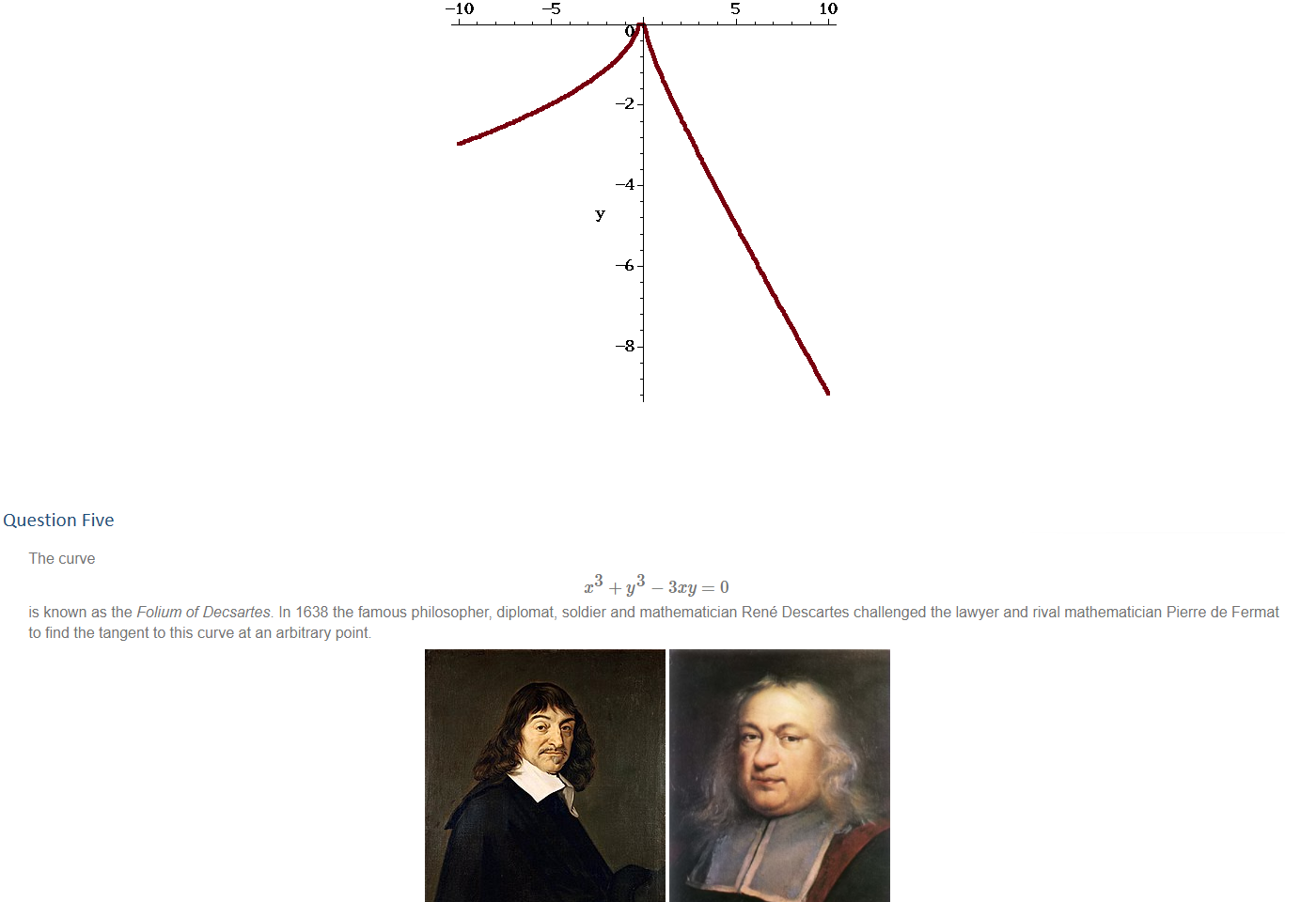
Untitled picture.png The curve defined by the relation 
has derivative 
At the point [O, O] the derivative is 
The graph of 4 xy 
dy 
+ lax + + 15 
0 can be seen below 
Ink Drawings
Ink Drawings
Ink Drawings


Untitled picture.png The curve defined by the relation 
has derivative 
At the point [O, O] the derivative is 
The graph of 4 xy 
dy 
+ lax + + 15 
0 can be seen below 


Question Five
Untitled picture.png The curve 
x +y —3xy = 0 
is known as the Folium of Decsartes In 1638 the famous philosopher, diplomat, soldier and mathematician René Descartes challenged the lawyer and rival mathematician Pierre de Fermat 
to find the tangent to this curve at an arbitrary point 
•a 
René Descartes (1596-1650) 
Pierre de Fermat (1601 - 1665) 
Fermat easily found the tangent; which is quite impressive since his method pre-dates Calculus by about 40 years' Now; about 400 years later we can find the tangent easily using implicit 
differentiation: 
dy 
dc 
Evaluated at the point [a, b] — 
[2/3, 4/3] the gradient is 
— du (2/3, 4/3) = 
dc 
The formula for the equation of the tangent at [a, b] with gradient m is: 
At the point [a, b] — 
[2/3, 4/3], this can be rewritten as 
y 
4X/5 + 4/5
Untitled picture.png The curve 
x +y —3xy = 0 
is known as the Folium of Decsartes In 1638 the famous philosopher, diplomat, soldier and mathematician René Descartes challenged the lawyer and rival mathematician Pierre de Fermat 
to find the tangent to this curve at an arbitrary point 
•a 
René Descartes (1596-1650) 
Pierre de Fermat (1601 - 1665) 
Fermat easily found the tangent; which is quite impressive since his method pre-dates Calculus by about 40 years' Now; about 400 years later we can find the tangent easily using implicit 
differentiation: 
dy 
dc 
Evaluated at the point [a, b] — 
[2/3, 4/3] the gradient is 
— du (2/3, 4/3) = 
dc 
The formula for the equation of the tangent at [a, b] with gradient m is: 
At the point [a, b] — 
[2/3, 4/3], this can be rewritten as 
y 
4X/5 + 4/5 

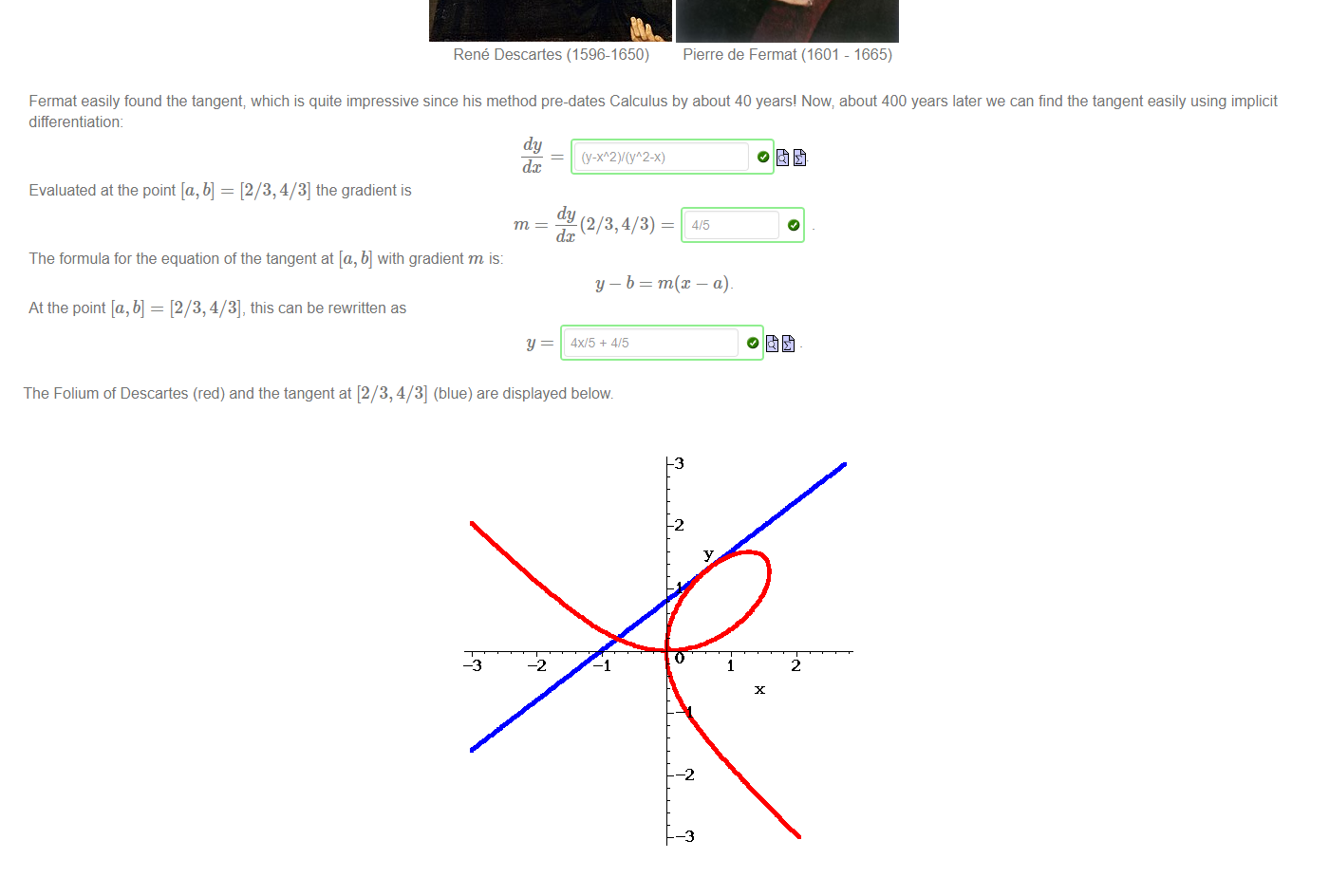
Untitled picture.png The Folium of Descartes (red) and the tangent at [2/3, 4/3] (blue) are displayed below.


Created with Microsoft OneNote 2016.