Calc1131W5T1 - The derivative

Thursday, 29 March 2018

11:39 PM

Question One
Untitled picture.png Machine generated alternative text:
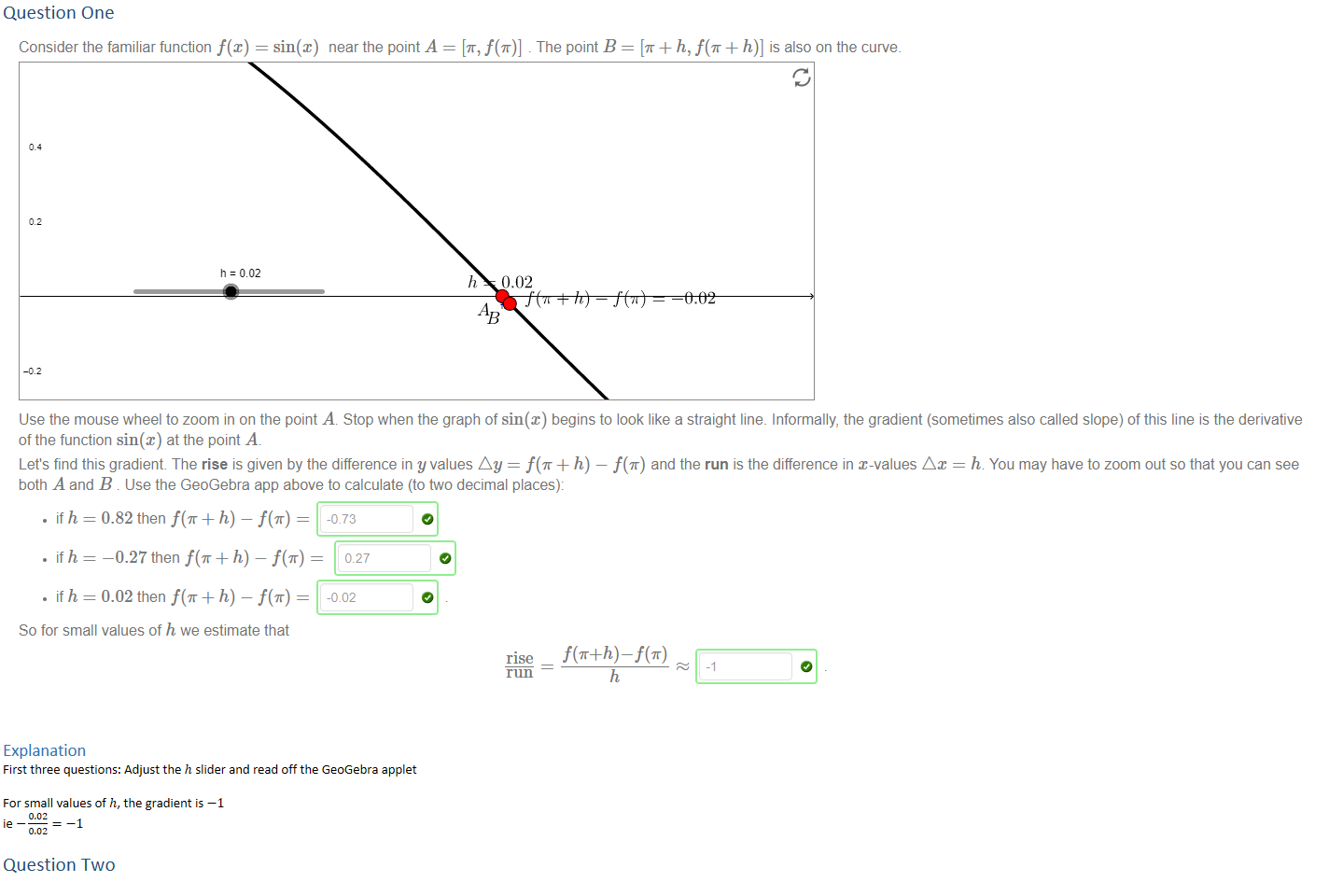
Consider the familiar function f(x) 
sin@) near the point A = [T, f(T)] . The point B 
[T + h, + h)] is also on the curve. 
h=C02 
h 0.02 
AB 
Use the mouse wheel to zoom in on the point A. Stop when the graph of sin(x) begins to look like a straight line. Informally, the gradient (sometimes also called slope) of this line is the derivative 
of the function sin@) at the point A 
Let's find this gradient The rise is given by the difference in y values Ay = + h) — f(ff) and the run is the difference in x-values Ax = h. You may have to zoom out so that you can see 
both A and B . Use the GeoGebra app above to calculate (to two decimal places): 
• if h = 0.82 then + h) ¯ f(T) 
• if h 
—0.27 then + h) ¯ f(T) 
• if h = 0.02 then + h) ¯ f(T) 
So for small values of h we estimate that 
f(ff+h) 
Explanation
First three questions: Adjust the ℎ slider and read off the GeoGebra applet

For small values of ℎ, the gradient is −1
ie −﷐0.02﷮0.02﷯=−1

Question Two
Untitled picture.png Machine generated alternative text:
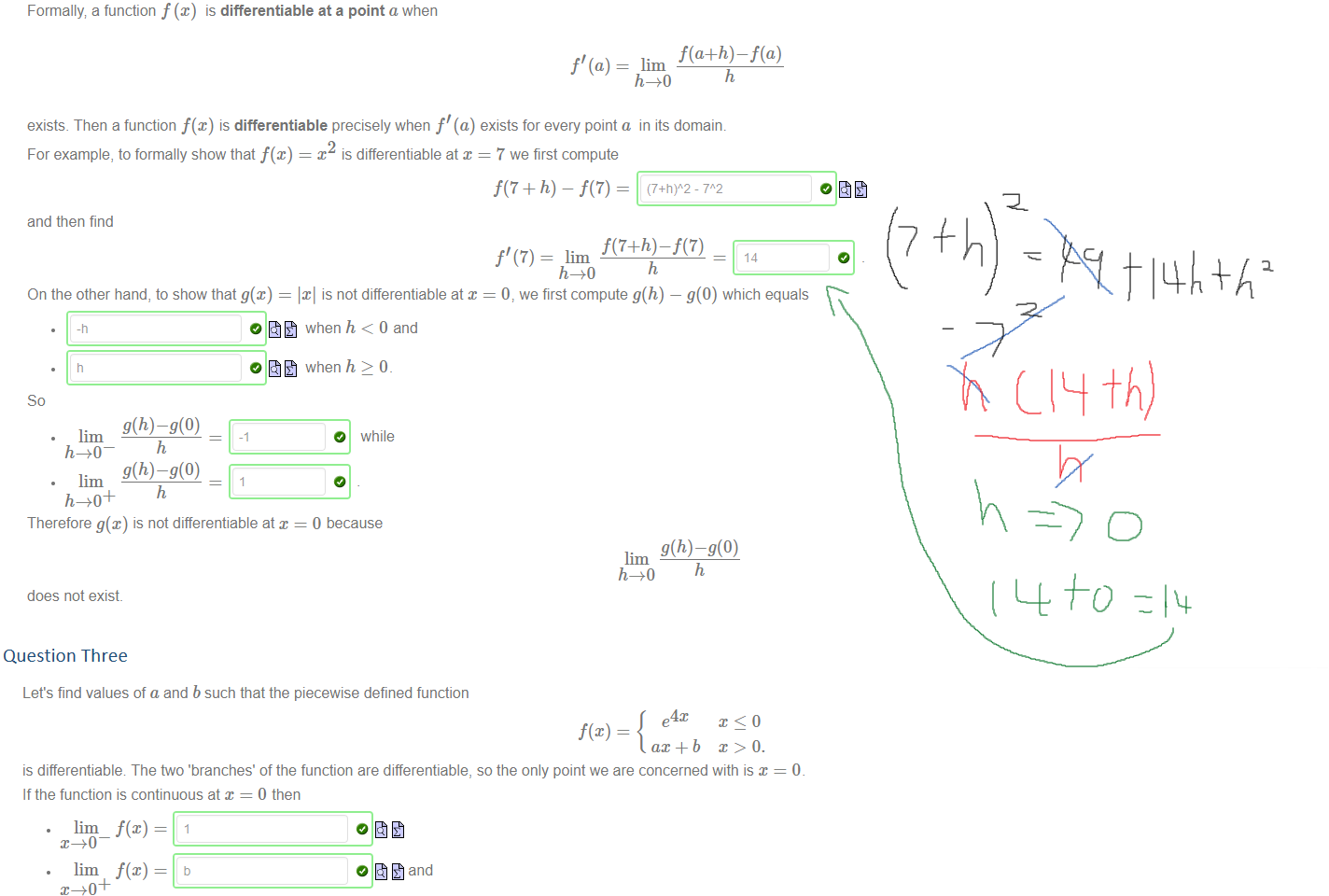
Formally a function f@) is differentiable at a point a when 
f' (a) — lim 
exists. Then a function f(x) is differentiable precisely when f' (a) exists for every point a in its domain. 
For example, to formally show that f@) 
and then find 
On the other hand, to show that g@) 
so 
g(h)—g(O) 
g(h)—g(O) 
Therefore g(x) is not differentiable at x 
does not exist. 
x is differentiable at x 
is not differentiable at x 
when h < O and 
when h > O 
O while 
0 because 
7 we first compute 
f' (7) = lim 
h 
14 
0, we first compute g(h) — g(0) which equals 
h
Untitled picture.png Machine generated alternative text:
Formally a function f@) is differentiable at a point a when 
f' (a) — lim 
exists. Then a function f(x) is differentiable precisely when f' (a) exists for every point a in its domain. 
For example, to formally show that f@) 
and then find 
On the other hand, to show that g@) 
so 
g(h)—g(O) 
g(h)—g(O) 
Therefore g(x) is not differentiable at x 
does not exist. 
x is differentiable at x 
is not differentiable at x 
when h < O and 
when h > O 
O while 
0 because 
7 we first compute 
f' (7) = lim 
h 
14 
0, we first compute g(h) — g(0) which equals 
h 
Question Three
Untitled picture.png Machine generated alternative text:
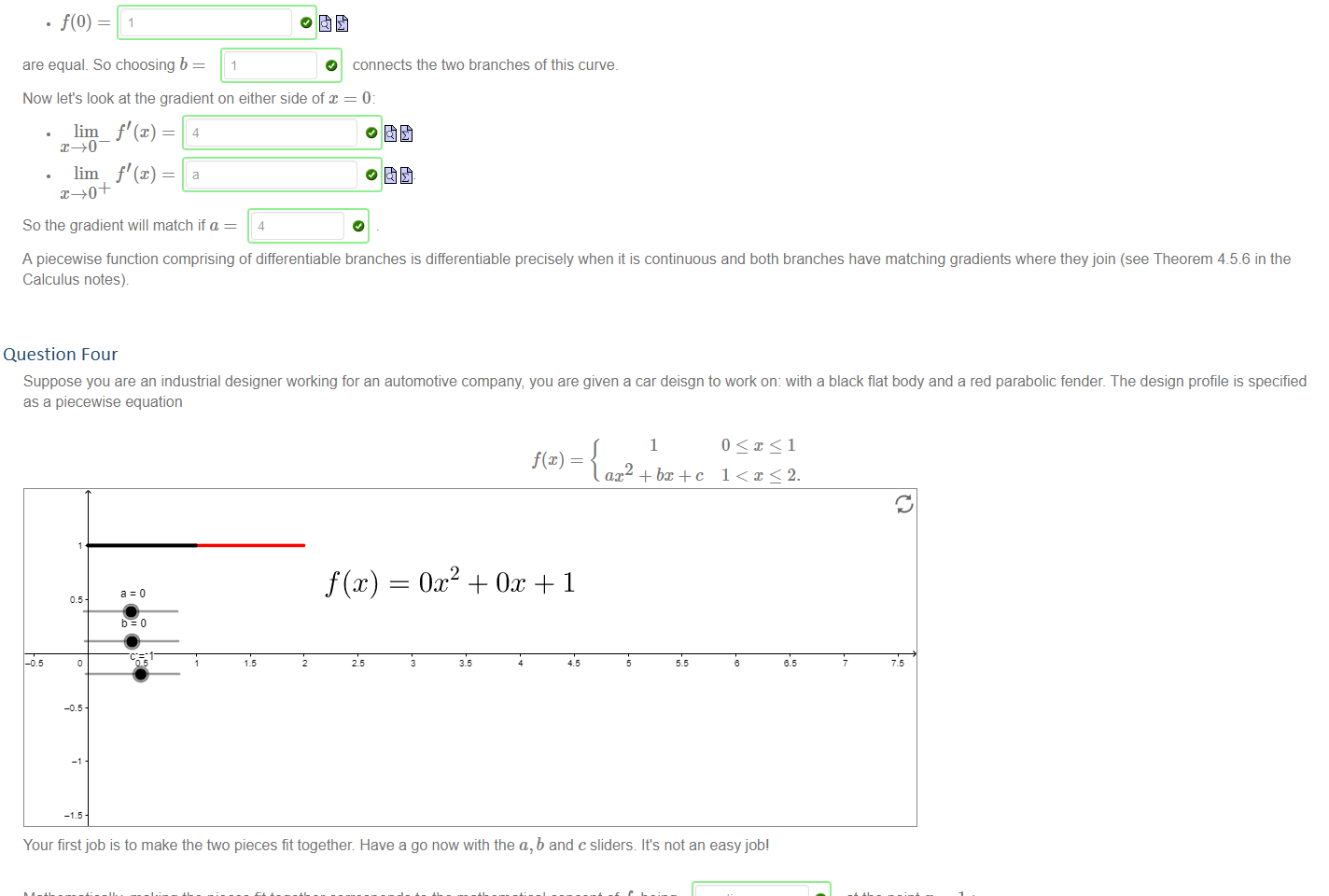
Let's find values of a and b such that the piecewise defined function 
e4x 
ax + b 
is differentiable The two 'branches' of the function are differentiable, so the only point we are concerned with is x 
If the function is continuous at x = O then 
lim — 
lim — 
b 
are equal. So choosing b 
o and 
connects the two branches of this curve. 
o 
Now let's look at the gradient on either side of x = 0: 
lim_ f' (x) = 
lim f' (x) = 
So the gradient will match if a 
4 
A piecewise function comprising of differentiable branches is differentiable precisely when it is continuous and both branches have matching gradients where they join (see Theorem 4_5.6 in the 
Calculus notes) 
Ink Drawings
Ink Drawings
Ink Drawings
Ink Drawings
Ink Drawings
Ink Drawings
Ink Drawings
Ink Drawings
Ink Drawings
Ink Drawings


Ink Drawings
Ink Drawings
Ink Drawings
Untitled picture.png Machine generated alternative text:
Let's find values of a and b such that the piecewise defined function 
e4x 
ax + b 
is differentiable The two 'branches' of the function are differentiable, so the only point we are concerned with is x 
If the function is continuous at x = O then 
lim — 
lim — 
b 
are equal. So choosing b 
o and 
connects the two branches of this curve. 
o 
Now let's look at the gradient on either side of x = 0: 
lim_ f' (x) = 
lim f' (x) = 
So the gradient will match if a 
4 
A piecewise function comprising of differentiable branches is differentiable precisely when it is continuous and both branches have matching gradients where they join (see Theorem 4_5.6 in the 
Calculus notes) 


Question Four
Untitled picture.png Machine generated alternative text:
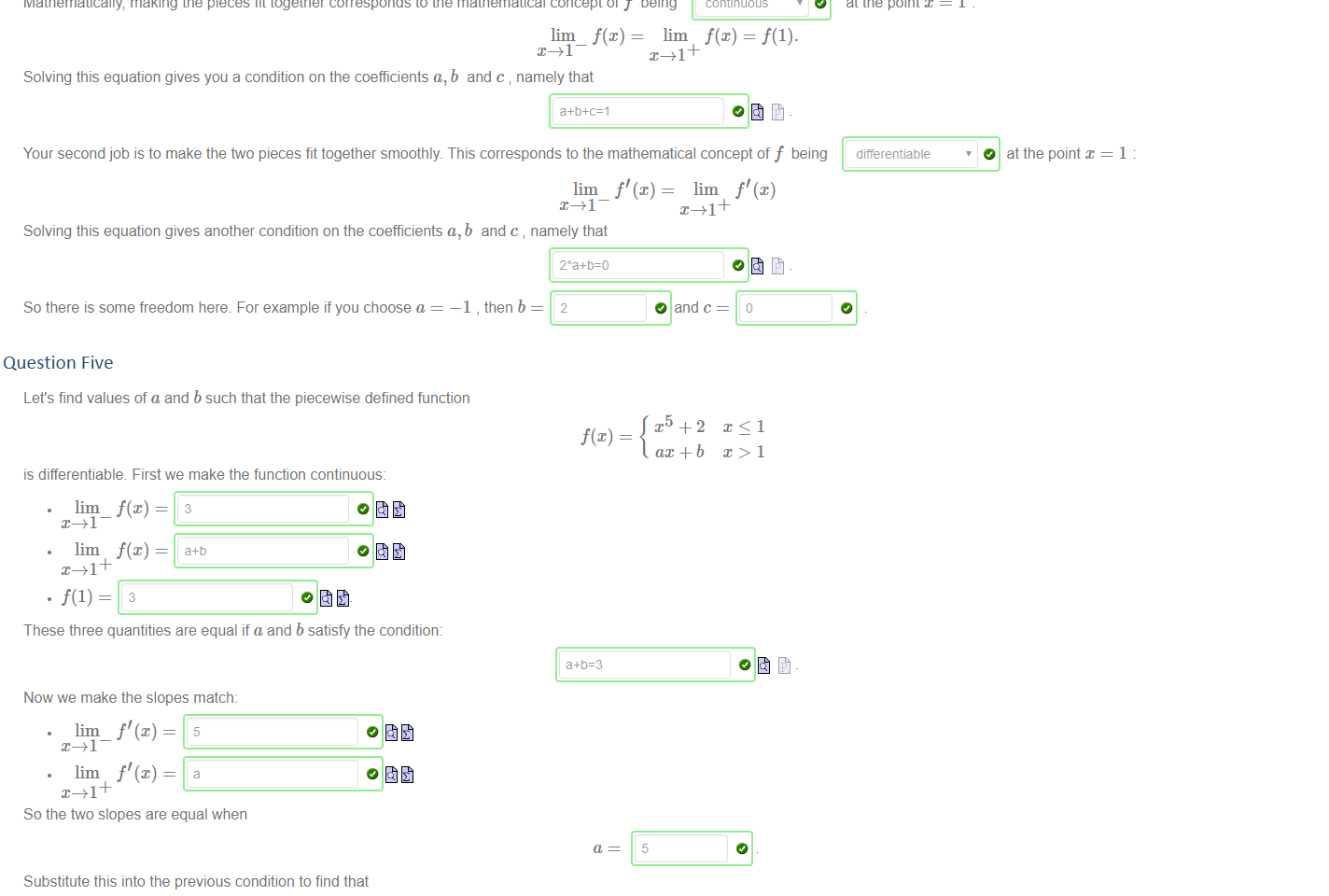
Suppose you are an industrial designer working for an automotive company, you are given a car deisgn to work on: with a black flat body and a red parabolic fender. The design profile is specified 
as a piecewise equation 
—1 
1 
ax2 + + c 
1 < x<2. 
Your first job is to make the ftvo pieces fit together Have a go now with the a, b and c sliders It's not an easy job' 
Mathematically making the pieces fit together corresponds to the mathematical concept of f being 
lim f(x) = lim 
Solving this equation gives you a condition on the coefficients a, b and c namely that 
a+b+c=l 
O 
continuous 
= f(l). 
at the point x 
differentiable 
Your second job is to make the two pieces fit together smoothly This corresponds to the mathematical concept of f being 
lim f' (x) lim f' (x) 
O at the point 
Solving this equation gives another condition on the coefficients a, b 
TAI 
and c namely that 
So there is some freedom here. For example if you choose a 
—1 , then b
Untitled picture.png Machine generated alternative text:
Suppose you are an industrial designer working for an automotive company, you are given a car deisgn to work on: with a black flat body and a red parabolic fender. The design profile is specified 
as a piecewise equation 
—1 
1 
ax2 + + c 
1 < x<2. 
Your first job is to make the ftvo pieces fit together Have a go now with the a, b and c sliders It's not an easy job' 
Mathematically making the pieces fit together corresponds to the mathematical concept of f being 
lim f(x) = lim 
Solving this equation gives you a condition on the coefficients a, b and c namely that 
a+b+c=l 
O 
continuous 
= f(l). 
at the point x 
differentiable 
Your second job is to make the two pieces fit together smoothly This corresponds to the mathematical concept of f being 
lim f' (x) lim f' (x) 
O at the point 
Solving this equation gives another condition on the coefficients a, b 
TAI 
and c namely that 
So there is some freedom here. For example if you choose a 
—1 , then b 

Question Five
Untitled picture.png Machine generated alternative text:
Let's find values of a and b such that the piecewise defined function 
f(x) 
is differentiable First we make the function continuous: 
lim_ 
lim 
These three quantities are equal if a and b satisfy the condition: 
Now we make the slopes match: 
lim_ f' (x) = 
lim f' (x) = 
So the two slopes are equal when 
Substitute this into the previous condition to find that 
b 
ax + b 
5 
-2


Created with Microsoft OneNote 2016.