Calc1131W11T4 - Logarithmic integrals and the prime number theorem

Sunday, 20 May 2018

10:12 PM

Untitled picture.png Machine generated alternative text:
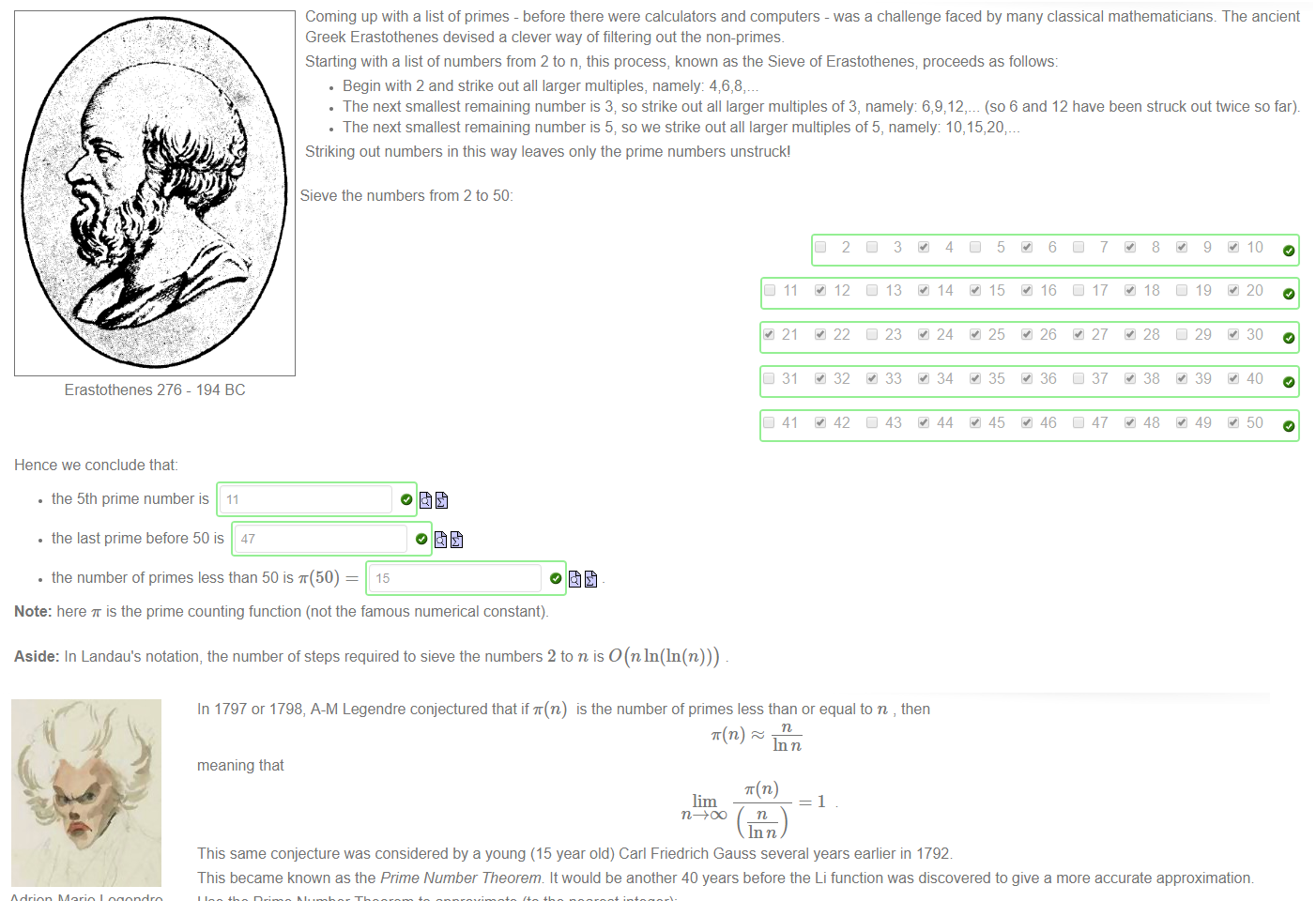
Coming up with a list of primes - before there were calculators and computers - was a challenge faced by many classical mathematicians. The ancient 
Greek Erastothenes devised a clever way of filtering out the non-primes. 
Starting with a list of numbers from 2 to n, this process, known as the Sieve of Erastothenes; proceeds as follows: 
• Begin with 2 and strike out all larger multiples, namely: 46,8, 
• The next smallest remaining number is 3; so strike out all larger multiples of 3, namely (so 6 and 12 have been struck out twice so far). 
• The next smallest remaining number is 5; so we strike out all larger multiples of 5, namely 10, 15,20;_ 
Striking out numbers in this way leaves only the prime numbers unstruckl 
Sieve the numbers from 2 to 50: 
o fit 
10 
12 
13 
14 
15 
16 
L 17 
18 
20 
• 21 
22 
23 
24 
25 
26 
27 
28 
29 
30 
L 31 
32 
33 
34 
35 
36 
38 
39 
40 
50 
11 
41 
2 
42 
3 
43 
4 
44 
5 
45 
6 
46 
7 
37 
47 
8 
48 
g 
49 
Erastothenes 276 - 194 BC 
Hence we conclude that: 
• the 5th prime number is 11 
• the last prime before 50 is 47 
• the number of primes less than 50 is T(50) 
15 
Note: here is the prime counting function (not the famous numerical constant). 
Aside: In Landau's notation, the number of steps required to sieve the numbers 2 to n is O(nln(ln(n))) 

Untitled picture.png Machine generated alternative text:
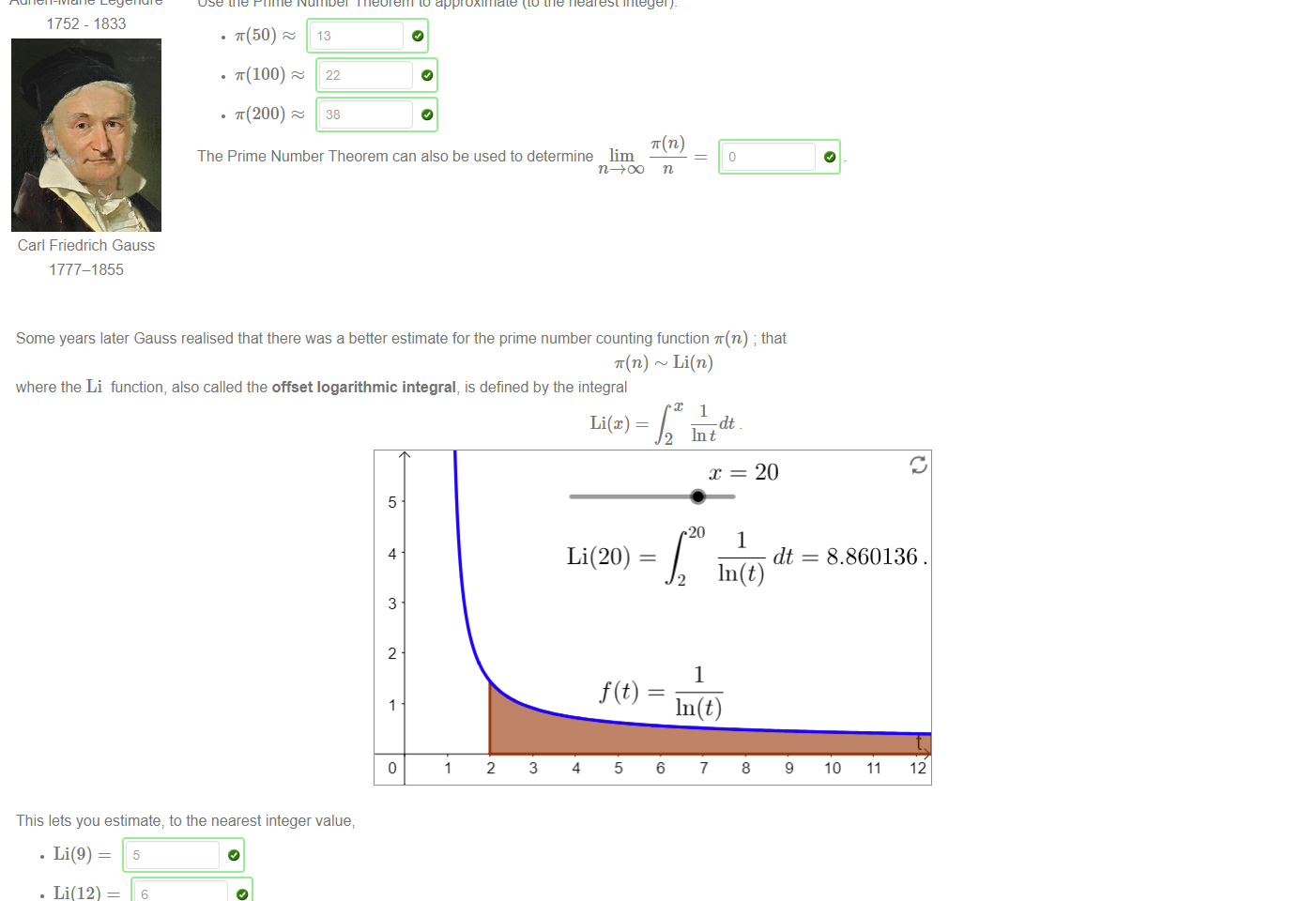
In 1797 or 1798, 
meaning that 
A-M Legendre conjectured that if T(n) 
is the number of primes less than or equal to n , then 
In n 
—1 
Adrien-Marie Legendre 
1752 - 1833 
Carl Friedrich Gauss 
1777-1855 
This same conjecture was considered by a young (15 year old) Carl Friedrich Gauss several years earlier in 1792 
This became known as the Prime Number Theorem It would be another 40 years before the Li function was discovered to give a more accurate approximation 
Use the Prime Number Theorem to approximate (to the nearest integer): 
• T(50) 
13 
The Prime Number Theorem can also be used to determine lim
Untitled picture.png Machine generated alternative text:
In 1797 or 1798, 
meaning that 
A-M Legendre conjectured that if T(n) 
is the number of primes less than or equal to n , then 
In n 
—1 
Adrien-Marie Legendre 
1752 - 1833 
Carl Friedrich Gauss 
1777-1855 
This same conjecture was considered by a young (15 year old) Carl Friedrich Gauss several years earlier in 1792 
This became known as the Prime Number Theorem It would be another 40 years before the Li function was discovered to give a more accurate approximation 
Use the Prime Number Theorem to approximate (to the nearest integer): 
• T(50) 
13 
The Prime Number Theorem can also be used to determine lim 

Untitled picture.png Machine generated alternative text:
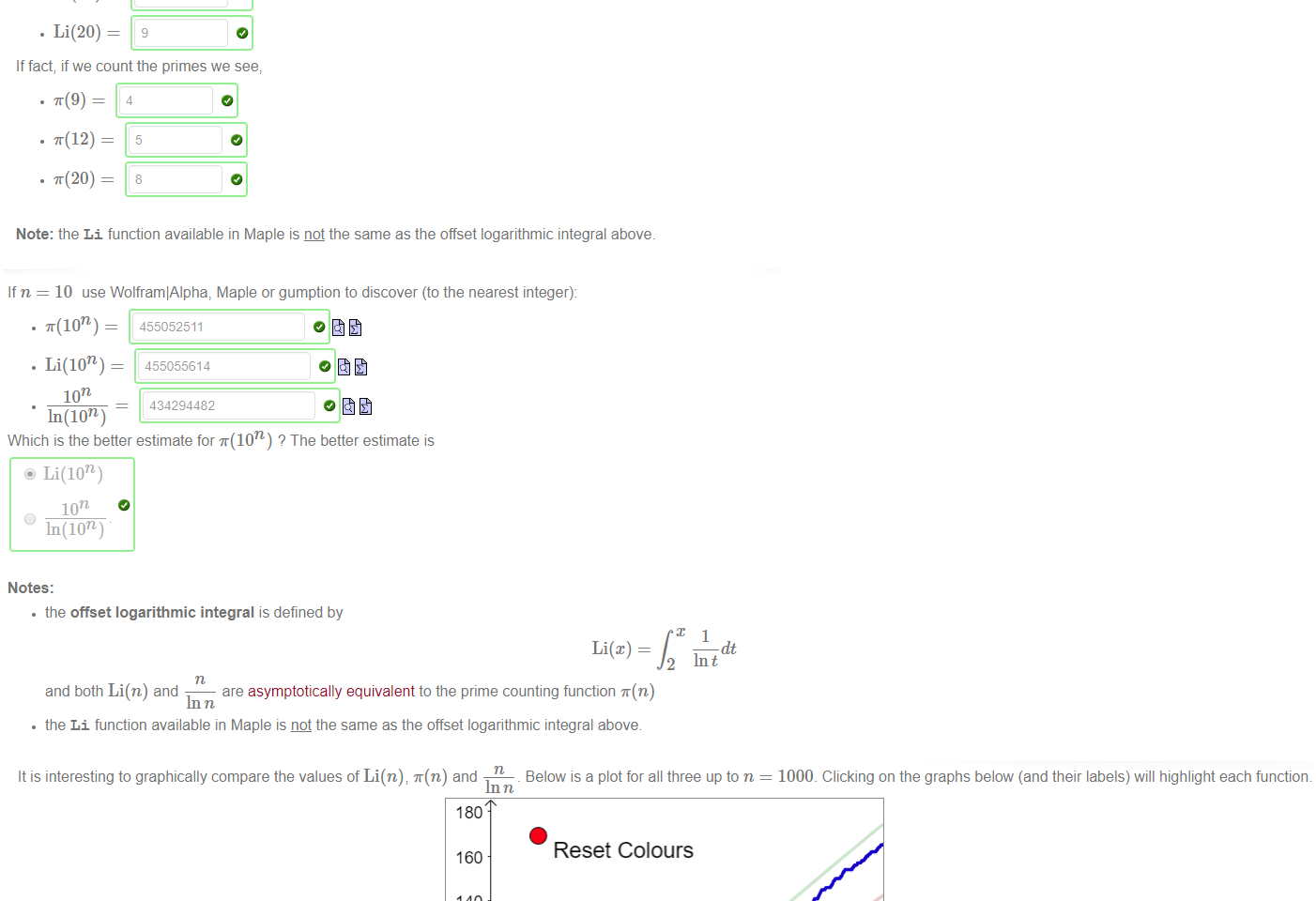
Some years later Gauss realised that there was a better estimate for the prime number counting function T(n) ; that 
T(n) Li(n) 
where the Li function, also called the offset logarithmic integral, is defined by the integral 
Li@) 
dt 
2 Int 
20 
5 
4 
3 
2 
This lets you estimate, to the nearest integer value; 
20 
Li(20) = 
2 
1 
f(t) 
1 
In(t) 
dt 8.860136 . 
2 
3 
4 
5 
6 
In(t) 
7 
8 
9 
10 
11 
12 
. Li(9) 
. Li(12) — 
. Li(20) — 
6 
9 
If fact, if we count the primes we see, 
. ff(9) — 
4 
. ff(12) = 
. ff(20) = 
Note: the Li function available in Maple is not the same as the offset logarithmic integral above.
Untitled picture.png Machine generated alternative text:
Some years later Gauss realised that there was a better estimate for the prime number counting function T(n) ; that 
T(n) Li(n) 
where the Li function, also called the offset logarithmic integral, is defined by the integral 
Li@) 
dt 
2 Int 
20 
5 
4 
3 
2 
This lets you estimate, to the nearest integer value; 
20 
Li(20) = 
2 
1 
f(t) 
1 
In(t) 
dt 8.860136 . 
2 
3 
4 
5 
6 
In(t) 
7 
8 
9 
10 
11 
12 
. Li(9) 
. Li(12) — 
. Li(20) — 
6 
9 
If fact, if we count the primes we see, 
. ff(9) — 
4 
. ff(12) = 
. ff(20) = 
Note: the Li function available in Maple is not the same as the offset logarithmic integral above. 

Untitled picture.png Machine generated alternative text:
If n = 10 use WolframIAlpha, Maple or gumption to discover (to the nearest integer): 
• T(10n) 
. Li(lon) - 
1 on 
In(10Tl) 
455055614 
434294482 
Which is the better estimate for Q The better estimate is 
@ Li(lon) 
1 on 
O 
In(10T1) 
Notes: 
• the offset logarithmic integral is defined by 
Li@) 
dt 
2 Int 
and both Li(n) and 
are asymptotically equivalent to the prime counting function ff(n) 
In n 
• the Li function available in Maple is not the same as the offset logarithmic integral above 

Untitled picture.png Machine generated alternative text:
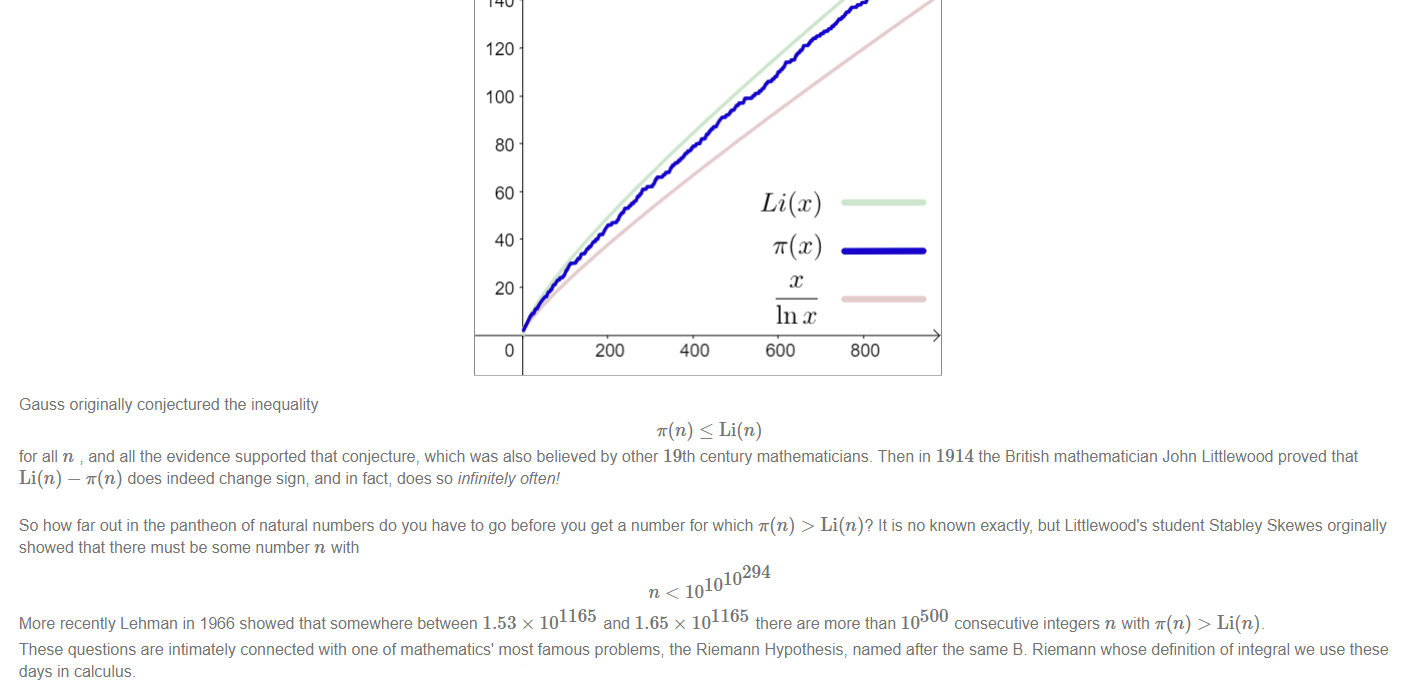
It is interesting to graphically compare the values of Li(n) T(n) and 
Below is a plot for all three up to n 
In n 
180 
160 
140 
120 
100 
80 
60 
40 
20 
Gauss originally conjectured the inequality 
Reset Colours 
200 
T(n) S Li(n) 
Li(x) 
In 
600 
1000. Clicking on the graphs below (and their labels) will highlight each function 
800 
for all n and all the evidence supported that conjecture, which was also believed by other 19th century mathematicians. Then in 1914 the British mathematician John Littlewood proved that 
Li(n) — T(n) does indeed change sign; and in fact, does so infinitely often! 
So how far out in the pantheon of natural numbers do you have to go before you get a number for which T(n) > Li(n)? It is no known exactly, but Littlewood's student Stabley Skewes orginally 
showed that there must be some number n With 
294 
1010 
n < 10 
1165 
1165 
500 
consecutive integers n with T(n) > Li(n)_ 
More recently Lehman in 1966 showed that somewhere between 1.53 x 10 
and 1.65 x 10 
there are more than 10 
These questions are intimately connected with one of mathematics' most famous problems; the Riemann Hypothesis, named after the same Riemann whose definition of integral we use these 
days in calculus. This whole business is, of course [select all that apply]
Untitled picture.png Machine generated alternative text:
It is interesting to graphically compare the values of Li(n) T(n) and 
Below is a plot for all three up to n 
In n 
180 
160 
140 
120 
100 
80 
60 
40 
20 
Gauss originally conjectured the inequality 
Reset Colours 
200 
T(n) S Li(n) 
Li(x) 
In 
600 
1000. Clicking on the graphs below (and their labels) will highlight each function 
800 
for all n and all the evidence supported that conjecture, which was also believed by other 19th century mathematicians. Then in 1914 the British mathematician John Littlewood proved that 
Li(n) — T(n) does indeed change sign; and in fact, does so infinitely often! 
So how far out in the pantheon of natural numbers do you have to go before you get a number for which T(n) > Li(n)? It is no known exactly, but Littlewood's student Stabley Skewes orginally 
showed that there must be some number n With 
294 
1010 
n < 10 
1165 
1165 
500 
consecutive integers n with T(n) > Li(n)_ 
More recently Lehman in 1966 showed that somewhere between 1.53 x 10 
and 1.65 x 10 
there are more than 10 
These questions are intimately connected with one of mathematics' most famous problems; the Riemann Hypothesis, named after the same Riemann whose definition of integral we use these 
days in calculus. This whole business is, of course [select all that apply] 
Ink Drawings


Created with Microsoft OneNote 2016.