Calc1131W11T3 - Comparison tests

Sunday, 20 May 2018

9:25 PM

Machine generated alternative text:
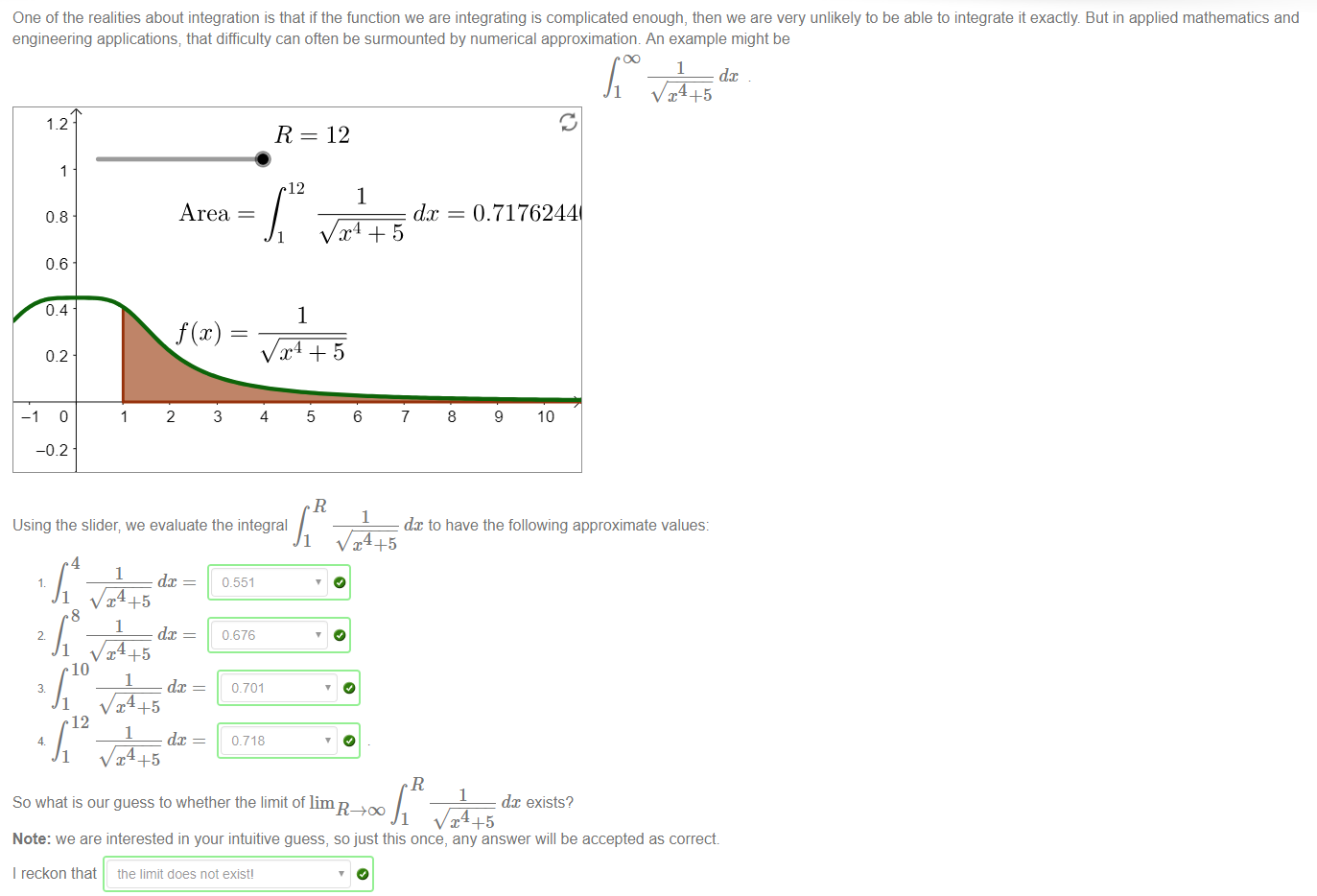
One of the realities about integration is that if the function we are integrating is complicated enough, then we are very unlikely to be able to integrate it exactly. But in applied mathematics and 
engineering applications; that difficulty can often be surmounted by numerical approximation. An example might be 
1.2 
0.8 
0.6 
0.4 
0.2 
Area 
3 
R 
12 
1 
12 
1 
6 
1 
1 
dc 
1 
0.7176244 
2 
4 
5 
1 
7 
8 
9 
10 
Using the slider; we evaluate the integral 
dc to have the following approximate values: 
4 
1 
1 
8 
1 
1 
1 
1 
dc 
dc 
dc 
dc 
0551 
0.676 
0.701 
0.718 
So what is our guess to whether the limit of limR_+D0 
1 
_J— dc exists? 
Note: we are interested in your intuitive guess, so just this once, any answer will be accepted as correct 
I reckon that tne limit does not exist'


Machine generated alternative text:
One way to show that an improper integral such as 
f(x) dc converges is to compare it to another convergent integral which is easier to calculate. If 0 < f(x) g@) on the interval [a, oo 
then the Comparison test states that if 
g(x) dc converges, then so does 
f@) dc A particularly useful family of functions to compare with are the p-integrals; integrals of the form 
smaller 
1 
O 
It helps to remember that if 1 < x and O < p, then the bigger p gets the 
converges precisely when 
dc 
gets, so that it is 
1 
dc 
more likely 
dc converges. In fact this integral 
O that 
To show that 
converges 
Since x > 1; 
O we will compare it to 
1 
1 
x6/3 
dc, which we know 
1 
converges 
O since it is a p-integral with p 
2 
x < x6 + 4 implies that 
2 
and hence 
1 
Integrating both sides of this inequality over [1, 00) completes the argument


Machine generated alternative text:
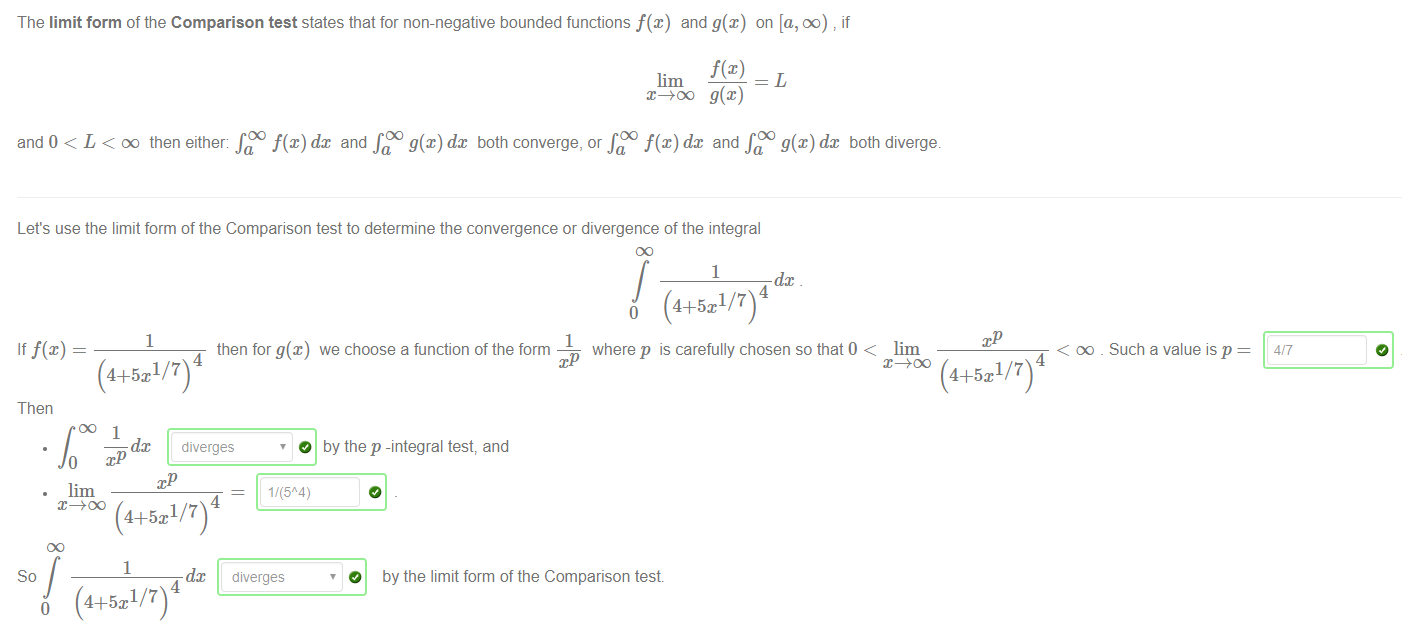
The limit form ofthe Comparison test states that for non-negative bounded functions f@) and g(x) on [a, DO) if 
f@) 
lim 
and 0 < L < DO then either: dc and both converge, or and both diverge. 
Let's use the limit form of the Comparison test to determine the convergence or divergence of the integral 
1 
If f@) 
(4+5x1/7)4 
Then 
then for g@) 
1 
dc 
4 
(4+5x1 7 
1 
where p is carefully chosen so that0 < lim 
we choose a function of the form 
by the p -integral test, and 
< oo _ Such a value is p 
4 
(4+5x1 7 
dc diverges 
O 
1/(5A4) 
1 
dc diverges 
so 
4 
o (4+5x1/7) 
O 
by the limit form of the Comparison test


Created with Microsoft OneNote 2016.