Calc1131W11T2 - Improper integrals

Sunday, 20 May 2018

9:06 PM

Untitled picture.png Machine generated alternative text:
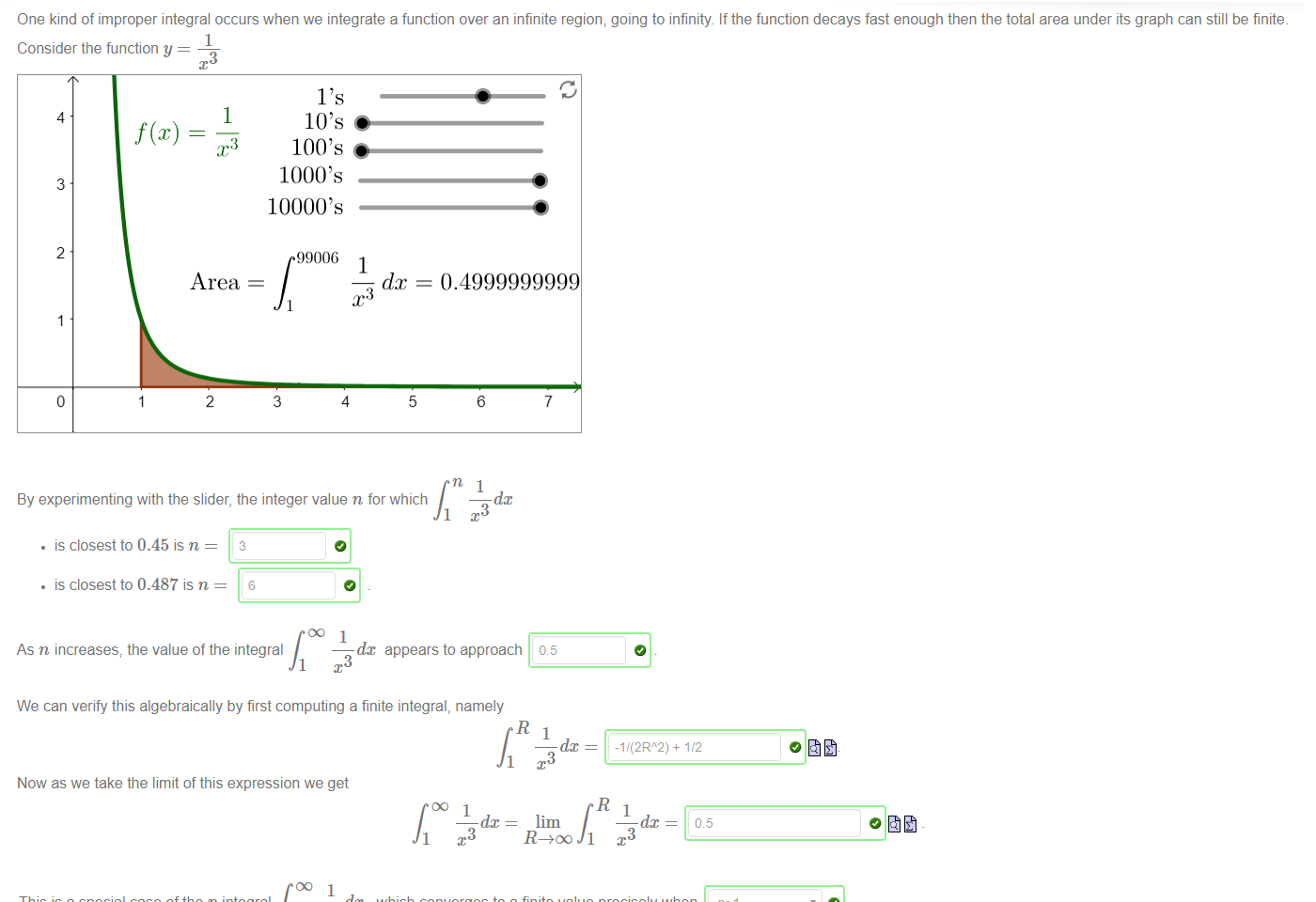
One kind of improper integral occurs when we integrate a function over an infinite region; going to infinity. If the function decays fast enough then the total area under its graph can still be finite. 
Consider the function y 
4 
3 
2 
1 
1 
3 
Area 
2 
100's 
1000's 
10000's 
0.4999999999 
1 
3 
99006 
1 
3 
4 
5 
6 
dc 
By experimenting with the slider, the integer value n for which 
• is closest to 0.45 is n 
• is closest to 0.487 is n 
6 
3 
DO 1 
dc appears to approach 
As n increases, the value of the integral 
3 
We can verify this algebraically by first computing a finite integral, namely 
1 
Now as we take the limit of this expression we get 
oo 1 
dc 
7 
0.5 
1 
dc 
lim 
-1/(2RA2) + 1/2 
1 
dc 
05 
1 

Untitled picture.png Machine generated alternative text:
1 
This is a special case of the p-integral 
1 
which converges to a finite value precisely when
Untitled picture.png Machine generated alternative text:
1 
This is a special case of the p-integral 
1 
which converges to a finite value precisely when 

Untitled picture.png Machine generated alternative text:
Evaluate the following improper integrals; or write undefined if they don't converge: 
i) 
xe¯3Xdx = 
-1(7) 
1 
2 
Note: use arctan (7) to write tan 
3 
, use pi to write T, and use exp (3) to write e 

Untitled picture.png Machine generated alternative text:
1 
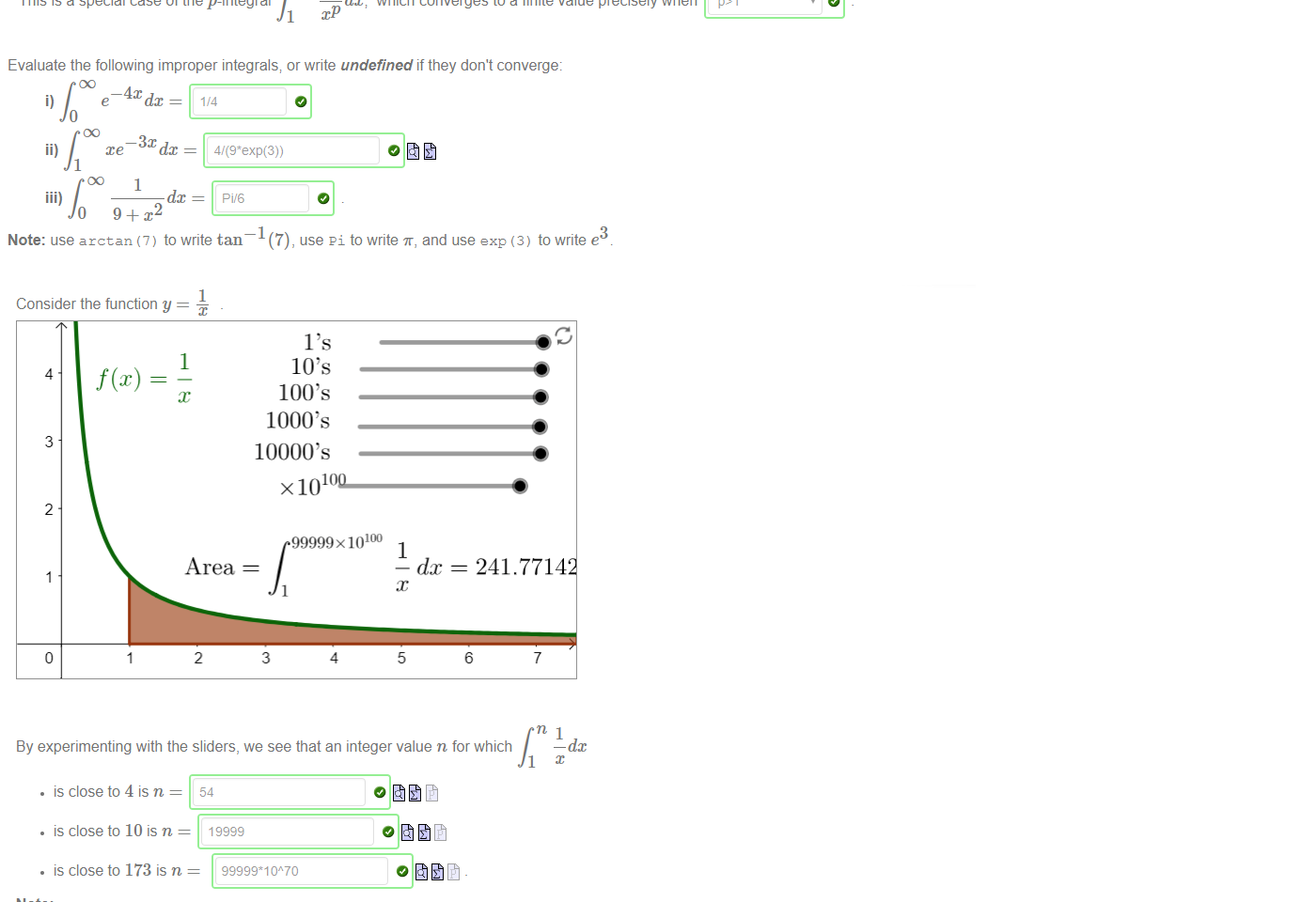
Consider the function y 
1 
4 
3 
2 
10's 
100's 
1000's 
10000's 
X 10100—4 
Area — 
2 
1 
3 
99999 x 10100 
4 
1 
—dr 241.7714 
5 
6 
7 
By experimenting with the sliders, we see that an integer value n for which 
• is close to 4 is n 
• is close to 10 is n 
• is close to 173 is n 
Note: 
54 
19999 
99999*10A70 
dc is within 1% of the required value. 
try to give an answer so 
• you can enter 12345 x 10678 
in Maple notation as 12345*10A (678) 
DO 1 
dc appears to be undefined 
As n increases, the value of the integral
Untitled picture.png Machine generated alternative text:
1 
Consider the function y 
1 
4 
3 
2 
10's 
100's 
1000's 
10000's 
X 10100—4 
Area — 
2 
1 
3 
99999 x 10100 
4 
1 
—dr 241.7714 
5 
6 
7 
By experimenting with the sliders, we see that an integer value n for which 
• is close to 4 is n 
• is close to 10 is n 
• is close to 173 is n 
Note: 
54 
19999 
99999*10A70 
dc is within 1% of the required value. 
try to give an answer so 
• you can enter 12345 x 10678 
in Maple notation as 12345*10A (678) 
DO 1 
dc appears to be undefined 
As n increases, the value of the integral 

Untitled picture.png Machine generated alternative text:
We can verify this algebraically by first computing a finite integral, namely 
RI 
Now as we take the limit of this expression we get 
Ill(R) 
RI 
lim 
R*D0 1 X 
undefined 
dc which converges to a finite value precisely when 
This is a special case of the p-integral 

Untitled picture.png Machine generated alternative text:
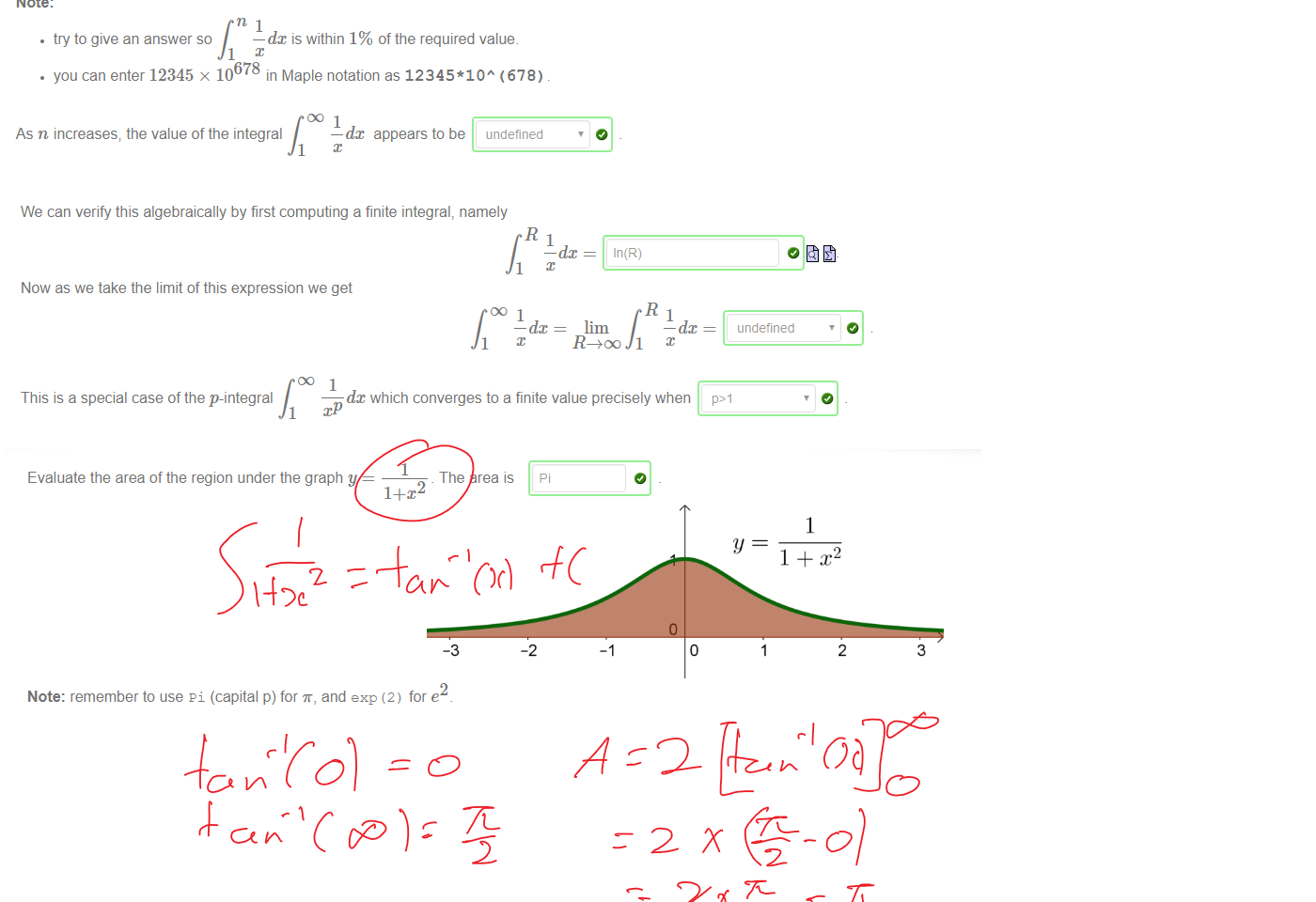
Evaluate the area of the region under the graph y 
Note: remember to use pi (capital p) for T, and exp (2) for e 
The area is 


Ink Drawings


Untitled picture.png Machine generated alternative text:
1 
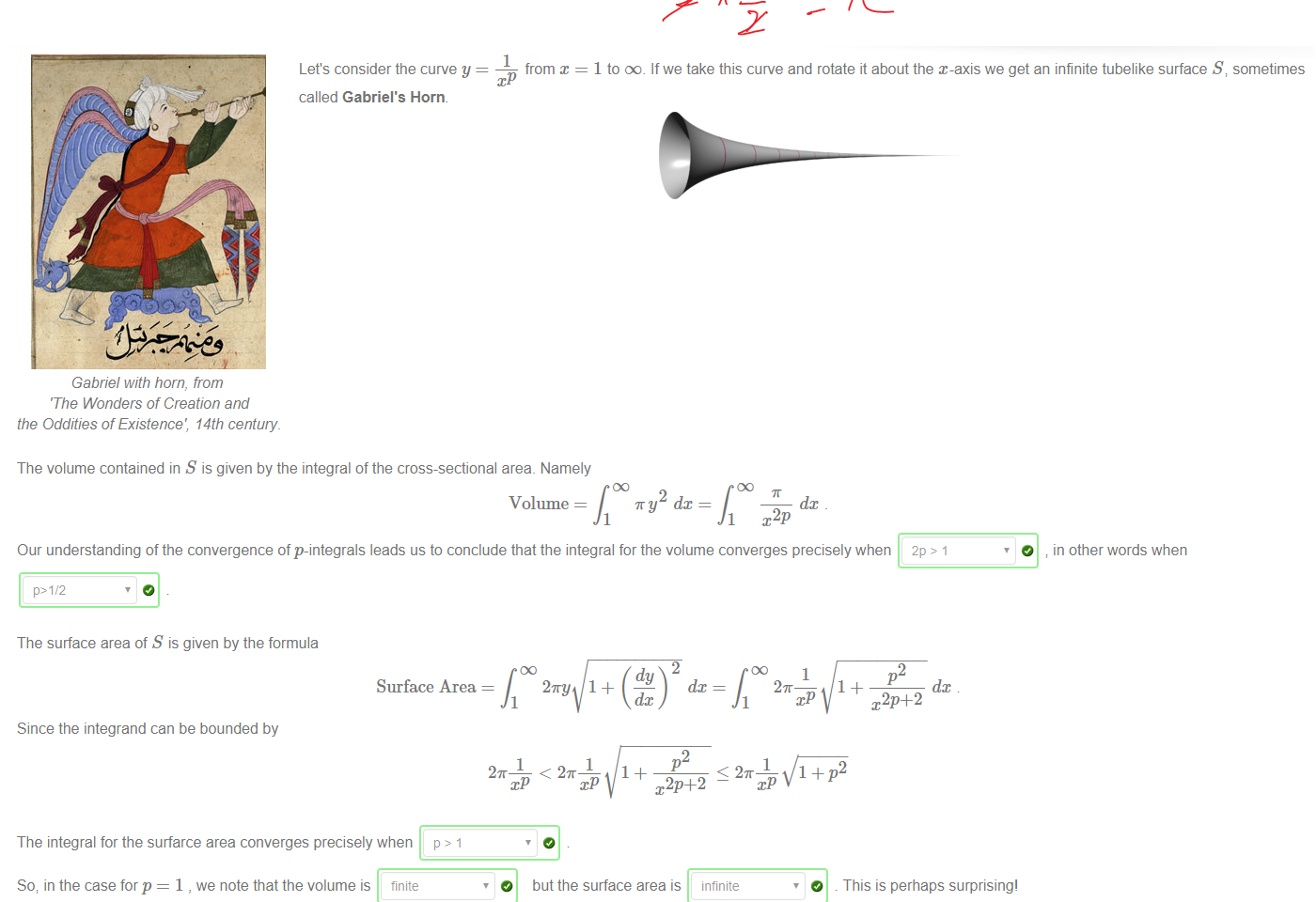
Let's consider the curve y 
from x 
called Gabriel's Horn. 
04 
Gabnel With horn, from 
'The Wonders of Creation and 
the Oddities of Existence', 14th century. 
The volume contained in S is given by the integral of the cross-sectional area. Namely 
Volume 
1 to DO. If we take this curve and rotate it about the x-axis we get an infinite tubelike surface s i sometimes 
T y dc 
1 
dc 
Our understanding of the convergence of p-integrals leads us to conclude that the integral for the volume converges precisely when 2P > 1 
p>1/2 
O 
in other words when 
The surface area of S is given by the formula 
Surface Area 
Since the integrand can be bounded by 
The integral for the surfarce area converges precisely when p > 1 
So; in the case for p = 1 , we note that the volume is finite 
2 
1 
O 
27ry 
< 2K 
dy 
dc 
1 
dc 
p2 
1 
< 27T 
but the surface area is infinite 
O 
p2 
dc 
This is perhaps surprising' 

Untitled picture.png Machine generated alternative text:
The Comparison Test is also useful to show than an improper integral such as 
O S f(x) g(x) on the interval [a, DO), then the comparison text states that if 
g(x) dc diverges; again by comparing it against another divergent integral which is easier to calculate. If 
f(x) dx diverges; then so does 
g@) dc 
To show that 
diverges 
Since x > 2 
2 
O we will compare it to 
2 
1 
x3/5 
which we know 
diverges 
1 
dc 
(x3 — 4)1/5 
O since it is a p-integral with p 
x3 — 4 < implies that 
(x3 -4)1/5 < 
and hence 
1 
x3/5 
Integrating both sides of this inequality over [2, 00) completes the argument.


Created with Microsoft OneNote 2016.