Alg1131W8T4 - Roots of unity

Saturday, 21 April 2018

11:24 AM

Machine generated alternative text:
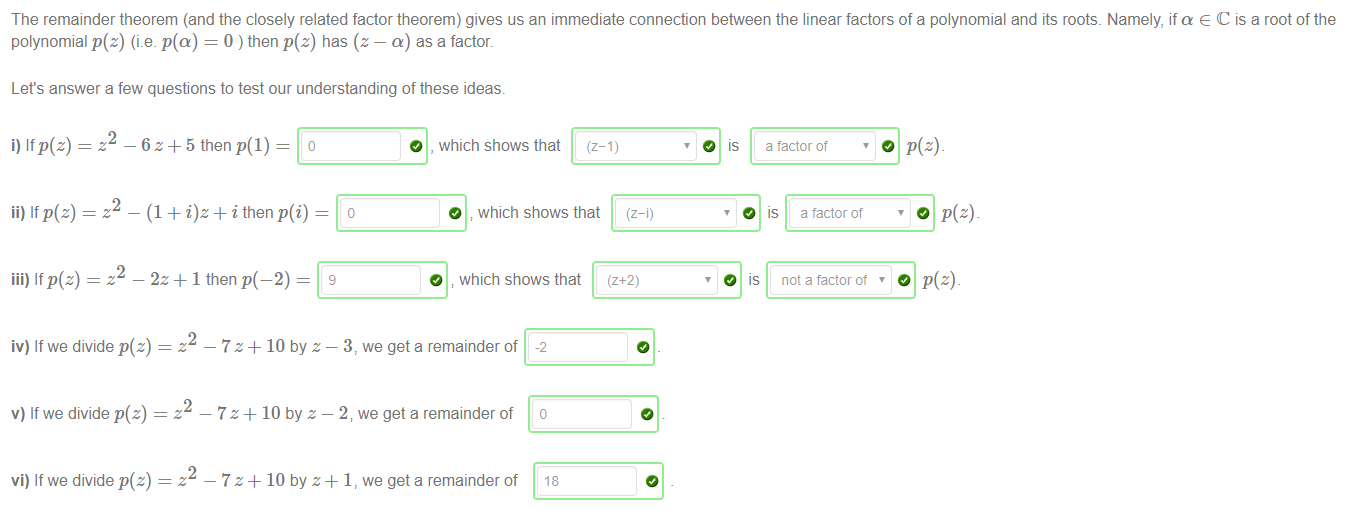
The remainder theorem (and the closely related factor theorem) gives us an immediate connection between the linear factors of a polynomial and its roots. Namely, if a e C is a root of the 
polynomial p(z) (i.e. p(a) = 0 ) then p(z) has (z — a) as a factor. 
Let's answer a few questions to test our understanding of these ideas. 
— 7 z + 10 by z — 2, we get a remainder of 
i) If p(z) — 
ii) If p(z) 
iii) If p(z) 
2 
—6z+5 then o 
2 
2 
O , which shows that (z-1) 
O 
_ (1 + + i then p(i) 
O which shows that 
- 2z+ 1 then 
O which shows that 
(z- 
IS 
O 
O is 
a tactor of 
is a tactor of 
not a factor ot 
iv) If we divide p(z) 
v) If we divide p(z) 
vi) If we divide p(z) 
2 
2 
2 
— 7 z + 10 by z — 3, we get a remainder of 
we get a remainder of 
-2 
18


Machine generated alternative text:
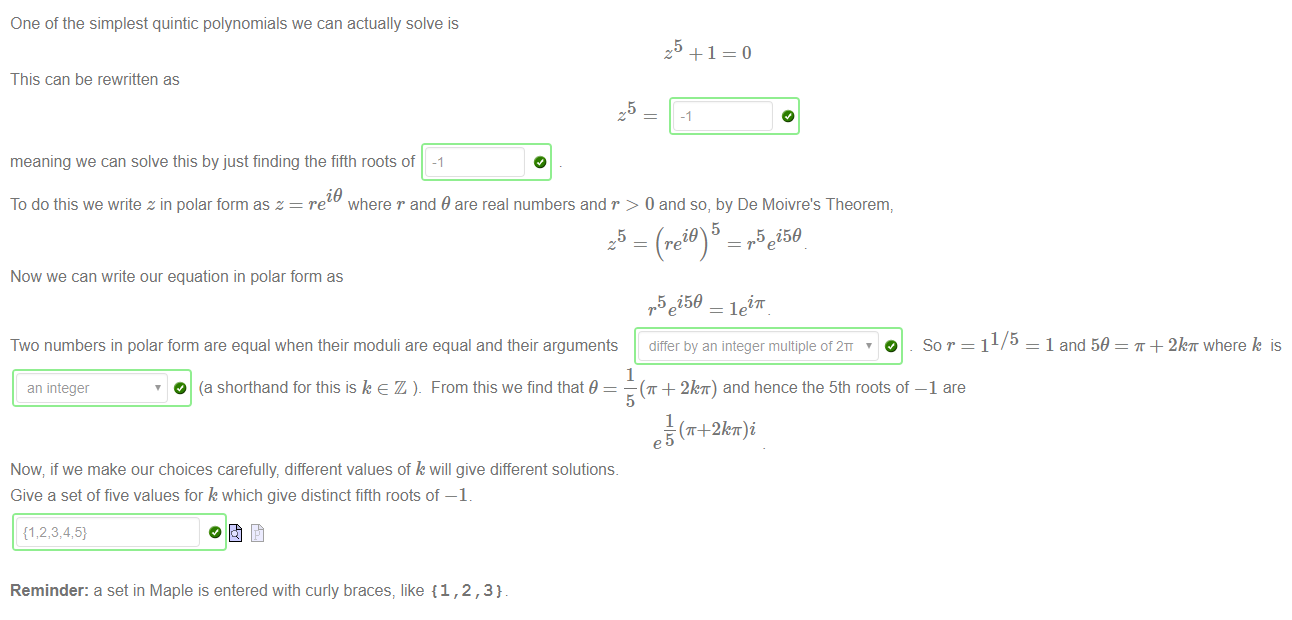
One of the simplest quintic polynomials we can actually solve is 
This can be rewritten as 
meaning we can solve this by just finding the fifth roots of -1 
i9 
5 
5 
To do this we write z in polar form as z = re where r and 9 are real numbers and r > 0 and so, by De Moivre's Theorem, 
5 i59 
5 
Now we can write our equation in polar form as 
5 i59 = leiT 
Two numbers in polar form are equal when their moduli are equal and their arguments differ by an integer multiple of 2n 
1/5 
= 1 and 59 
+ 2kT where k is 
an integer 
1 
O (a shorthand for this is k e Z From this we find that 9 
— (T + 2kT) and hence the 5th roots of 
5 
1 
— (T+2kff)i 
—1 are 
Now; if we make our choices carefully, different values of k will give different solutions. 
Give a set of five values for k which give distinct fifth roots of —1. 
Reminder: a set in Maple is entered with curly braces, like {1 , 2 , 3}


Machine generated alternative text:
1m 
12 
11 
10 
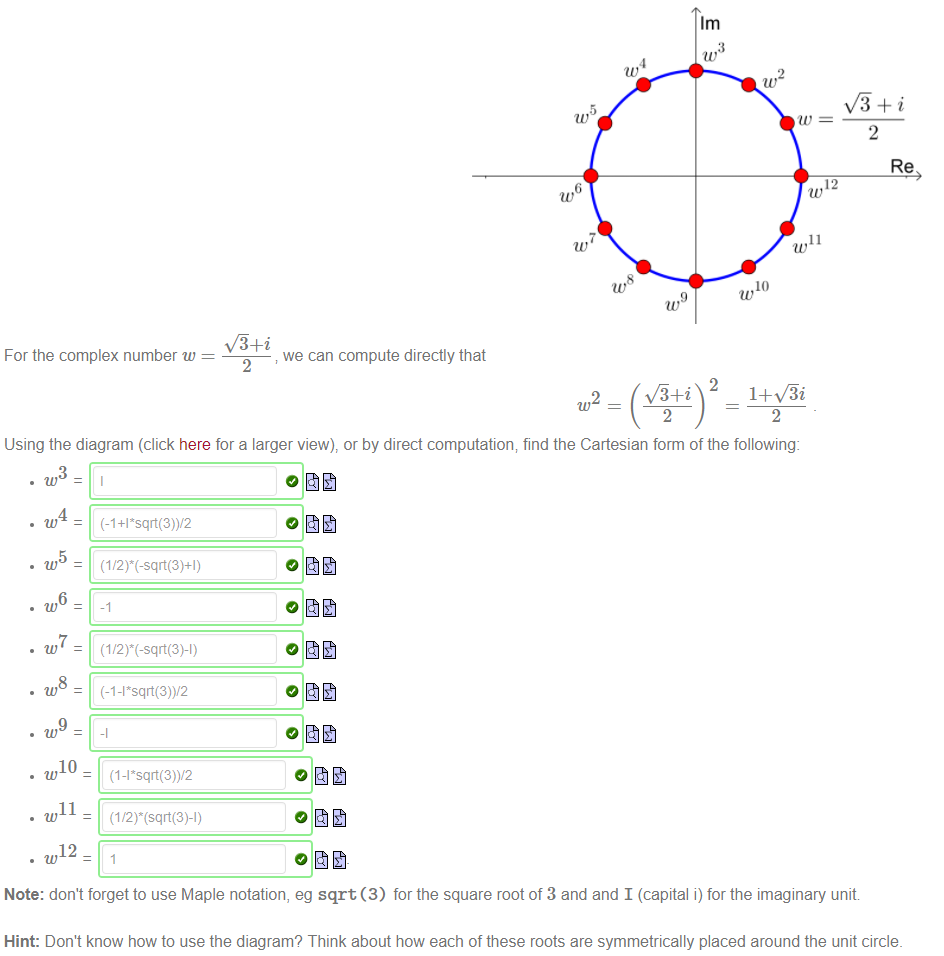
For the complex number w 
we can compute directly that 
Using the diagram (click here for a larger view), or by direct computation; find the Cartesian form of the following: 
10 
11 
12 
Note: don't forget to use Maple notation, eg sqrt (3) for the square root of 3 and and I (capital i) for the imaginary unit 
Hint: Don't know how to use the diagram? Think about how each of these roots are symmetrically placed around the unit circle.


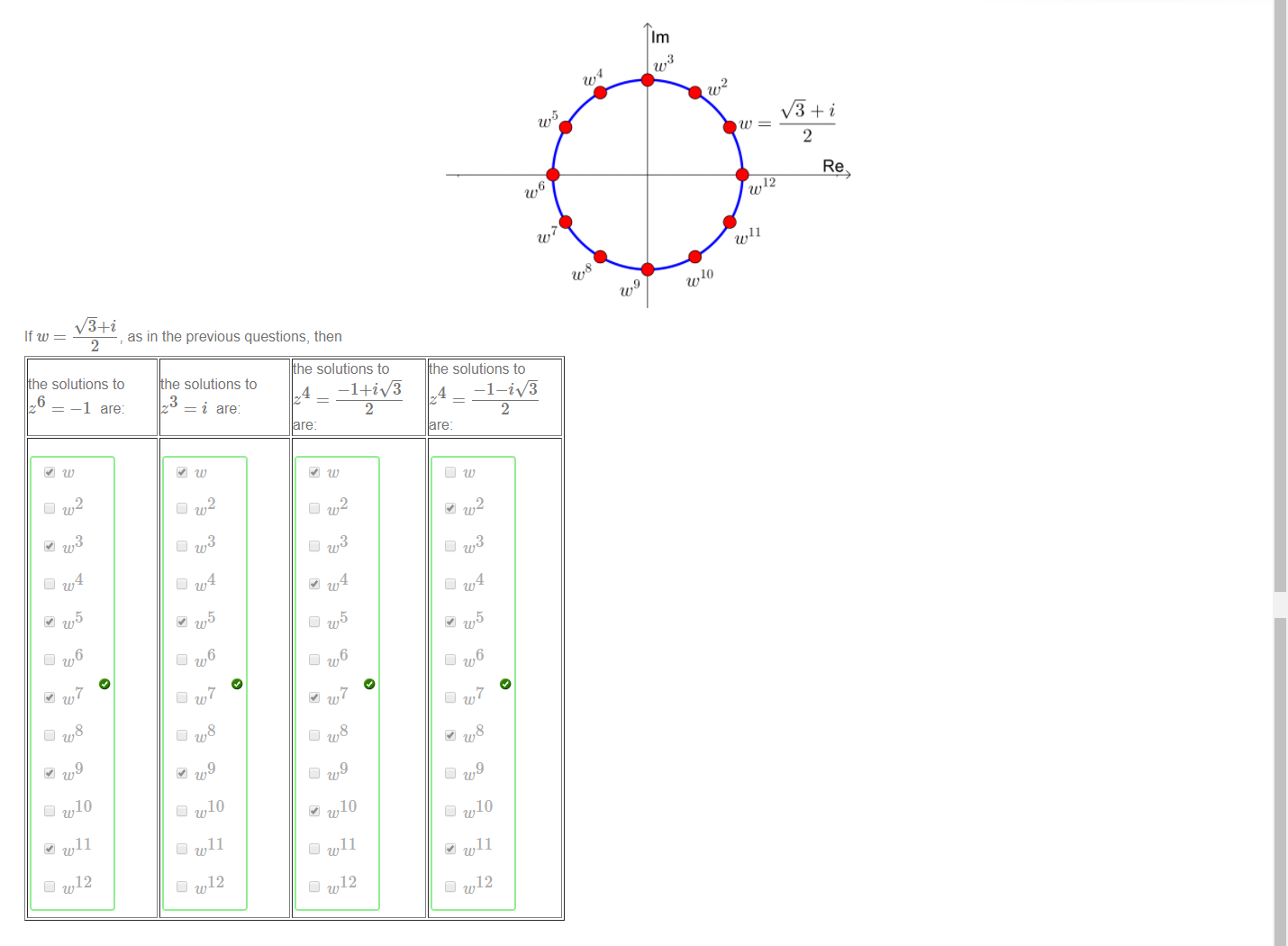
Ifw - 
he solutions to 
-- 1 are. 
〔 〕 10 
〔 〕 12 
as in the previous questions then 
he solutions to 
are - 
〔 〕 10 
〔 〕 12 
he solutionsto 
-1 十 i 
〔 〕 12 
Re 
he solutionsto 
4 
〔 〕 10 
〔 〕 12


Here is a challenging problem. Consider the polynomial 
5 
4 
2 
— 5 z + 25 z 
— 36 z + 18_ 
Give the setof complex linear factors of p. To help you out, you are told that 1 + i is a root, and that three of the roots are integers. 
The set of factors is: 
{z-3, z-1, z-l-l, z-I+I, z+3] 
Note: Your set should be of a form like {z-1 , z- (1+2*1) _ Don't forget to use I (capital i) to represent the complex unit


Created with Microsoft OneNote 2016.