Alg1131W8T2 - Powers of sine and cosine

Saturday, 21 April 2018

11:24 AM

Machine generated alternative text:
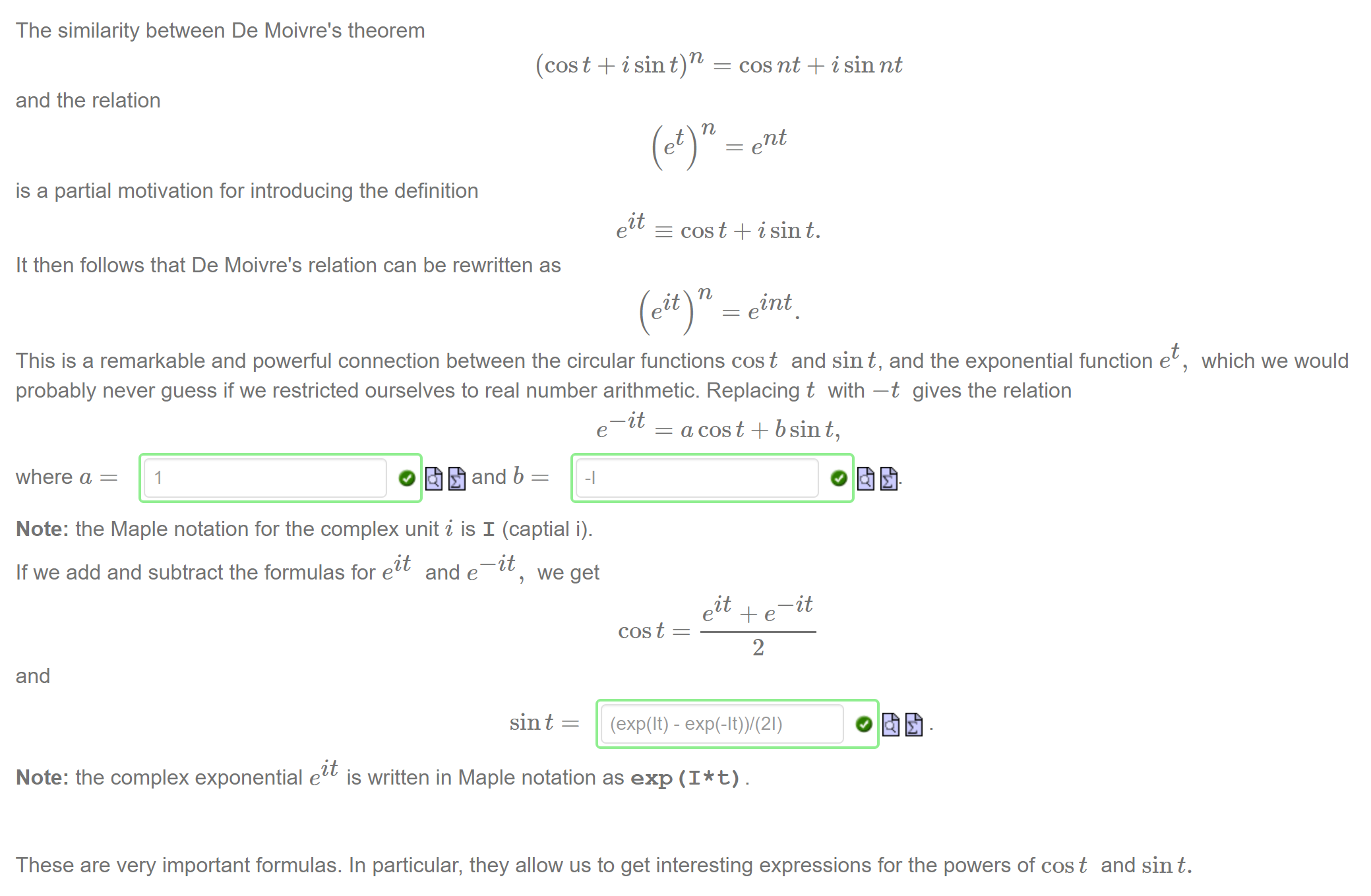
The similarity between De Moivre's theorem 
(cos t + i sin 
and the relation 
is a partial motivation for introducing the definition 
it 
e 
It then follows that De Moivre's relation can be rewritten as 
cos nt + i sin nt 
nt 
cos t + i sin t. 
int 
e 
This is a remarkable and powerful connection between the circular functions cost and sin t, and the exponential function e 
probably never guess if we restricted ourselves to real number arithmetic. Replacing t with —t gives the relation 
which we would 
—it 
e 
a cos t + b sin t, 
where a = 
1 
Note: the Maple notation for the complex unit i is I (captial i). 
—it 
If we add and subtract the formulas for ect and e 
we get 
and 
sin t 
—it 
cos t 
2 
(exp(lt) - exp(-lt))/(21) 
Note: the complex exponential ect is written in Maple notation as exp (I* t) . 
These are very important formulas. In particular, they allow us to get interesting expressions for the powers of cost and sin t.


Machine generated alternative text:
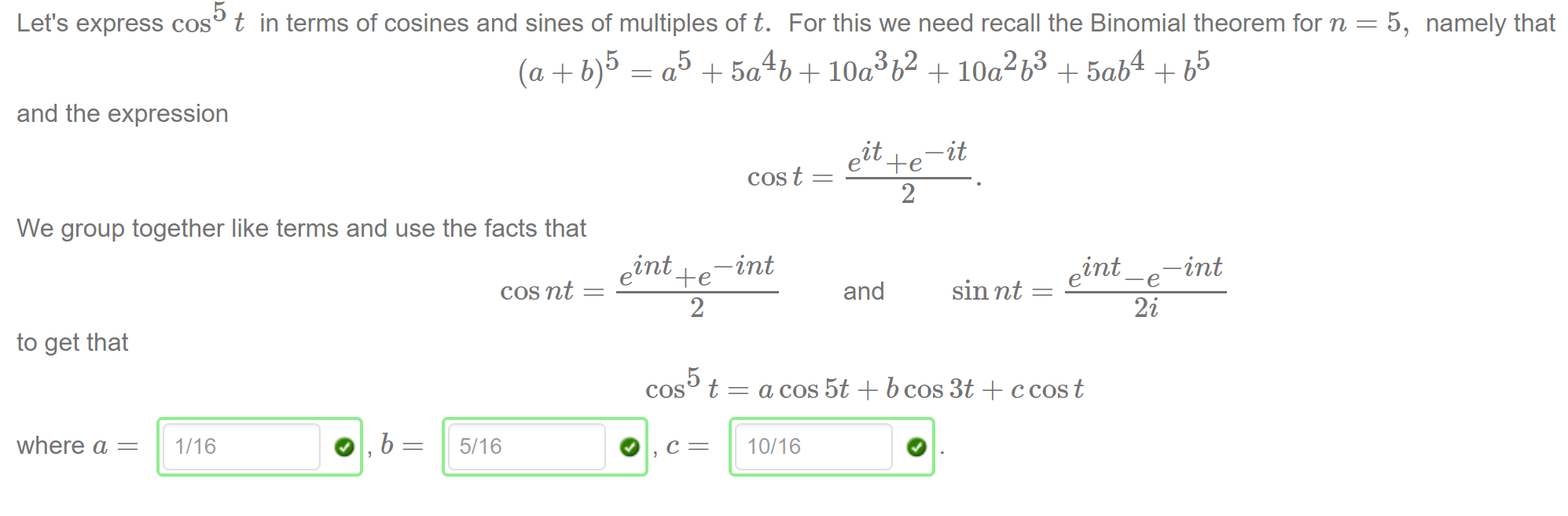
Let's express cos t in terms of cosines and sines of multiples of t. 
and the expression 
For this we need recall the Binomial theorem for n = 
—it 
5, 
namely that 
We group together like terms and use the facts that 
cos t 
—int 
2 
—int 
and 
to get that 
where a = 
1/16 
cos nt 
5/16 
e 
sin nt 
2 
cos t 
a cos 5t + b cos 3t + c cos t 
10/16


Machine generated alternative text:
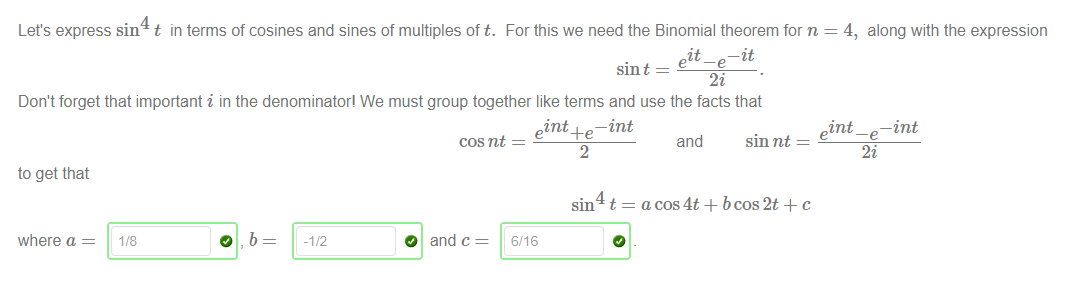
Let's express sin t in terms of cosines and sines of multiples oft. For this we need the Binomial theorem for n = 4, 
it 
—it 
sin t 
Don't forget that important i in the denominator! We must group together like terms and use the facts that 
int 
along with the expression 
—int 
to get that 
where a 
118 
o 
b 
-1/2 
O 
cos nt 
and c 
— int 
t 
and 
sin nt 
sm 
6/16 
a cos4t + bcos2t + c


Machine generated alternative text:
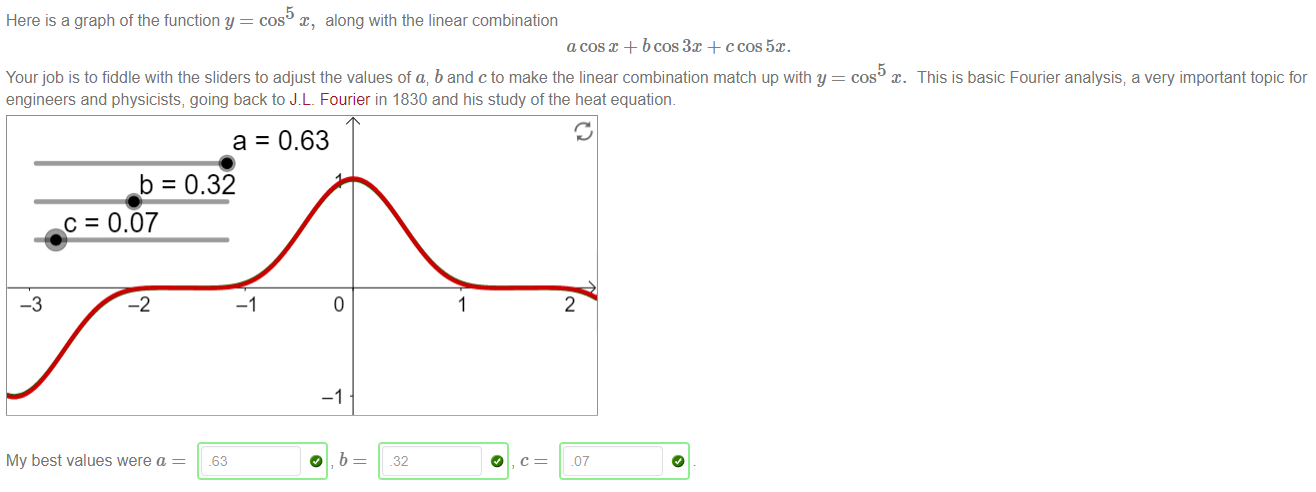
Here is a graph of the function y = cos x, along with the linear combination 
acosx + bcos3x + ccos 5m. 
Your job is to fiddle with the sliders to adjust the values of a; b and c to make the linear combination match up with y 
engineers and physicists, going back to JL. Fourier in 1830 and his study of the heat equation. 
a = 0.63 
b=032 
cos x. 
This is basic Fourier analysis; a very important topic for 
—3 
c = 0.07 
-2 
2 
My best values were a


Machine generated alternative text:
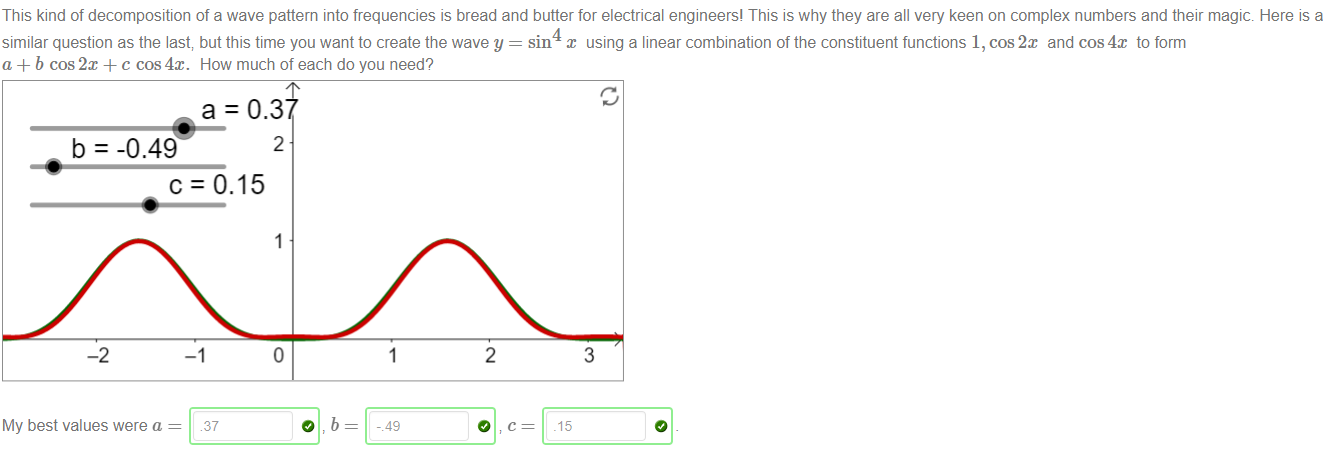
This kind of decomposition of a wave pattern into frequencies is bread and butter for electrical engineers' This is why they are all very keen on complex numbers and their magic. Here is a 
similar question as the last; but this time you want to create the wave y = sin x using a linear combination of the constituent functions 1, cos2x and cos4x to form 
a + b cos2x + c cos4x. How much of each do you need? 
a = 0.3 
2 
b = -0 49 
c: 0.15 
-2 
My best values were a 
2 
37 
3 
.15


Created with Microsoft OneNote 2016.