Alg1131W8T1 - Multiple angle formulas

Saturday, 21 April 2018

11:24 AM

De Moivre's theorem gives that 
[r(cost + isin t)] 
rn (cosnt + isin nt) 
The meaning of this is that the modulus of zn is the nth power of the modulus of z and that the argument of zn is n times the argument of z . 
2345 
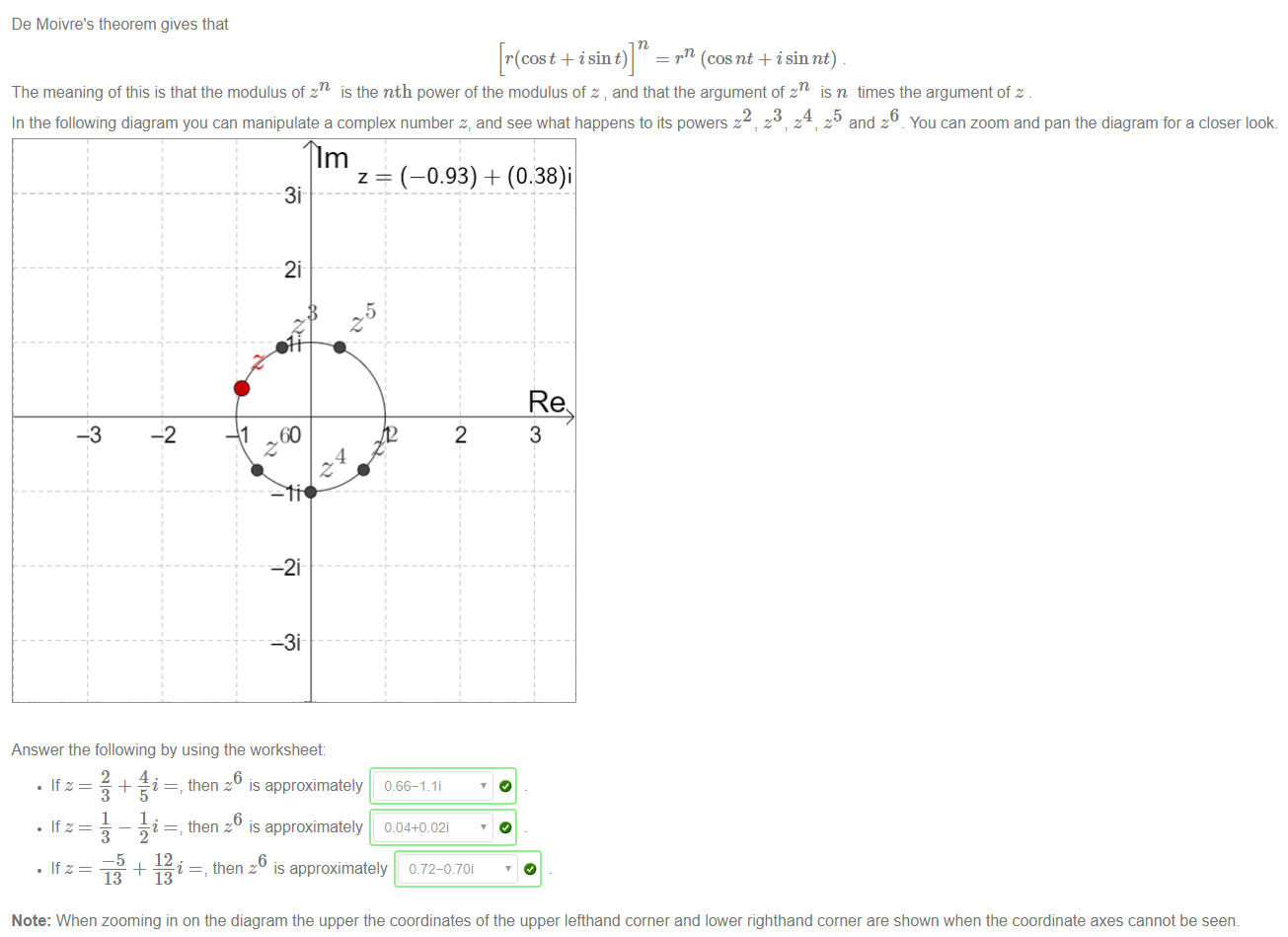
In the following diagram you can manipulate a complex number z, and see what happens to its powers z , z v z , z and z _ You can zoom and pan the diagram for a closer look. 
1 
60 
Answer the following by using the worksheet: 
z (—0.93) + (0.38)i 
0.66-1 li 
0.04+002i 
-5 
13 
12 • 
13 
then z is approximately 
Note: When zooming in on the diagram the upper the coordinates of the upper lefthand corner and lower righthand corner are shown when the coordinate axes cannot be seem


De Moivre's theorem asserts that 
(cost + i sin 
cos nt + i sin nt 
2 
for any integer n. For example (cost + i sin t) 
cos 2t + isin2t. In fact ifwe expand the left hand side we get 
Re ((cos t + i sin t) 2) 
and 
1m (cos t + i sin t) 2 ) 
so that De Moivre's formula in this case yields the familiar relations 
O 
O 
and 
O 
O 
cos 2t 
cos 2t 
cos 2t 
sin 2t 
sin 2t 
sin 2t 
cos t —sin t 
sin t — cos t 
2 cos t sin t 
cos t 
sin t 
sin t 
cos t 
2 cos t sin t 
1 toget cos2t purely in terms of cost, namely cos2t = acos t +b where 
The first relation can in this case be rewritten using the relation cos t + sin t 
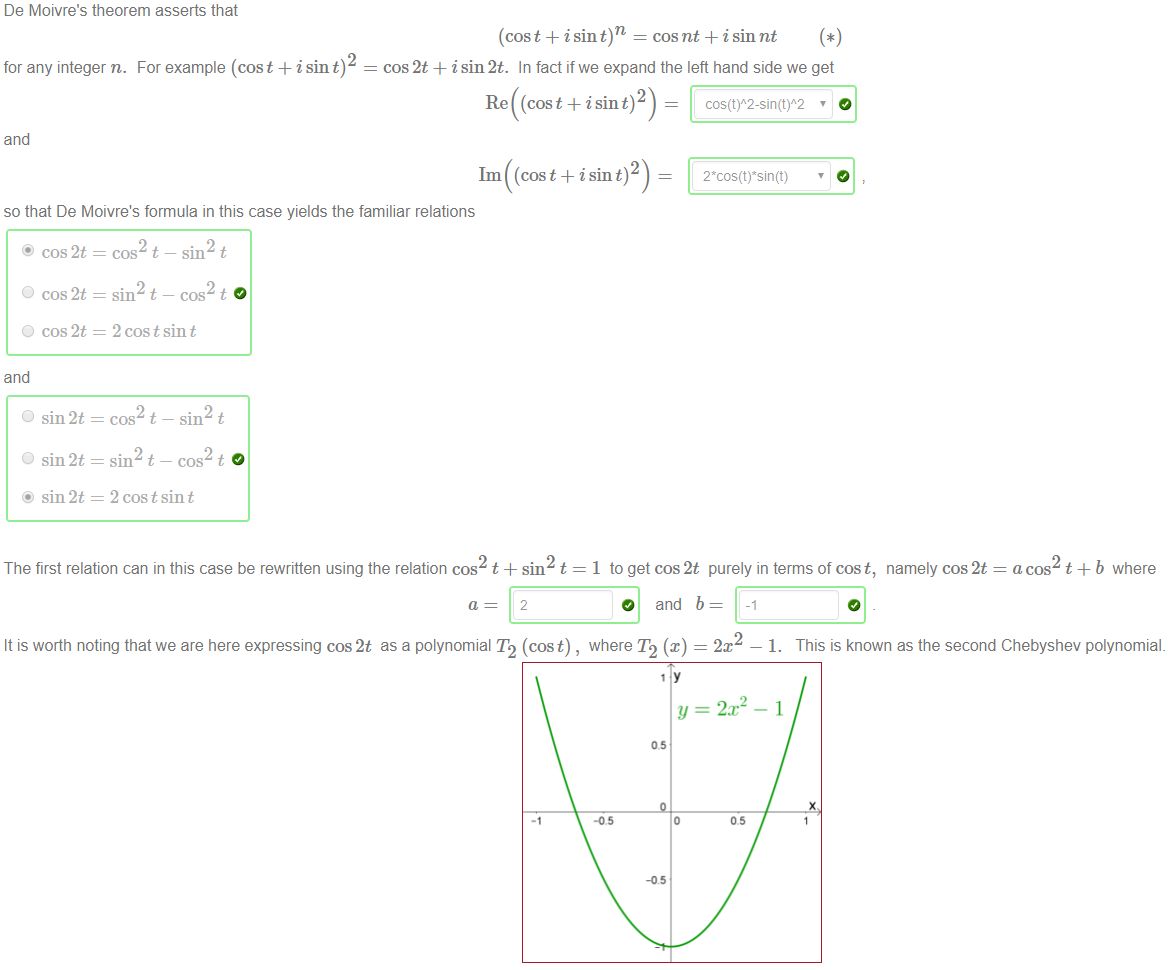
It is worth noting that we are here expressing cos2t as a polynomial T2 (cost) , where T2 (x) 
2 
2m 
1. This is known as the second Chebyshev polynomial. 
— 2x2 - 1


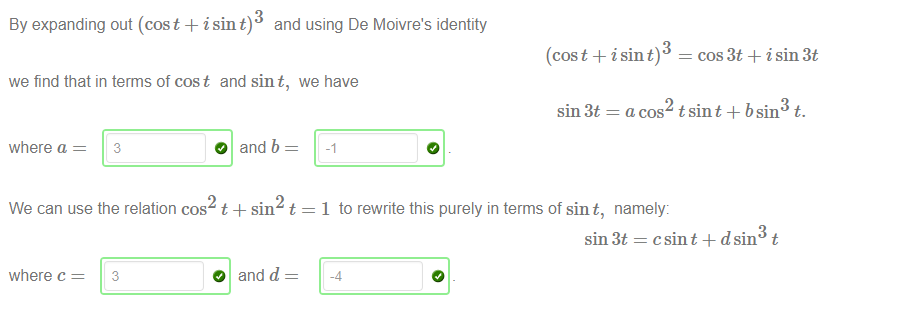
By expanding out (cost + i sin t) and using De Moivre's identity 
we find that in terms of cost and sint, we have 
3 
(cost + i sin t) 
cos 3t + i sin 3t 
sin3t=acos tsint+bsin3 t. 
where a 
3 
O and b 
We can use the relation cos t + sin 
t 
where c — 
3 
O and d 
1 to rewrite this purely in terms of sint, namely: 
sin3t = csint + dsin3 t 
-4


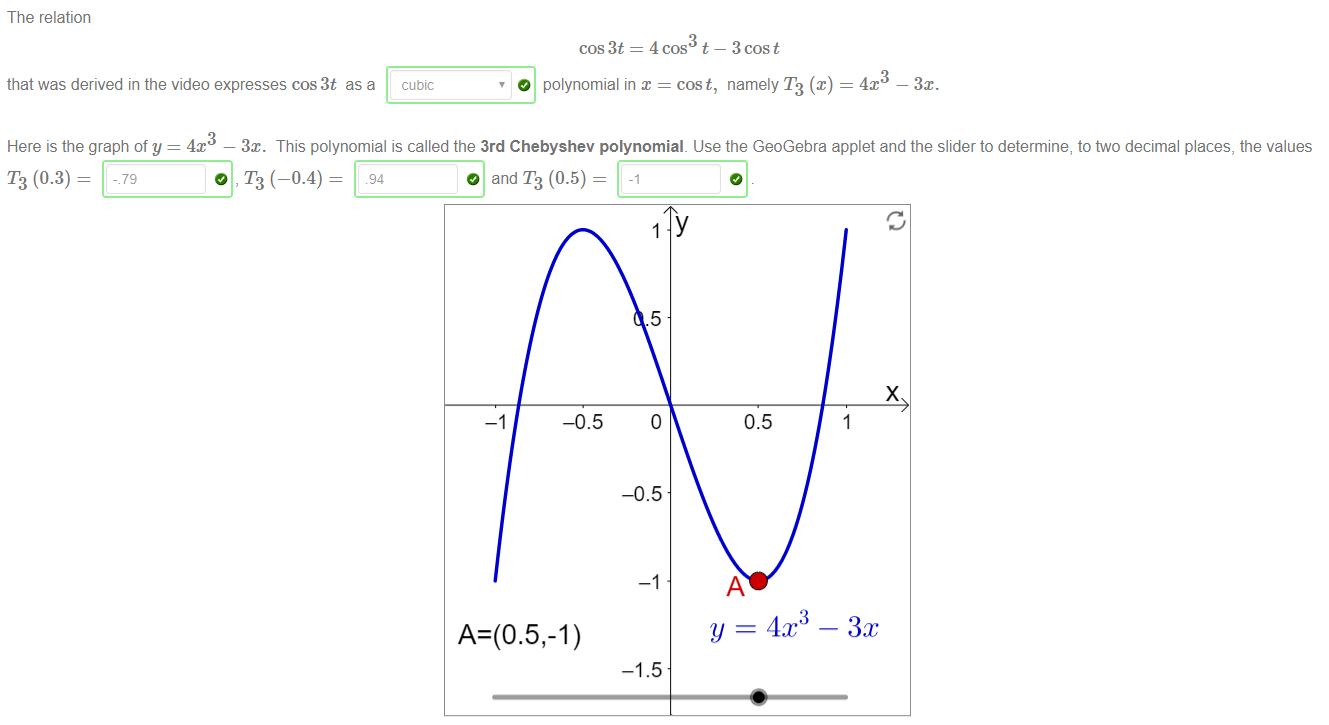
The relation 
that was derived in the video expresses cos 3t as a cubic 
cos3t= 4cos t— 3cost 
O polynomial in x = cost, namely 173 @) = 4x — .3x. 
Here is the graph of y = 4x — 3x. This polynomial is called the 3rd Chebyshev polynomial. Use the GeoGebra applet and the slider to determine, to ftvo decimal places, the values 
T3 (0.3) — 
- 79 
5 
_0.5 
0.5 
x 
1 
— 3m 
-1.5


There is in fact a family of Chebyshev polynomials Tn (x) that express cosnt in terms of 
and using De Moivre's identity 
4 
(cos t + i sin t) 
We can find that in terms of cost and sin t, we have 
4 
cost. Let's find the fourth Chebyshev polynomial by expanding out (cost + isin t) 
cos 4t + isin4t. 
cos4t=acos t+bcos2tsin t -kcsin t 
where a 
Now using a bit of algebra with our favourite relation cos t +sin t = 1, we can rewrite this purely in terms of powers of cost, namely: 
where d 
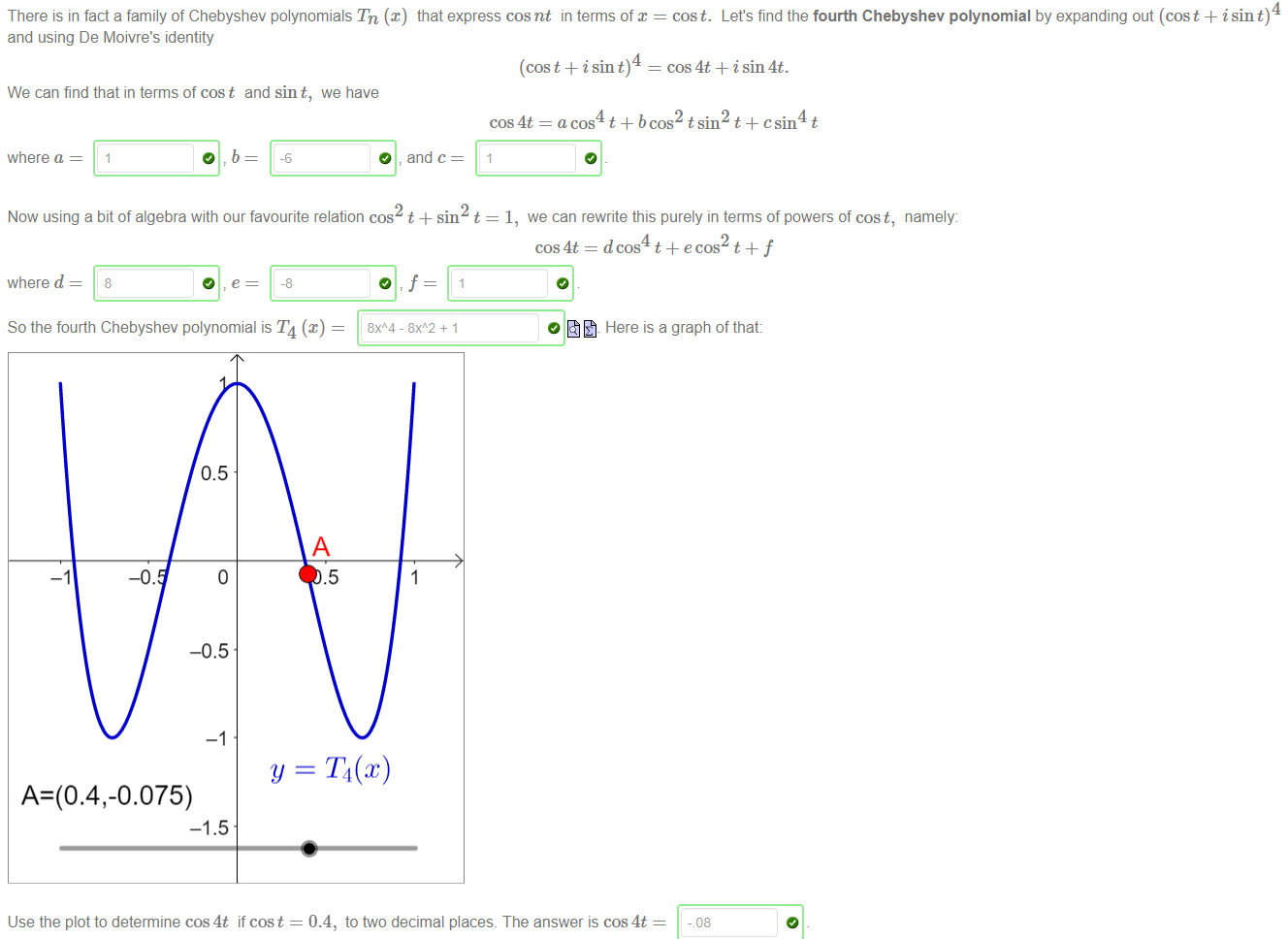
So the fourth Chebyshev polynomial is T4 (x) 
cos4t= dcos4t+ecos t + f 
Here is a graph of that: 
Use the plot to determine cos4t if cos t 
0.4, to two decimal places. The answer is cos4t 
- 08


Created with Microsoft OneNote 2016.