Alg1131W6T4 - Complex conjugate root theorem
Saturday, 14 April 2018
12:15 PM
Created with Microsoft OneNote 2016.
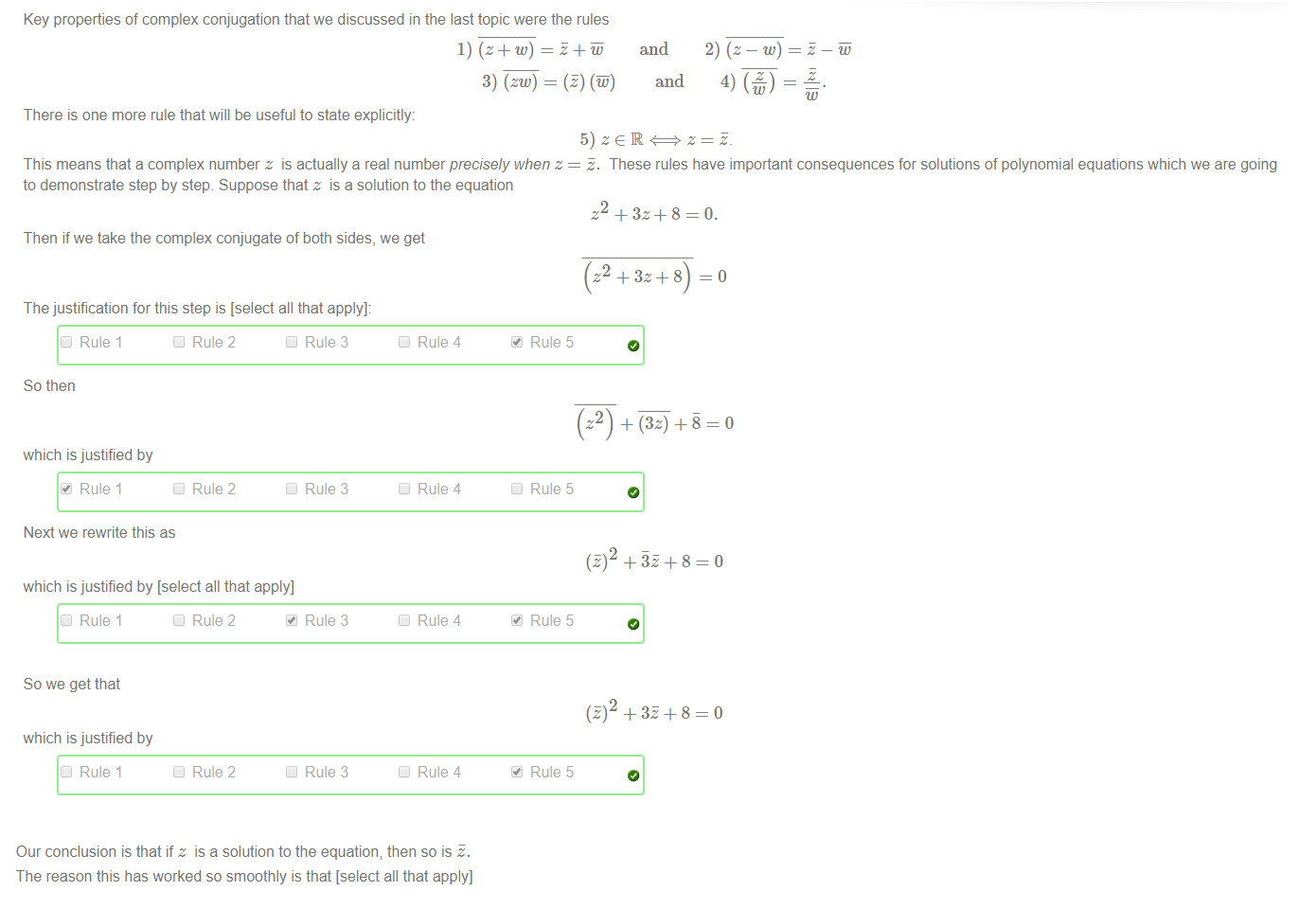
![Untitled picture.png Our conclusion is that if z is a solution to the equation; then so is S.
The reason this has worked so smoothly is that [select all that apply]
We know our rules for complex conjugation
this equation is a quadratic
this equation has small coefficients
this equation has real coefficients
we were lucky
Untitled picture.png Recall that if the monic quadratic equation z + sz+ r = O has roots (or zeroes) WI and w2, then we can write
By comparing the coefficients of z on both sides, it follows that
WI tL'2
— 12
so:
2
i) The sum of the roots of z
0 is 4
O while the product of the roots is
-12
z
ii) The monic quadratic equation, in z, with complex conjugate roots 5 + 6i and 5 — 6i must be 0
iii) The monic quadratic equation, in z, with complex conjugate roots —5 + 2i and —5 — 2i must be O
- laz + 61
+ laz + 29
Untitled picture.png Machine generated alternative text:
i) If a monic quadratic polynomial in z has real coefficients, and one root is —4 + i, then that polynomial is
ii) If a monic quadratic polynomial in z has real coefficients; and one root is 1 — 4i, then that polynomial is
Untitled picture.png Machine generated alternative text:
Let's review how to transform the general quadratic polynomial
ax2 + bx + c.
(2
First we factor out a
Now add and subtract
0 to get
inside the brackets to get
2
b
use the syntax p/ (3 * q)
Note: to enter a fraction like
There is a perfect square inside these brackets; namely the square of
x+ö/(2a)
2
a
a
For the last step, we multiply through by
0 to get
a
a
2a) ¯ 4a2
4a
b2 _4ac
4a
This is one of the key derivations in mathematics, going back to the Persian mathematician al Khwarizmi (780-800 AD) We have rewritten the quadratic polynomial az2 + bz+c in the form
a(x — + k where
h
In fact the point [h, k] is the vertex ofthe parabola y = az2 + bz+ c.
-b/(2a)
- 4acV(4a)
and
+ k where
and
As a consequence, the parabola with equation y = 3m + 10m + 7 can be rewritten asy = 3 @
h
-10/6
This tells us that the vertex occurs at the point [-10/6,-4/31
Note: to write the point [7, 4] in Maple we write [7 , 4]
Ink Drawings
Ink Drawings

Ink Drawings
Ink Drawings
Ink Drawings
Ink Drawings
Ink Drawings
Ink Drawings](Alg1131W6T4%20-%20Complex%20conjugate%20root%20theorem_files/image002.png)
![Untitled picture.png Machine generated alternative text:
Let's review how to transform the general quadratic polynomial
ax2 + bx + c.
(2
First we factor out a
Now add and subtract
0 to get
inside the brackets to get
2
b
use the syntax p/ (3 * q)
Note: to enter a fraction like
There is a perfect square inside these brackets; namely the square of
x+ö/(2a)
2
a
a
For the last step, we multiply through by
0 to get
a
a
2a) ¯ 4a2
4a
b2 _4ac
4a
This is one of the key derivations in mathematics, going back to the Persian mathematician al Khwarizmi (780-800 AD) We have rewritten the quadratic polynomial az2 + bz+c in the form
a(x — + k where
h
In fact the point [h, k] is the vertex ofthe parabola y = az2 + bz+ c.
-b/(2a)
- 4acV(4a)
and
+ k where
and
As a consequence, the parabola with equation y = 3m + 10m + 7 can be rewritten asy = 3 @
h
-10/6
This tells us that the vertex occurs at the point [-10/6,-4/31
Note: to write the point [7, 4] in Maple we write [7 , 4]
Untitled picture.png Machine generated alternative text:
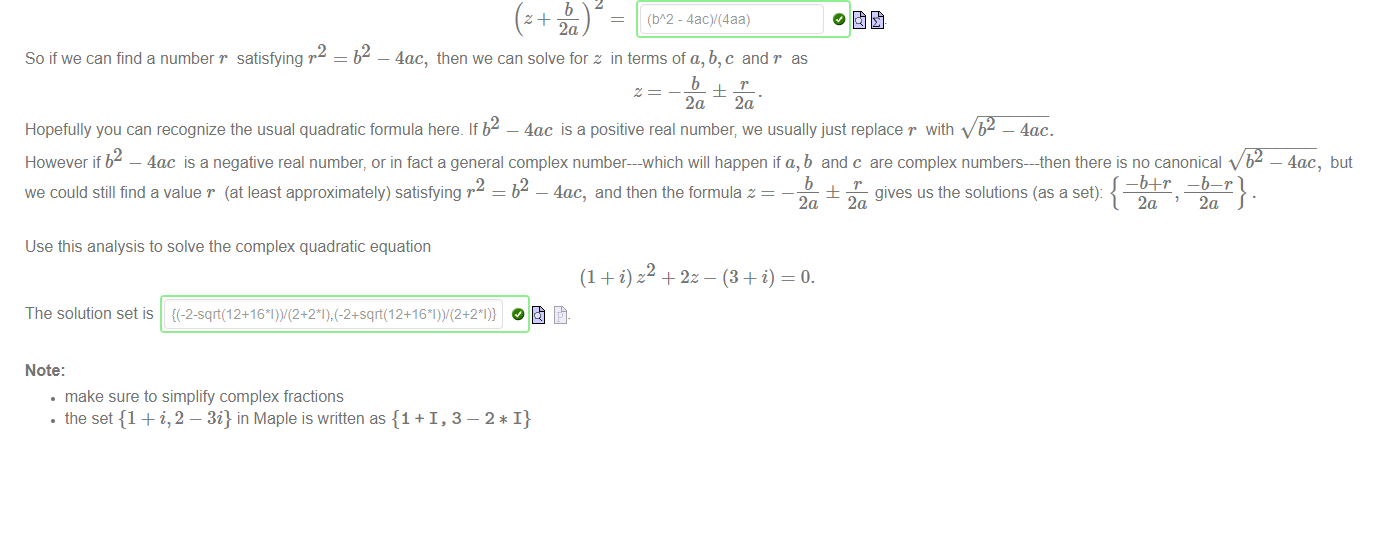
The usual quadratic formula follows from al Khwarizmi's identity: if
(b2 4ac)
az2 + c = z +
—o.
2a
then
4a
2 = b2 — 4ac, then we can solve for z in terms of a, b,c andr as
So if we can find a number r satisfying r
b
2a 2a
Hopefully you can recognize the usual quadratic formula here. If b2 — 4ac is a positive real number; we usually just replace r with •v/'j2¯7c.
However if b2 — 4ac is a negative real number, or in fact a general complex number—-which will happen if a, b and c are complex numbers—-then there is no canonical but
2 = b2 — 4ac, and then the formula z
we could still find a value r (at least approximately) satisfying r
Use this analysis to solve the complex quadratic equation
The solution set is
Note:
• make sure to simplify complex fractions
• the set {1 + i,2 — 3i} in Maple is written as {1 +1, 3
_b4_r —b—r
b
± — gives us the solutions (as a set):
2a 2a](Alg1131W6T4%20-%20Complex%20conjugate%20root%20theorem_files/image003.png)