Alg1131W6T3 - Complex conjugates

Saturday, 14 April 2018

12:14 PM

Machine generated alternative text:
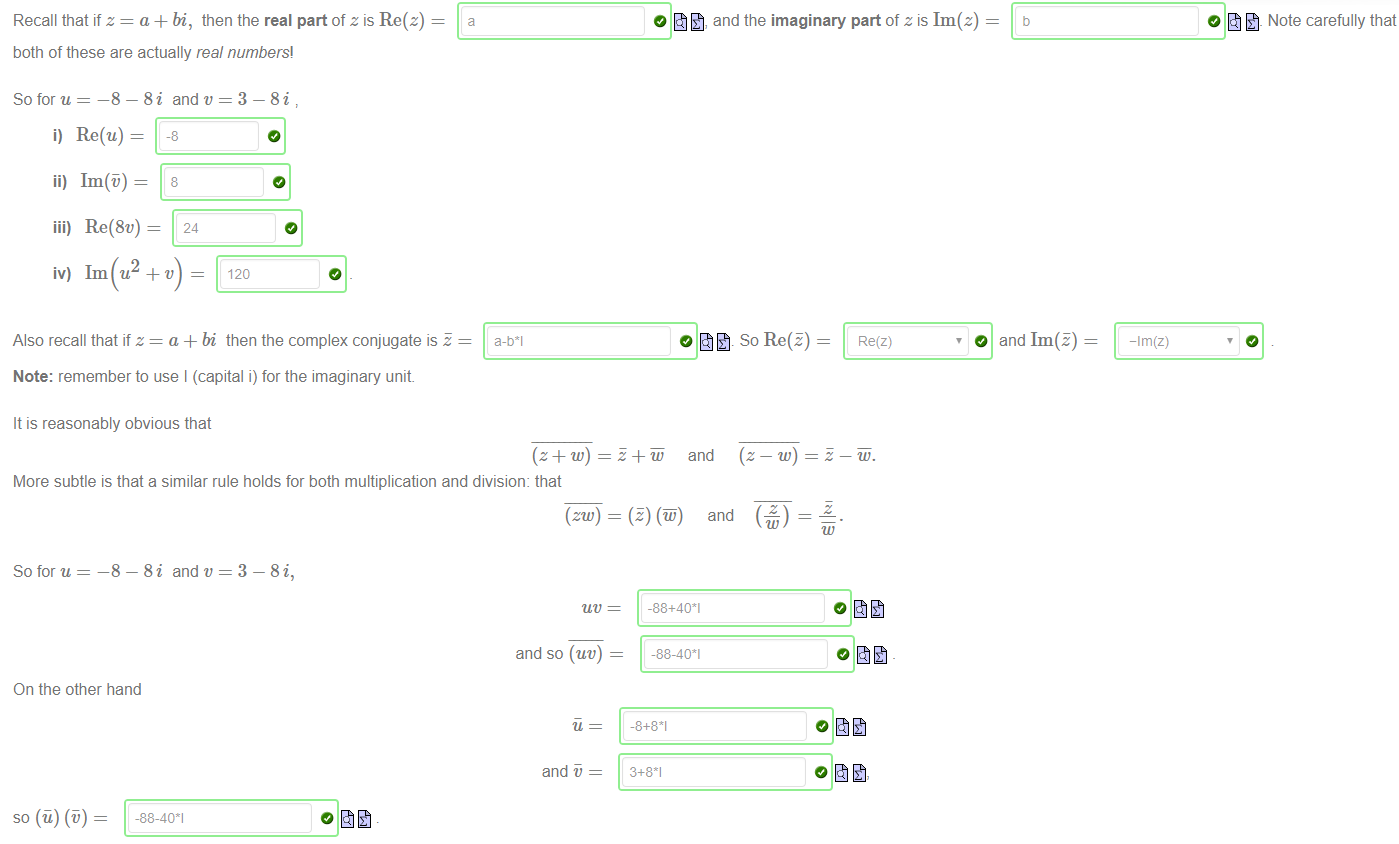
Recall that if z = a + bi, then the real part of z is Re(z) 
both of these are actually real numbers! 
—8 —8i and 
So for u 
i) Re(u) = 
—8 
and the imaginary part of z is Im(z) 
O Note carefully that 
ii) Im@) 
8 
iii) Re(8v) 
24 
iv) 1m u2 + v 
120 
Also recall that if z = a + bi then the complex conjugate is 
Note: remember to use I (capital i) for the imaginary unit 
It is reasonably obvious that 
a-bl 
Re(z) 
O and Im(E) 
-Im(z) 
More subtle is that a similar rule holds for both multiplication and division: that 
So for u 
On the other hand 
8i and v = 3 
8i, 
and so (uv) 
and 
+ and 
and ( z 
-88+401 
-88-401 
_8+8*1 
3+81 
so (u) @) 
-88-401


Machine generated alternative text:
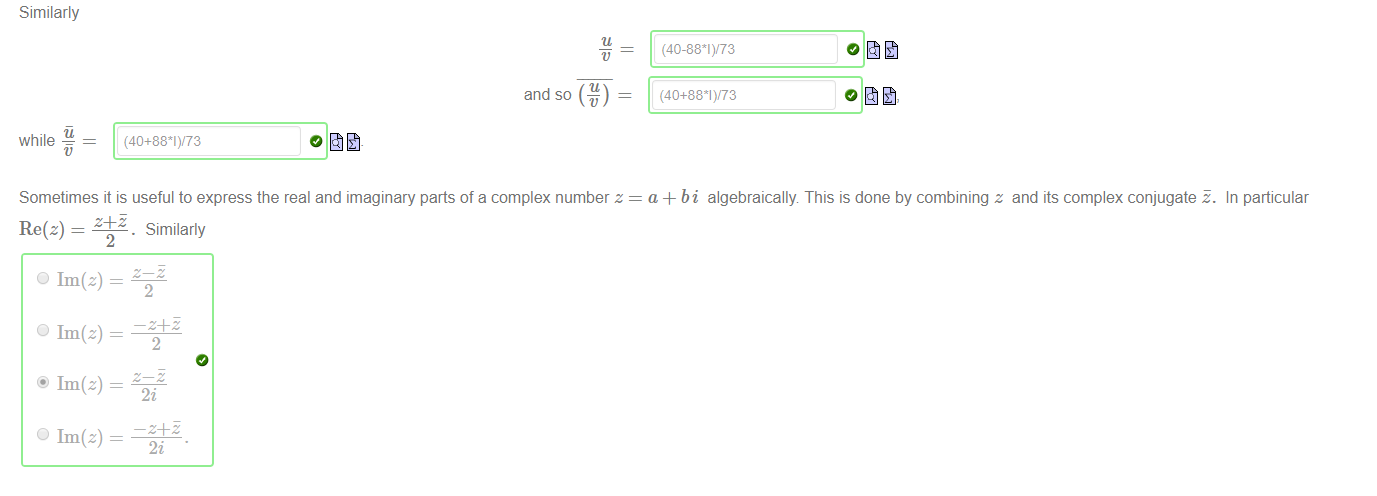
Similarly 
while 
and so 
(40+881)/73 
Sometimes it is useful to express the real and imaginary parts of a complex number z 
(40-881)/73 
(40+881)/73 
a + bi algebraically. This is done by combining z and its complex conjugate E. 
In particular 
Re(z) — 
2 
O Im(z) — 
O Im(z) — 
@ Im(z) — 
O Im(z) — 
. Similarly 
2 
2


Machine generated alternative text:
Given that 3z — 2w = —10 — 17i and — = —3 + 4i, we can find that z 
Note: remember to use I (capital i) as the complex unit in Maple notation.

So therefore,

And

Machine generated alternative text:
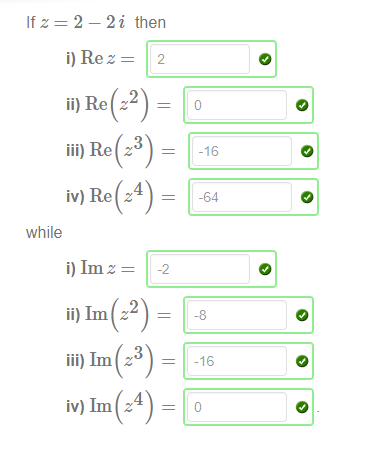
If —2i then 
i) Re z 
2 
ii)Re z2 
iii)Re z3 
iv)Re z4 
while 
i) 1m z 
-2 
ii)lm z2 
iii)lm z3 
iv)lm z4


Machine generated alternative text:
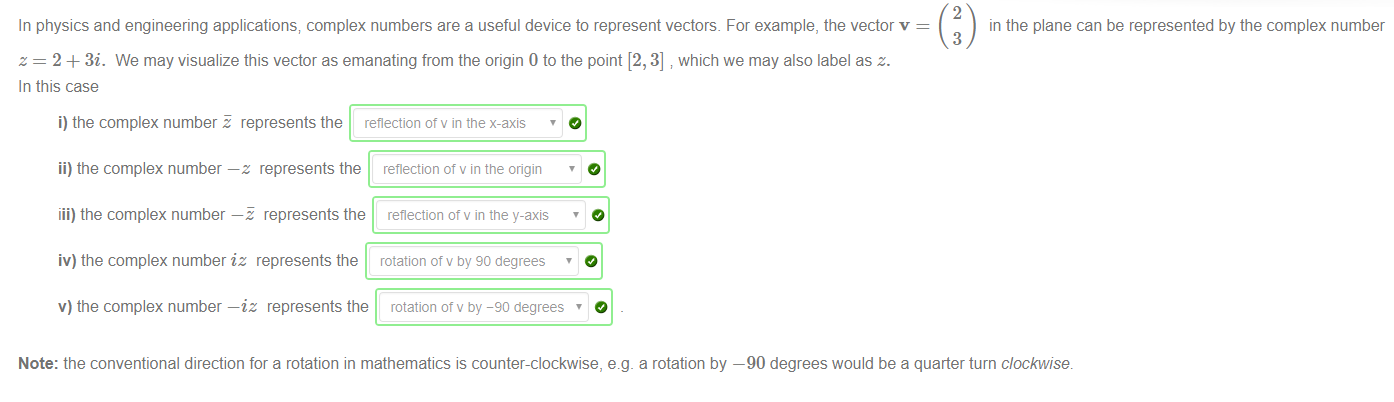
In physics and engineering applications; complex numbers are a useful device to represent vectors. For example, the vector v 
z = 2 + 3i. We may visualize this vector as emanating from the origin 0 to the point [2, 3] which we may also label as z. 
In this case 
i) the complex number E represents the reflection of v in tne x-axis 
2 
in the plane can be represented by the complex number 
3 
ii) the complex number —z represents the 
iii) the complex number —E represents the 
iv) the complex number iz represents the 
reflection of v in the origin 
reflection ot v in the y-axis 
rotation of v by 90 degrees 
v) the complex number —iz represents the rotation of v by -90 degrees 
Note: the conventional direction for a rotation in mathematics is counter-clockwise, e.g. a rotation by —90 degrees would be a quarter turn clockwise.


Created with Microsoft OneNote 2016.