Alg1131W6T1 - Complex arithmetic

Saturday, 14 April 2018

12:14 PM

Machine generated alternative text:
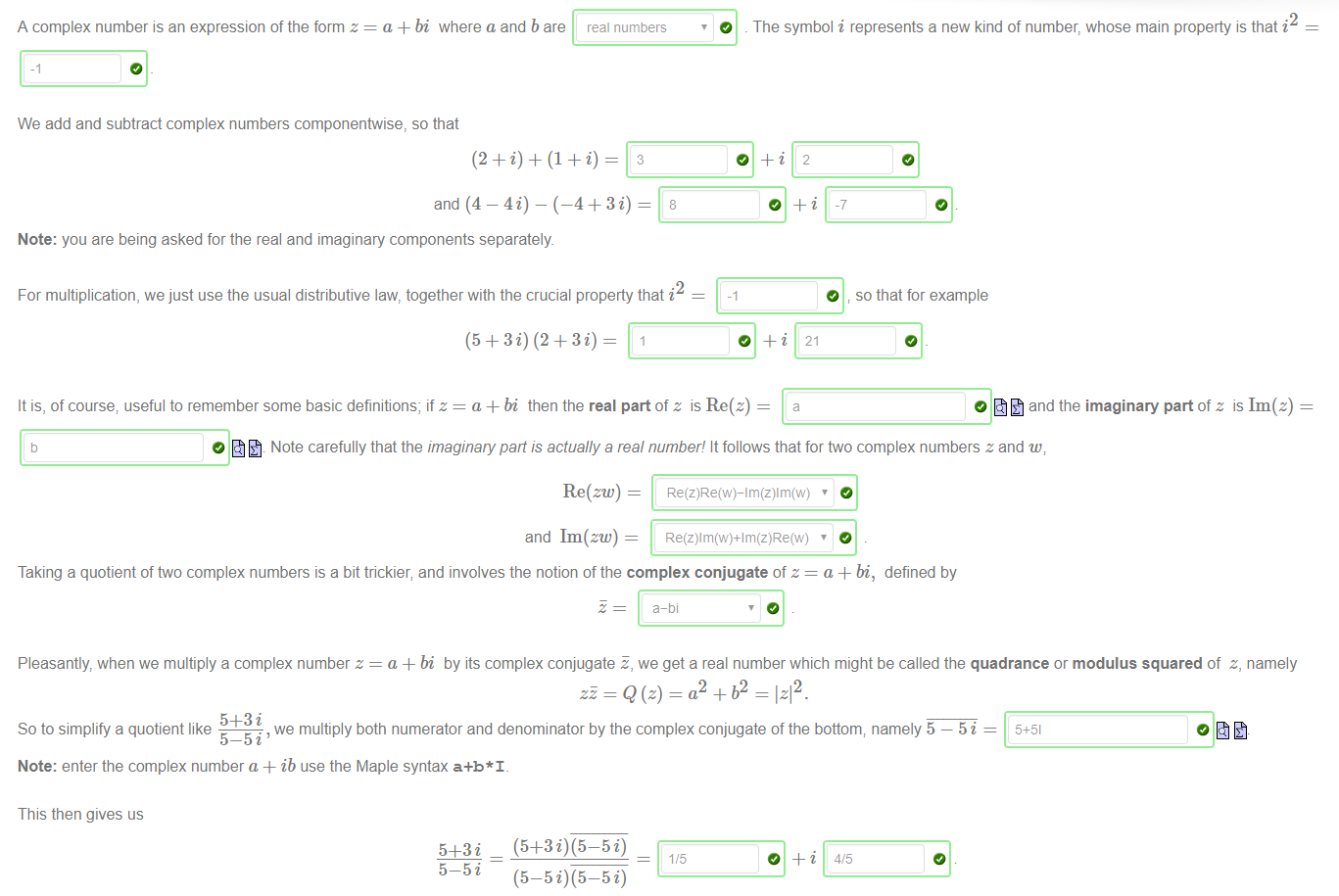
A complex number is an expression of the form z 
a + bi where a and b are 
real numbers 
3 
O 
We add and subtract complex numbers componentwise, so that 
and (4 — 4i) — (—4+ 3 i) 
Note: you are being asked for the real and imaginary components separately 
2 
For multiplication, we just use the usual distributive law, together with the crucial property that i 
2 
The symbol i represents a new kind of number, whose main property is that i 
O so that for example 
It is, of course; useful to remember some basic definitions; if z = a+bi then the real part of z is Re 
O and the imaginary part of z is Im(z) 
O Note carefully that the imaginary pan is actually a real number! It follows that for two complex numbers z and w; 
Re(zw) = 
and Im(zw) 
Taking a quotient of two complex numbers is a bit trickier, and involves the notion of the complex conjugate of z = a + bi, defined by 
a-bi 
Pleasantly, when we multiply a complex number z = a +bi by its complex conjugate E, we get a real number which might be called the quadrance or modulus squared of z, namely 
12 
we multiply both numerator and denominator by the complex conjugate of the bottom; namely 5 — 5 i — 
So to simplify a quotient like 
5—5i' 
Note: enter the complex number a + ib use the Maple syntax a+b*l_ 
This then gives us 
5—5 i 
4/5 
(5—5 i) (5—5 i)


Machine generated alternative text:
—9 
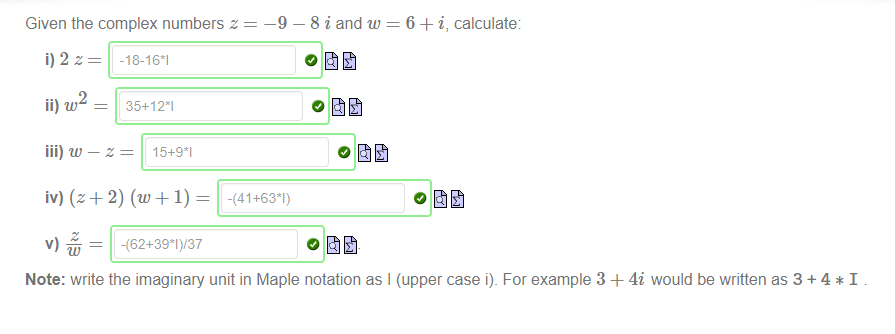
Given the complex numbers z 
8 i and w 
o fit 
6 + i, calculate. 
2 
ii) w 
35+121 
iii) w —z 
15+91 
-(62+391)/37 
-(41+631) 
Note: write the imaginary unit in Maple notation as I (upper case i). For example 3 + 4i would be written as 3 + 4 * I


Machine generated alternative text:
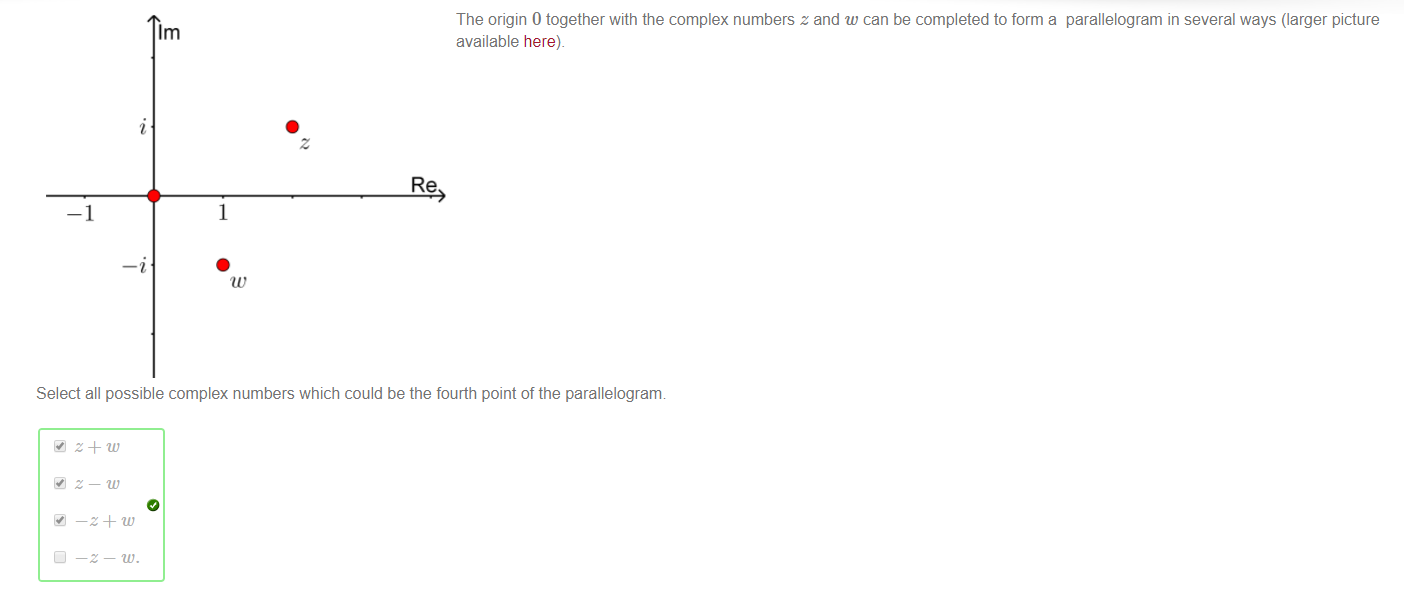
The origin 0 together with the complex numbers z and w can be completed to form a parallelogram in several ways (larger picture 
1m 
available here). 
Re 
Select all possible complex numbers which could be the fourth point of the parallelograrn


Machine generated alternative text:
2 
Marvin asserts that if both z and w are complex numbers on the unit circle x + y 
1, then their product zw will also be 
Which two of the following complex numbers lie on the unit circle? 
5 
12 
13 13 
Write the answer as a subset of {z, w, u, v, t}: 
Note: the subset {z, w, u} would be written in Maple notation as {z , u} 
1 
{z,v} 
4. 
u 
2i, t' 
—3 
5 
4. 
t 
5 
18 
17 
18 
The product of z and v above is y = zv 
So it appears that Marvin might be right 
Note: make sure to use I (capital i) as the imaginary unit 
O t] and we may check that 
In fact Marvin is right: this follows from the important fact that for any two complex numbers z and w v [select all that apply] 
Q(zw) =


Machine generated alternative text:
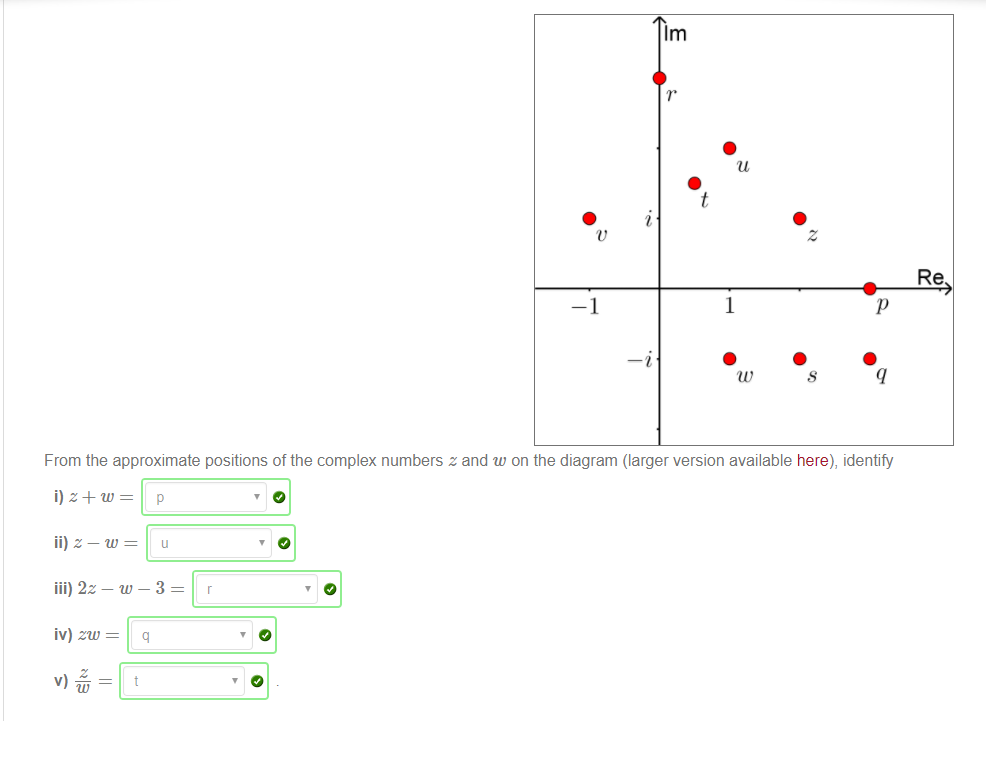
From the approximate positions of the complex numbers z and w on the diagram (larger version available here), identify 
ii) z — w 
iii) 2z — w 
-3 
iv) zw


Machine generated alternative text:
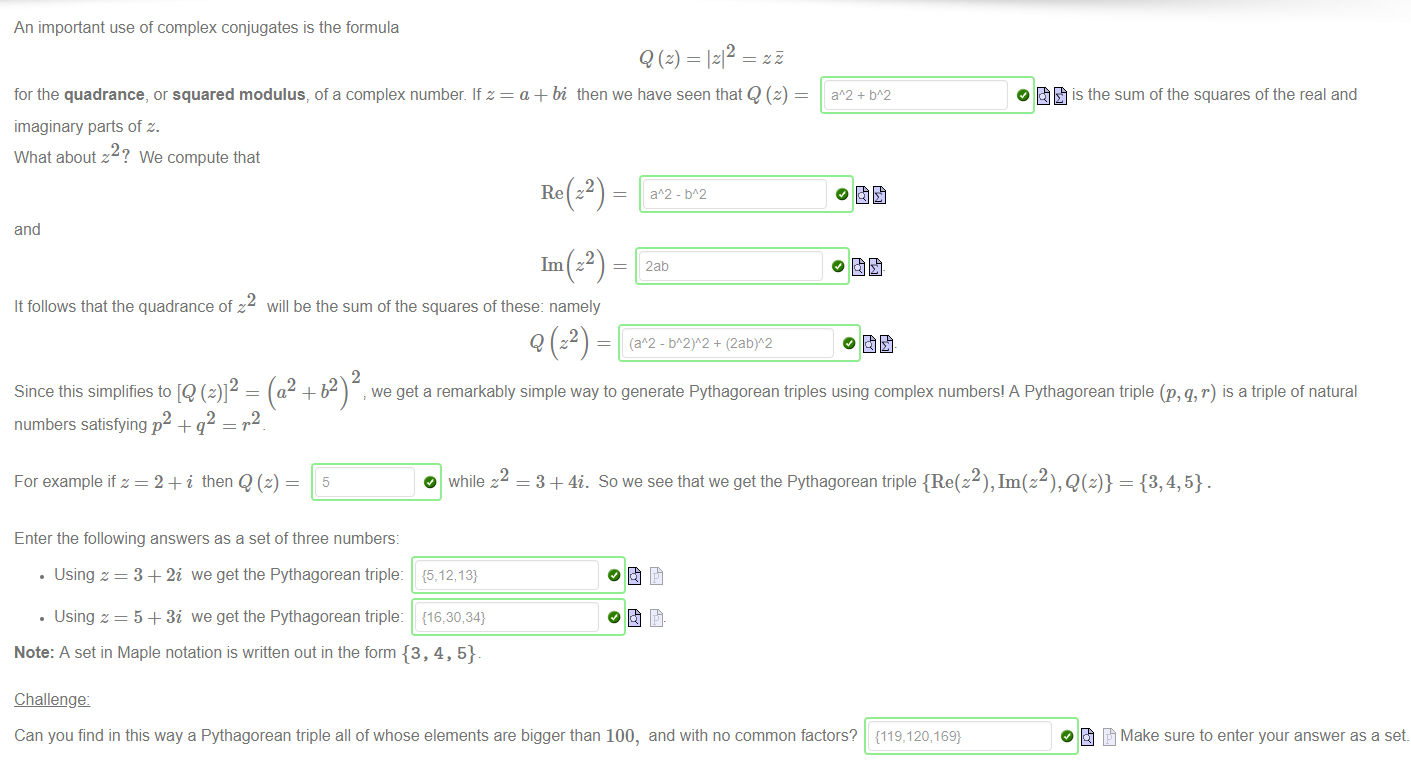
An important use of complex conjugates is the formula 
for the quadrance, or squared modulus, of a complex number. If z 
imaginary parts of z. 
What about z2? We compute that 
12 
a + bi then we have seen that Q (z) 
is the sum of the squares of the real and 
and 
It follows that the quadrance of z 
2 
Since this simplifies to [Q (z)] 
1m z2 
will be the sum of the squares of these: namely 
2aö 
o fit 
(a2 + b2) we get a remarkably simple way to generate Pythagorean triples using complex numbers! A Pythagorean triple (p, q, r) is a triple of natural 
2 
2 
numbers satisfying p + q 
For example if z = 2 + i then Q (z) 
2 
O while z 
— 3 + 4i. Sowe see that we get the Pythagorean triple {Re(z2), Im(z2), Q(z)} = {3, 4, 5} . 
Enter the following answers as a set of three numbers: 
• Using z = 3 + 2i we get the Pythagorean triple: 
• Using z = 5 + 3i we get the Pythagorean triple: 
Note: A set in Maple notation is written out in the form {3 , 4, 5}. 
Challengæ 
Can you find in this way a Pythagorean triple all of whose elements are bigger than 100, and with no common factors? {119,120,169} 
O Make sure to enter your answer as a set.


Created with Microsoft OneNote 2016.