Alg1131W4T3 - Cross products

Friday, 23 March 2018

1:29 PM

Machine generated alternative text:
The definition in terms of coordinates is 
al bl 
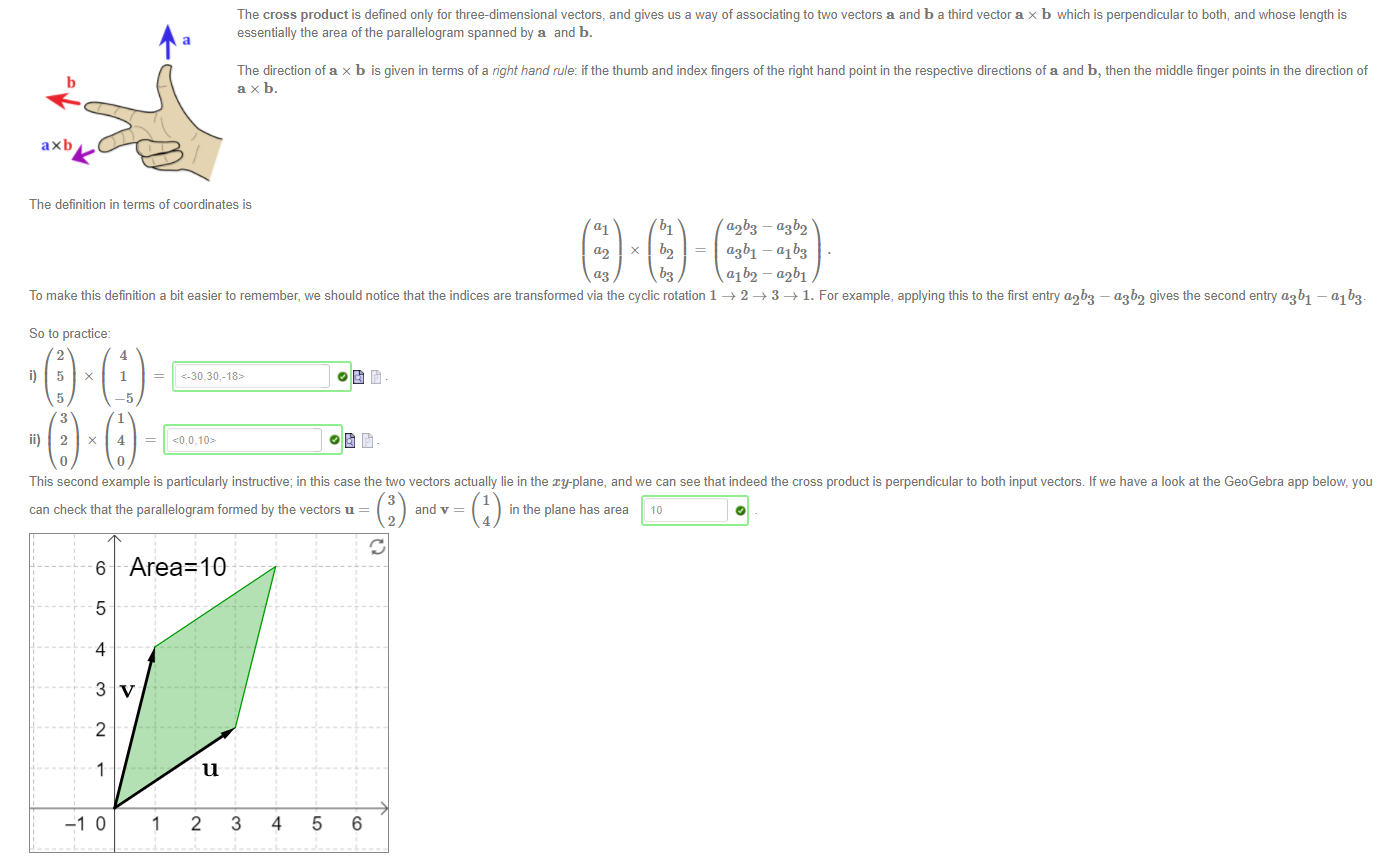
The cross product is defined only for three-dimensional vectors, and gives us a way of associating to two vectors a and b a third vector a x b which is perpendicularto both, and whose length is 
essentially the area of the parallelogram spanned by a and b. 
The direction of a x b is given in terms of a right hand rule: if the thumb and index fingers of the right hand point in the respective directions of a and b, then the middle finger points in the direction of 
b 
ax b. 
ax b 
dib2 - "2b1 
a2b3 
— a3b2 
To make this definition a bit easier to remember, we should notice that the indices are transformed via the cyclic rotation 1 —+ 2 —+ 3 —+ 1. For example, applying this to the first entry a2b3 — a3b2 gives the second entry a3b1 
So to practice: 
— 01 b3 
2 
5 
3 
4 
ii) 2 x 4 
0 
This second example is particularly instructive; in this case the two vectors actually lie in the xy-plane, and we can see that indeed the cross product is perpendicular to both input vectors If we have a look at the GeoGebra app below, you 
can check that the parallelogram formed by the vectors u = 
6 
5 
4 
3 
2 
u 
3 
and v = 
2 
in the plane has area 10 
4 
1 
2 
3 
4 
5 
6


Machine generated alternative text:
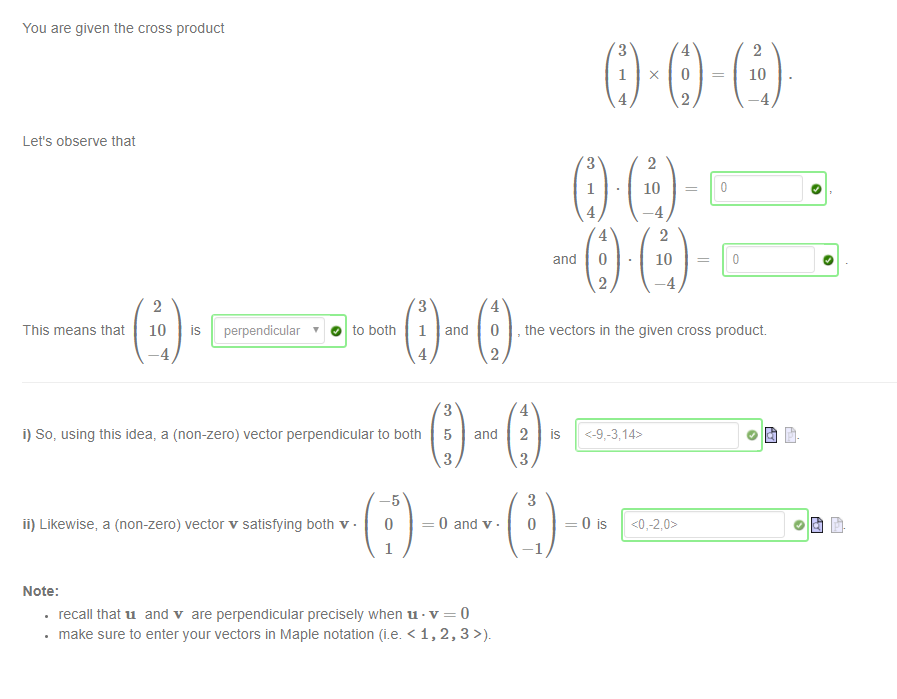
You are given the cross product 
Let's observe that 
and 
1 
0 
x 
10 
10 
o 
10 
This means that 
10 
is 
perpendicular 
' O to both 
1 
and 
5 
O 
and 
, the vectors in the given cross product. 
i) So, using this idea, a (non-zero) vector perpendicular to both 
ii) Likewise, a (non-zero) vector v satisfying both v • 
Note: 
2 
is 
0 and v. 
. recall that u and v are perpendicular precisely when u •v = 0 
. make sure to enter your vectors in Maple notation (i.e. < 1, 2, 3


Machine generated alternative text:
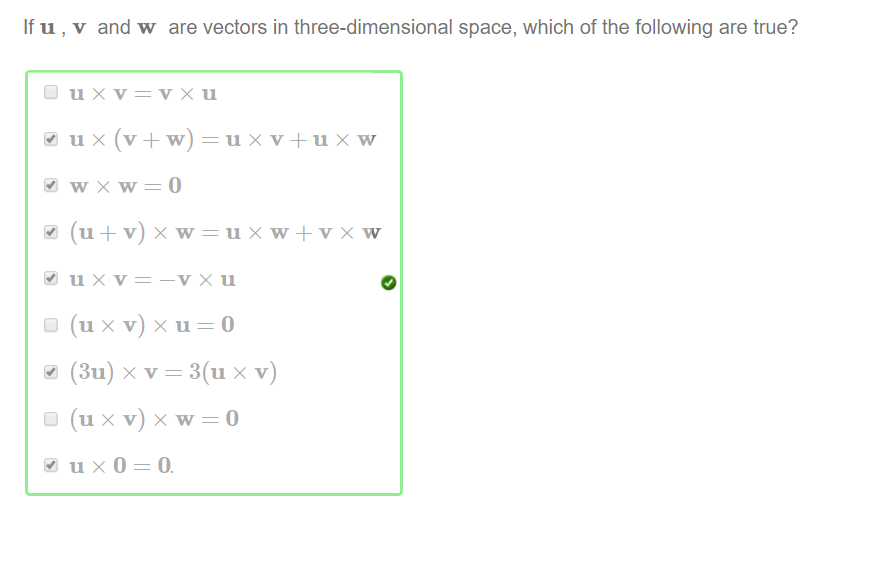
If u , v and w are vectors in three-dimensional space, which of the following are true? 
(3u) x v 3(u x v)


Machine generated alternative text:
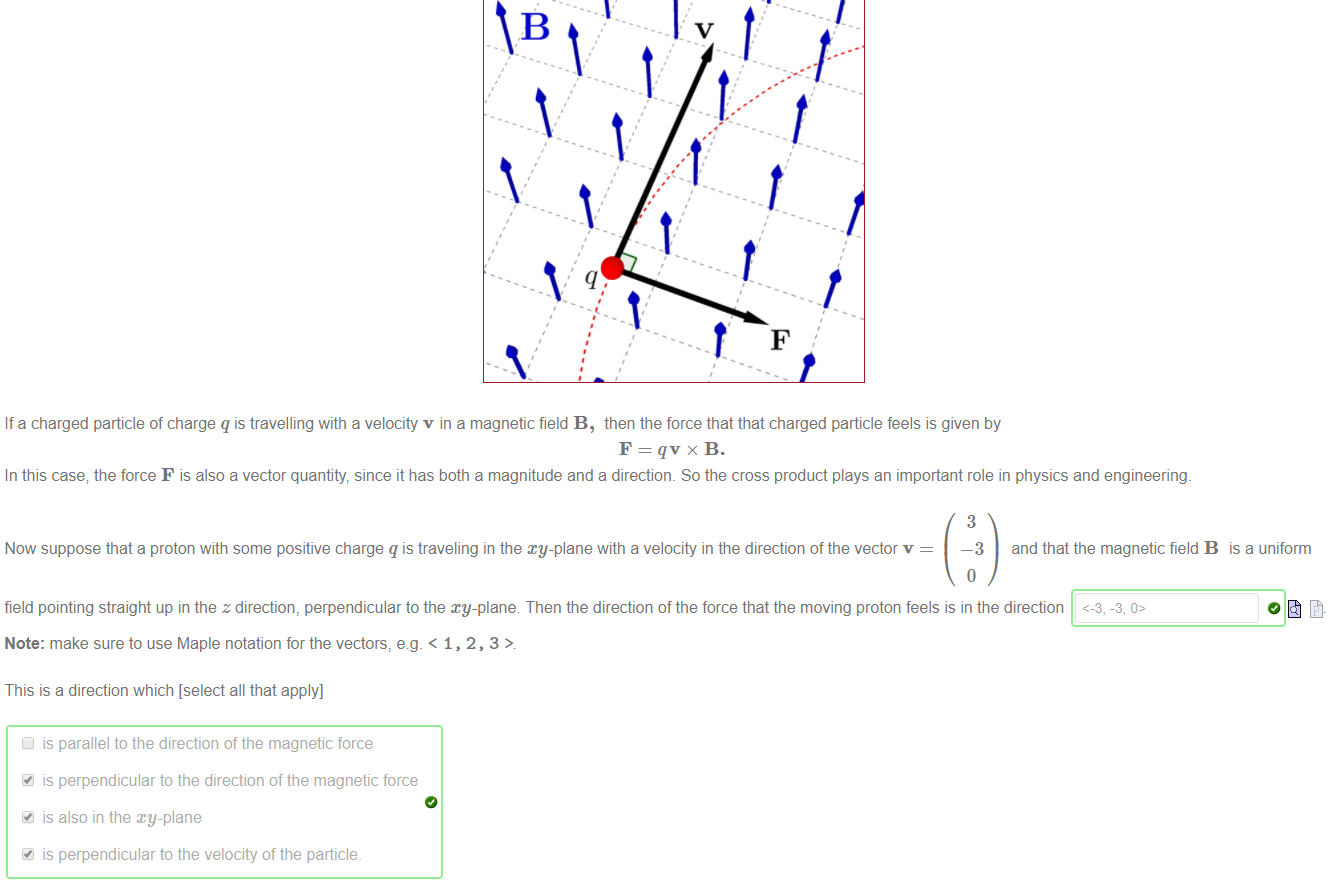
If a charged particle of charge q is travelling with a velocity v in a magnetic field B, then the force that that charged particle feels is given by 
In this case; the force F is also a vector quantity since it has both a magnitude and a direction. So the cross product plays an important role in physics and engineering. 
Now suppose that a proton with some positive charge q is traveling in the my-plane with a velocity in the direction of the vector v 
3 
—3 and that the magnetic field B is a uniform 
field pointing straight up in the z direction, perpendicular to the xy-plane Then the direction of the force that the moving proton feels is in the direction <-3, -3, 
Note: make sure to use Maple notation for the vectors, e.g. < 1, 2, 3 
This is a direction which [select all that apply] 
is parallel to the direction of the magnetic force 
is perpendicular to the direction of the magnetic force 
is also in the my-plane 
is perpendicular to the velocity of the particle.


Machine generated alternative text:
Challenge: (worth 2 marks) 
If we observed this particle for a while, we would see that its trajectory was a circle 
O in the my-plane.


Machine generated alternative text:
Consider the points A 
Find the following cross products: 
. öBxö*A 
• OC x OA 
• OA x OC 
. OD x OC 
. 0B x OC 
, 0] and E = [O, —1, 0] lying on the unit circle in the xy-plane_ Furthermore, let u 
and z 
Note that the magnitude 10B x OAI is given by the area of the parallelogram spanned by 0B and OA


Machine generated alternative text:
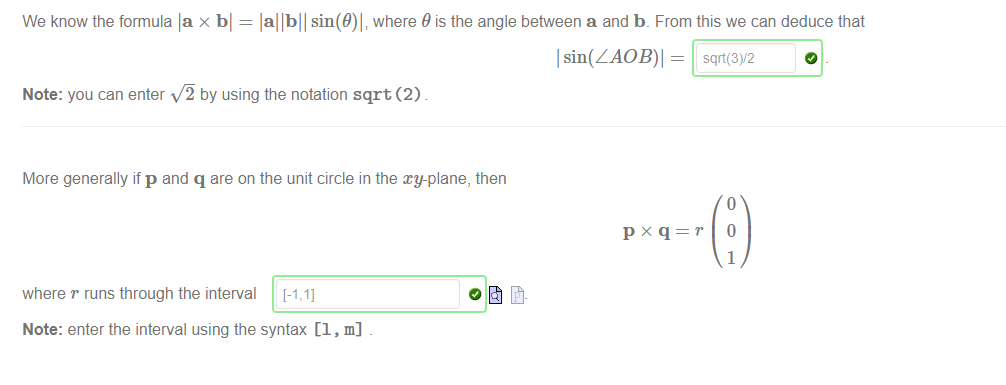
We know the formula la x bl = lallbll where 9 is the angle between a and b. From this we can deduce that 
Note: you can enter V'9 by using the notation sqrt (2) 
More generally if p and q are on the unit circle in the xy-plane, then 
1 
where r runs through the interval [-1,1] 
Note: enter the interval using the syntax [1 , m]


Created with Microsoft OneNote 2016.