Alg1131W4T2 - Projections

Friday, 23 March 2018

1:29 PM

Untitled picture.png Machine generated alternative text:
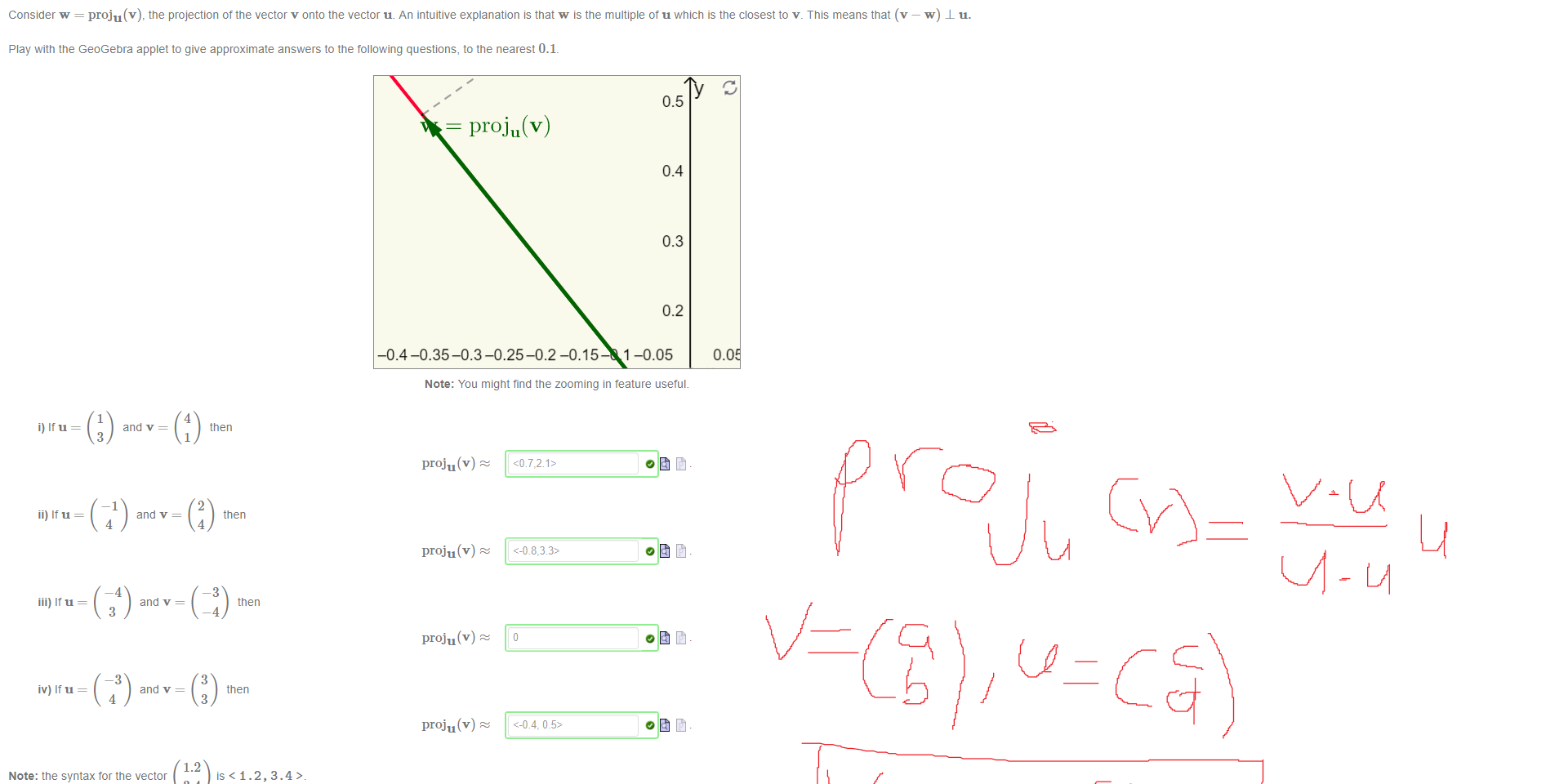
Consider w = proju(v), the projection of the vector v onto the vector u. An intuitive explanation is that w is the multiple of u which is the closest to v _ This means that (v 
Play witn the GeoGebra applet to give approximate answers to the following questions, to the nearest 0.1. 
0.0 
i) It u 
ii) It u 
iii) It u 
iv) It u 
and v = 
3 
and v = 
4 
-4 
and v = 
3 
—3 
and v = 
4 
1.2 
4 
then 
1 
2 
then 
4 
-3 
then 
—4 
3 
then 
3 
0.5 
proju(v) 
0.4 
0.3 
0.2 
-0.4-0.35-0.3-0.25-0.2 -0.15 1-0.05 
Note: You might find the zooming in teature useful. 
proju(v) z 
proju(v) z 
proju(v) z 
proju(v) z 
Note: the syntax for the vector 
3.4 
is < 1.2, 3.4> 
Ink Drawings
Ink Drawings
Ink Drawings
Ink Drawings

Ink Drawings
Ink Drawings
Ink Drawings
Ink Drawings


Untitled picture.png Machine generated alternative text:
Consider w = proju(v), the projection of the vector v onto the vector u. An intuitive explanation is that w is the multiple of u which is the closest to v _ This means that (v 
Play witn the GeoGebra applet to give approximate answers to the following questions, to the nearest 0.1. 
0.0 
i) It u 
ii) It u 
iii) It u 
iv) It u 
and v = 
3 
and v = 
4 
-4 
and v = 
3 
—3 
and v = 
4 
1.2 
4 
then 
1 
2 
then 
4 
-3 
then 
—4 
3 
then 
3 
0.5 
proju(v) 
0.4 
0.3 
0.2 
-0.4-0.35-0.3-0.25-0.2 -0.15 1-0.05 
Note: You might find the zooming in teature useful. 
proju(v) z 
proju(v) z 
proju(v) z 
proju(v) z 
Note: the syntax for the vector 
3.4 
is < 1.2, 3.4> 

Untitled picture.png Machine generated alternative text:
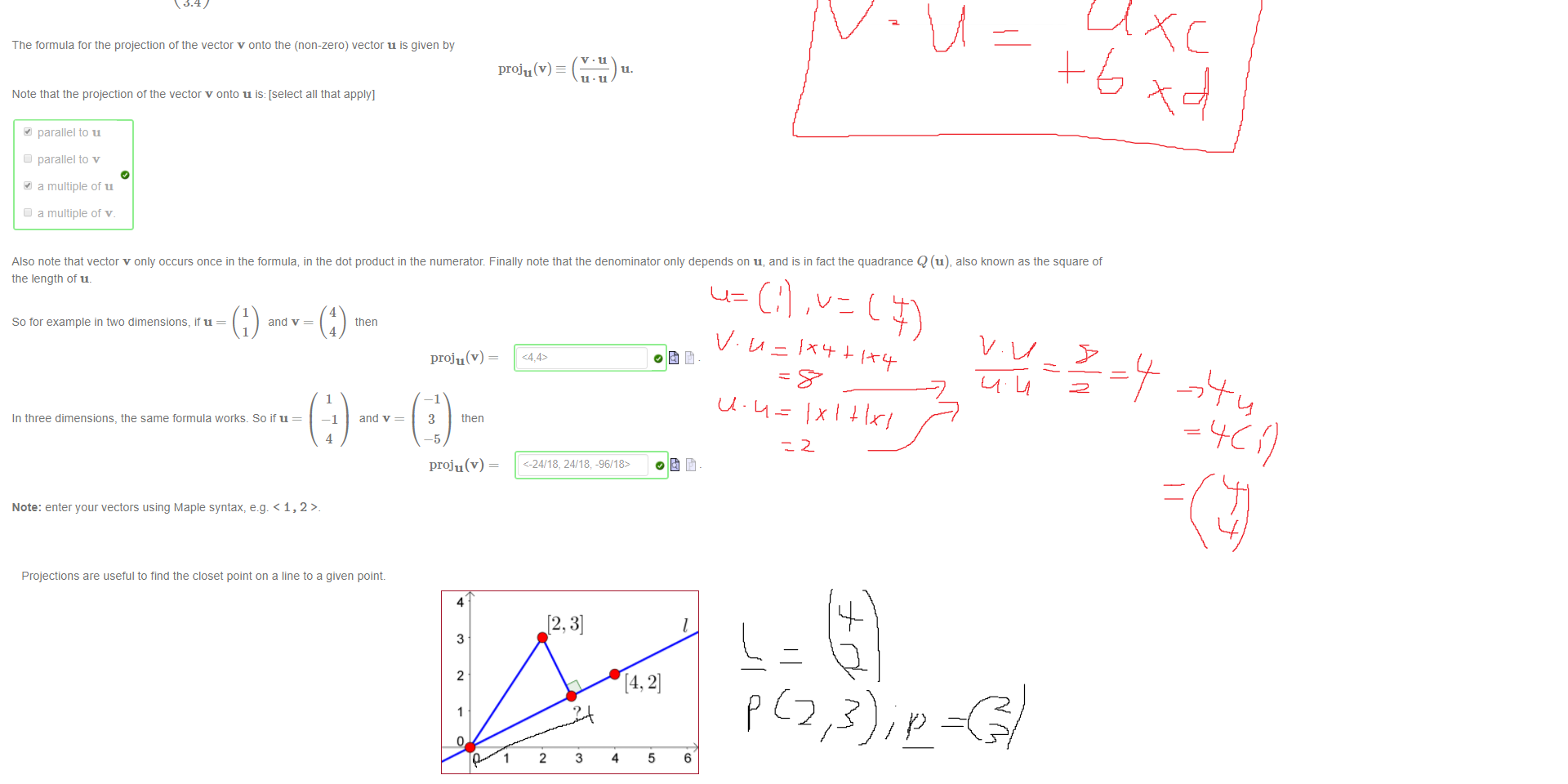
The formula for the projection of the vector v onto the (non-zero) vector u is given by 
proj u (v) 
Note that the projection of the vector v onto u is: [select all that apply] 
parallel to u 
C' parallel to v 
a multiple of u 
C' a multiple of v. 
Also note that vector v only occurs once in the formula, in the dot product in the numerator. Finally note that the denominator only depends on u, and is in tact the quadrance Q (u), also known as the square of 
the length ot u. 
So tor example in two dimensions, it u = 
and v = 
4 
4 
1 
4 
then 
and v = 
proju (v) 
In three dimensions, the same formula works. So it u = 
Note: enter your vectors using Maple syntax, e.g. < 1, 2 
—1 
3 
—5 
then 
proju(v) 
<-2418. 24/18, -96/18> 

Untitled picture.png Machine generated alternative text:
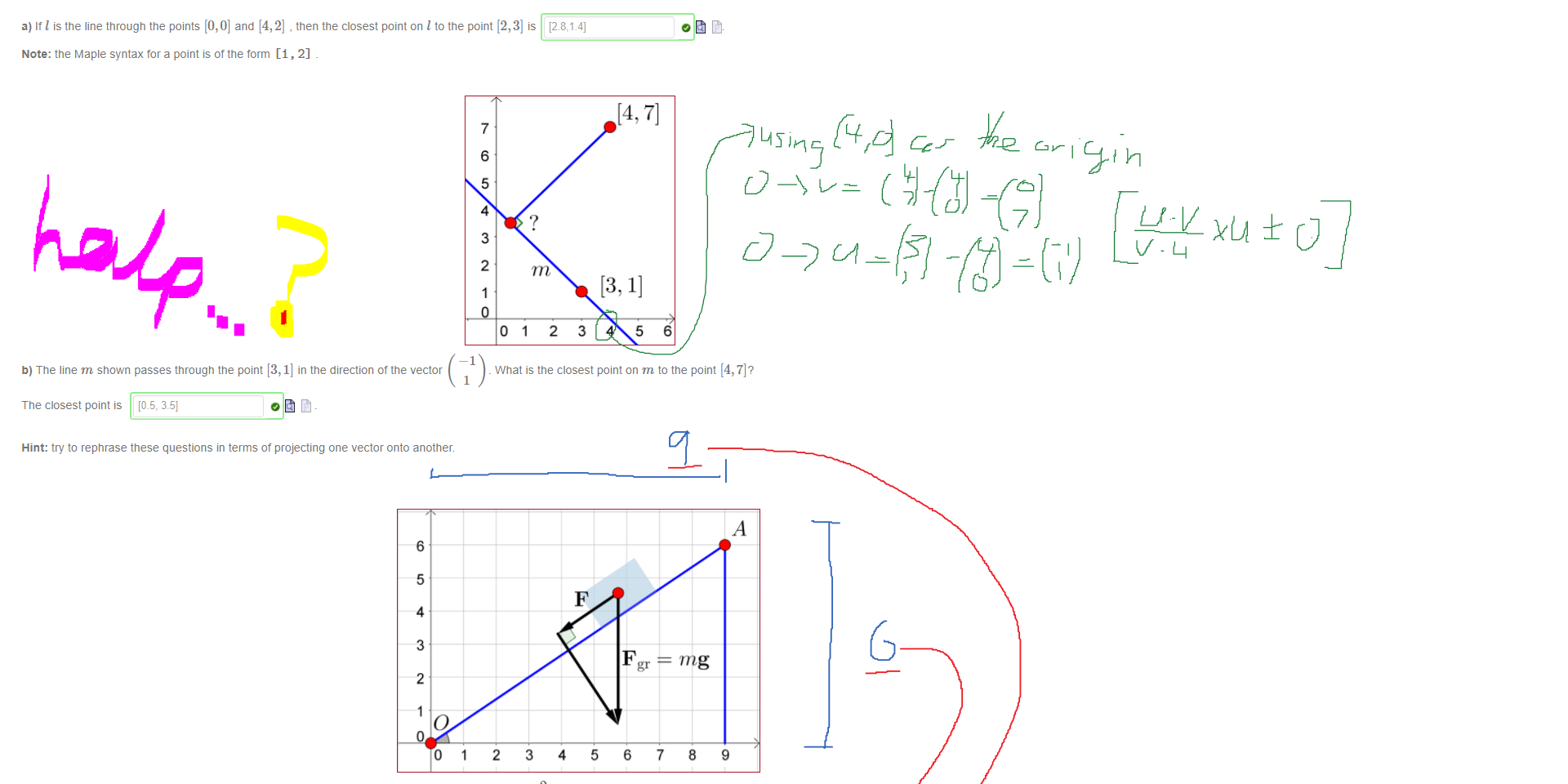
Projections are useful to find the closet point on a line to a given point 
4 
3 
2 
a) It I is the line tnrougn the points [0,0] and [4, 2] , then the closest point on I to the point [2, 3] is 
Note: the Maple syntax tor a point is of the form [1, 2] 
7 
6 
5 
4 
3 
2 
1 
2 
3 
4 
5 
6 
0123456 
b) The line m shown passes tnrougn the point [3, 1] in the direction of the vector 
_ What is the closest point on m to the point [4, 7]? 
1 
The closest point is [08, 351 
Hint: try to rephrase these questions in terms ot projecting one vector onto another. 
Ink Drawings
Ink Drawings
Ink Drawings
Ink Drawings
Ink Drawings
Ink Drawings
Ink Drawings


Ink Drawings
Ink Drawings
Ink Drawings
Ink Drawings
Ink Drawings


Ink Drawings
Ink Drawings
Ink Drawings


Untitled picture.png Machine generated alternative text:
Projections are useful to find the closet point on a line to a given point 
4 
3 
2 
a) It I is the line tnrougn the points [0,0] and [4, 2] , then the closest point on I to the point [2, 3] is 
Note: the Maple syntax tor a point is of the form [1, 2] 
7 
6 
5 
4 
3 
2 
1 
2 
3 
4 
5 
6 
0123456 
b) The line m shown passes tnrougn the point [3, 1] in the direction of the vector 
_ What is the closest point on m to the point [4, 7]? 
1 
The closest point is [08, 351 
Hint: try to rephrase these questions in terms ot projecting one vector onto another. 

Untitled picture.png Machine generated alternative text:
6 
5 
4 
3 
2 
2 
2 
Consider a block of ice of mass m = 0.5 kg sitting on an inclined plane with a slope of 
The force due to gravity (measured in Newtons) is given by the well known formula 
6 
7 
mg 
8 
-9.8 
9 
m/sec2 
F gr = mg 
where the vector g is acceleration due to gravity (measured in meters per second per second), namely g 
Let's use our projection formula to determine F, the force acting parallel to the plane. 
i) From the picture we see AO = 
Note: make sure to enter your vectors in Maple notation (e.g. < 1, 2 
ii) The force parallel to the plane is (to the nearest 0.1) 
F = (Fgr) 
So we see that the magnitude of the force F is (to the nearest 0.1) 
O Newtons (kg m/sec2)_ 
It is the force F which determines the actual motion of the block down the inclined plane. 
Ink Drawings
Ink Drawings
Ink Drawings
Ink Drawings
Ink Drawings
Ink Drawings
Ink Drawings
Ink Drawings
Ink Drawings
Ink Drawings
Ink Drawings
Ink Drawings
Ink Drawings
Ink Drawings
Ink Drawings
Ink Drawings
Ink Drawings
Ink Drawings
Ink Drawings
Ink Drawings
Ink Drawings


Ink Drawings
Ink Drawings
Ink Drawings
Ink Drawings


Ink Drawings
Ink Drawings
Ink Drawings
Ink Drawings
Untitled picture.png Machine generated alternative text:
6 
5 
4 
3 
2 
2 
2 
Consider a block of ice of mass m = 0.5 kg sitting on an inclined plane with a slope of 
The force due to gravity (measured in Newtons) is given by the well known formula 
6 
7 
mg 
8 
-9.8 
9 
m/sec2 
F gr = mg 
where the vector g is acceleration due to gravity (measured in meters per second per second), namely g 
Let's use our projection formula to determine F, the force acting parallel to the plane. 
i) From the picture we see AO = 
Note: make sure to enter your vectors in Maple notation (e.g. < 1, 2 
ii) The force parallel to the plane is (to the nearest 0.1) 
F = (Fgr) 
So we see that the magnitude of the force F is (to the nearest 0.1) 
O Newtons (kg m/sec2)_ 
It is the force F which determines the actual motion of the block down the inclined plane. 

Untitled picture.png Machine generated alternative text:
You may find this question challenging. 
Given the three points A = [6, —2], B = [—3, 0] and C = [3, —5], consider the triangle A ABC, and let M be the point on AC so that BM is the altitude through B perpendicular to 
AC. Likewise let N be the point on AB so that CN is the altitude through C perpendicular to AB 
(diagram not to scale) 
i) Find M 
ii) Find N 
1 
Note: in Maple notation the point [ 
Challenge (worth 2 points): 
M 
N 
3 
—l is entered as [1/2, 3/4] 
[25, -55] 
[321/85: -128/85] 
iii) It is known that the three altitudes of any triangle meet at a common point called the orthocenter For A ABC, this orthocenter is 
H = [31/11,-64/111 
Ink Drawings
Ink Drawings
Ink Drawings
Ink Drawings
Ink Drawings


Ink Drawings
Ink Drawings
Ink Drawings
Ink Drawings


Ink Drawings
Ink Drawings
Ink Drawings
Ink Drawings


Ink Drawings

Ink Drawings
Ink Drawings
Ink Drawings
Untitled picture.png Machine generated alternative text:
There is 4 steps to calculate the orthocenter of any triangle as described below. 
Step 1: Calculate the slope of the sides of the triangle using following formula: 
Y2—YI 
Slope of a line — 
X2—X1 
Step 2: Calculate the perpendicular slope of the sides using following formula: 
Perpendicular slope of the line 
Slope of a line 
Step 3: Calculate the equation for any two altitudes with their respective coordinates using following formula: 
Step 4: Solving altitude equations (any two altitude equation of Step 3) 
Untitled picture.png Machine generated alternative text:
You may find this question challenging. 
Given the three points A = [6, —2], B = [—3, 0] and C = [3, —5], consider the triangle A ABC, and let M be the point on AC so that BM is the altitude through B perpendicular to 
AC. Likewise let N be the point on AB so that CN is the altitude through C perpendicular to AB 
(diagram not to scale) 
i) Find M 
ii) Find N 
1 
Note: in Maple notation the point [ 
Challenge (worth 2 points): 
M 
N 
3 
—l is entered as [1/2, 3/4] 
[25, -55] 
[321/85: -128/85] 
iii) It is known that the three altitudes of any triangle meet at a common point called the orthocenter For A ABC, this orthocenter is 
H = [31/11,-64/111 
http://eguruchela.com/math/Calculator/triangle-orthocenter-calculator

Ink Drawings
Ink Drawings


Created with Microsoft OneNote 2016.