Alg1131W4T1 - Lines and planes

Friday, 23 March 2018

1:29 PM

Untitled picture.png Machine generated alternative text:
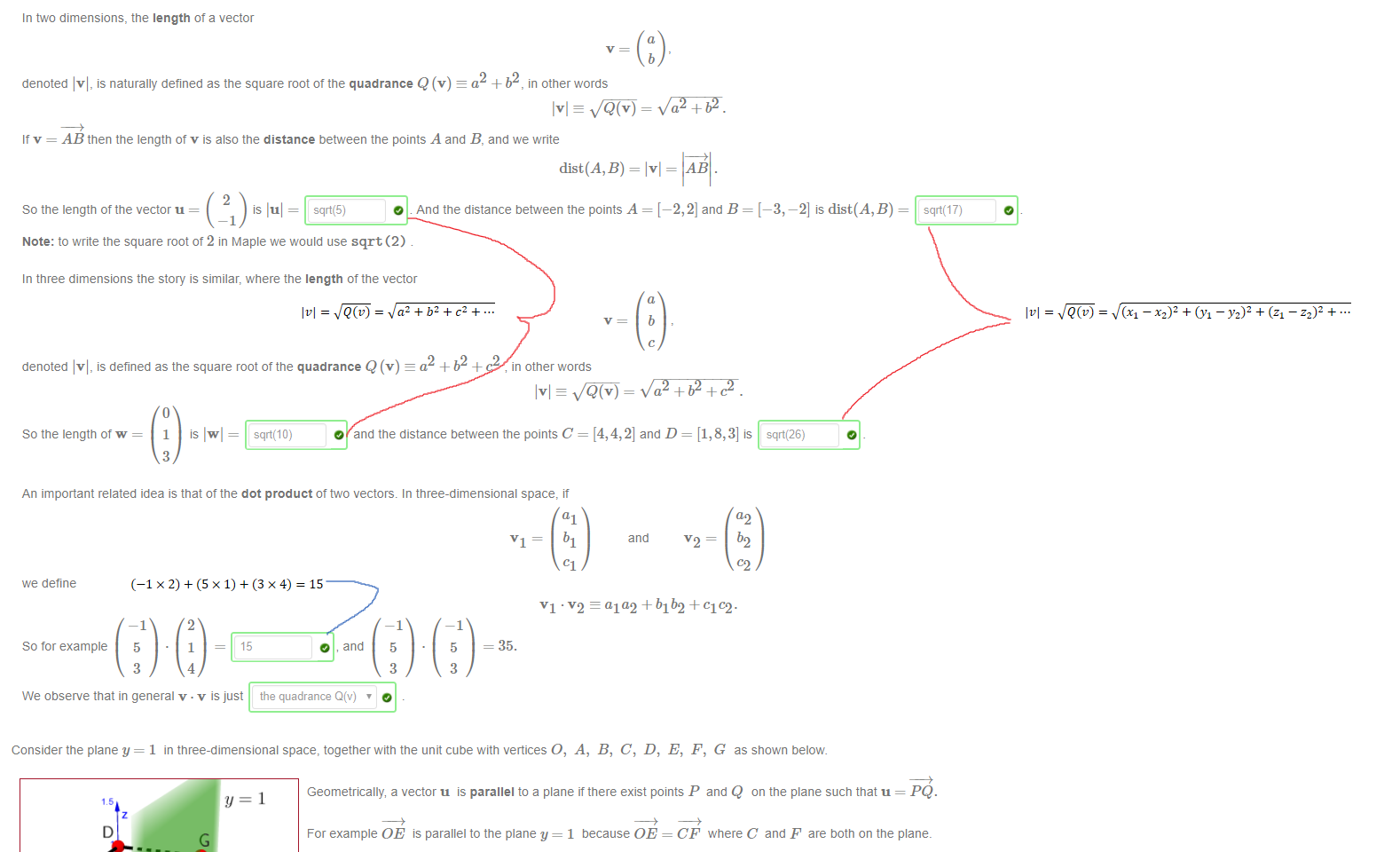
In two dimensions, the length ot a vector 
denoted Ivl, is naturally defined as the square root ot the quadrance Q (v) a2 + b2, in other words 
It v = AB then the length of v is also the distance between the points A and B, and we write 
b 
2 
So the length of the vector u = 
—1 
Ivl= AB . 
O . And the distance between the points A = [—2, 2] and B = [—3, —2] is dist(A,B) 
Note: to write the square root of 2 in Maple we would use sqrt (2) 
In three dimensions the story is similar, where the length of the vector 
b 
denoted Ivl, is defined as the square root ot the quadrance Q (v) a2 + b2 + c2 in other words 
So the length of w 
1 
3 
is 
sqrt(1 0) 
O and the distance between the points C = and D = [1, 8,3] is 
sqrt(26) 
An important related idea is that ot the dot product ot two vectors. In three-dimensional space, it 
a2 
bl 
we define 
So for example 
and 
- ald2+b1b2+c102. 
—1 
5 
3 
2 
1 
4 
15 
O , and 
—1 
5 
3 
—1 
5 
3 
VI 
= 35. 
We observe that in general v . v is just the quadrance Q(v) 

Untitled picture.png Machine generated alternative text:
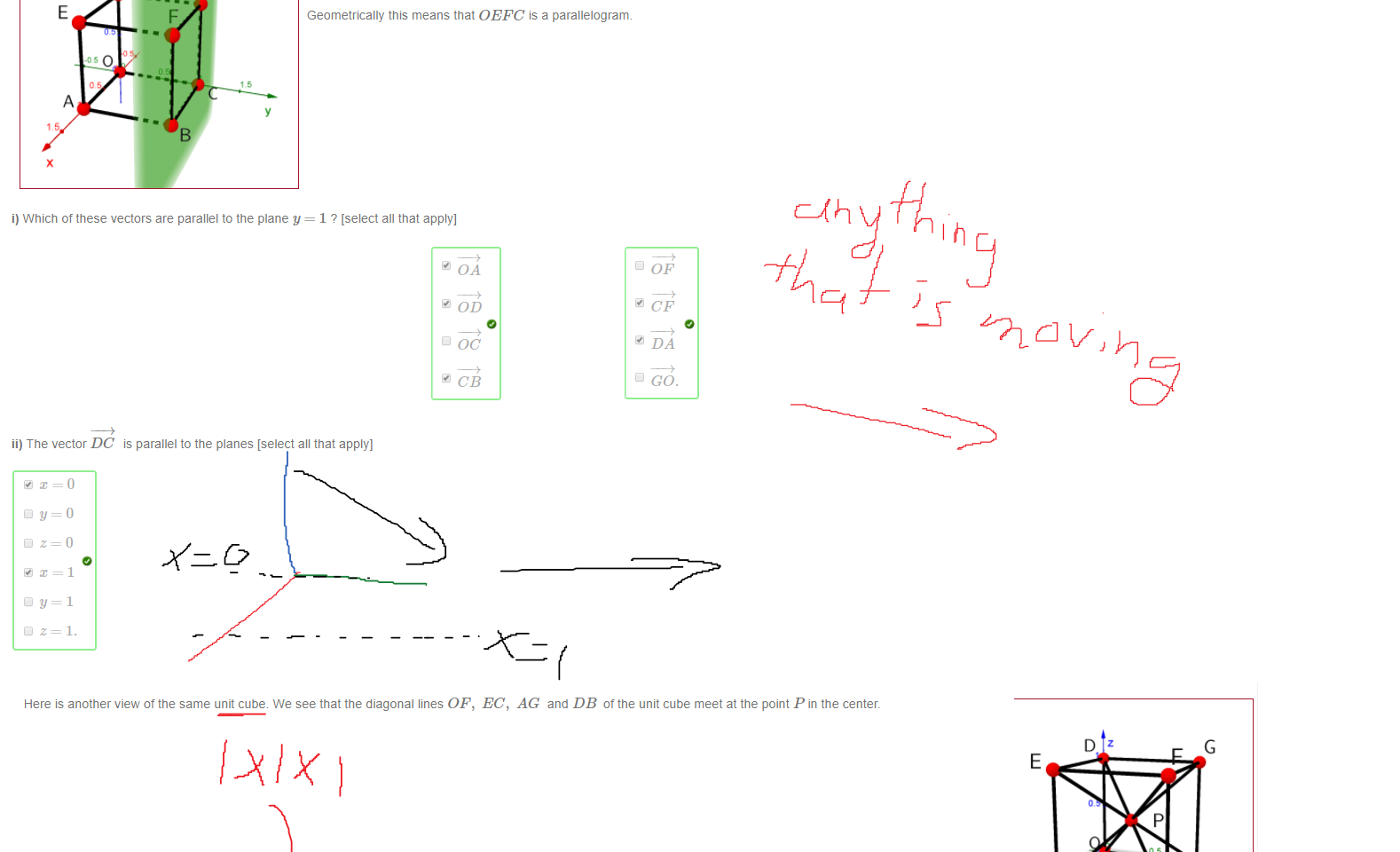
Consider the plane y = 1 in three-dimensional space, together witn the unit cube with vertices O, A, B, C, D, E, F, G as shown below 
Geometrically, a vector u is parallel to a plane it there exist points P and Q on the plane such that u = PQ. 
For example OE is parallel to the plane y = 1 because OE = CF where C and F are öotn on the plane. 
Geometrically this means that OEFC is a parallelogram. 
i) Which of these vectors are parallel to the plane y = 1 ? [select all that apply] 
OD 
D OC 
D GO. 
ii) The vector DC is parallel to the planes [select all that apply) 
Ink Drawings
Ink Drawings
﷐𝑣﷯=﷐﷮𝑄﷐𝑣﷯﷯=﷐﷮﷐﷐﷐𝑥﷮1﷯−﷐𝑥﷮2﷯﷯﷮2﷯+﷐﷐﷐𝑦﷮1﷯−﷐𝑦﷮2﷯﷯﷮2﷯+﷐﷐﷐𝑧﷮1﷯−﷐𝑧﷮2﷯﷯﷮2﷯+…﷯
﷐𝑣﷯=﷐﷮𝑄﷐𝑣﷯﷯=﷐﷮﷐𝑎﷮2﷯+﷐𝑏﷮2﷯+﷐𝑐﷮2﷯+…﷯
Ink Drawings
Ink Drawings
﷐−1×2﷯+﷐5×1﷯+﷐3×4﷯=15
Ink Drawings
Untitled picture.png Machine generated alternative text:
Consider the plane y = 1 in three-dimensional space, together witn the unit cube with vertices O, A, B, C, D, E, F, G as shown below 
Geometrically, a vector u is parallel to a plane it there exist points P and Q on the plane such that u = PQ. 
For example OE is parallel to the plane y = 1 because OE = CF where C and F are öotn on the plane. 
Geometrically this means that OEFC is a parallelogram. 
i) Which of these vectors are parallel to the plane y = 1 ? [select all that apply] 
OD 
D OC 
D GO. 
ii) The vector DC is parallel to the planes [select all that apply) 

Untitled picture.png Machine generated alternative text:
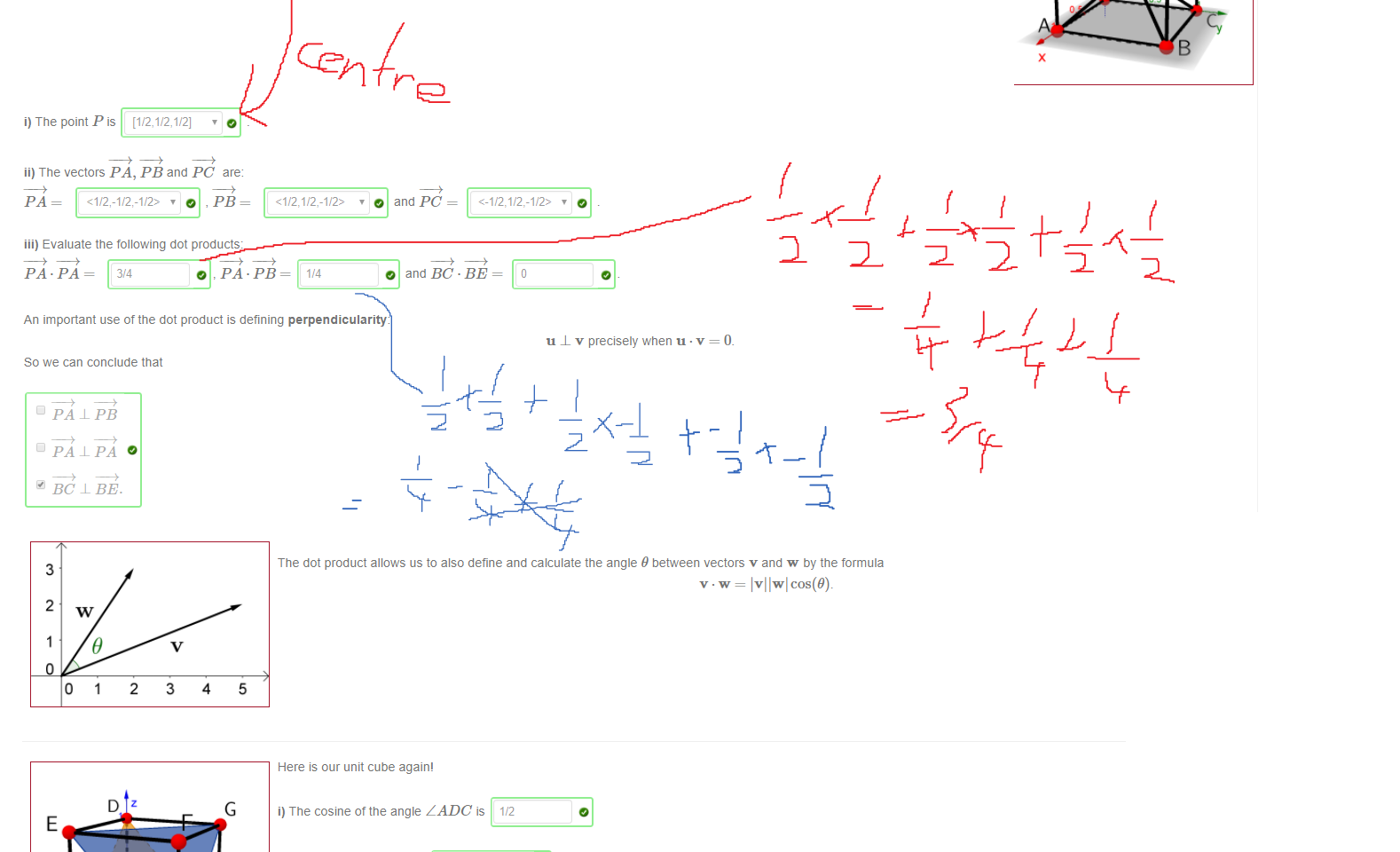
Here is another view ot the same unit cube. We see that the diagonal lines OF, EC, AG and DB ottne unit cube meet at the point P in the center. 
i) The point Pis 
ii) The vectors PA, PB and PC are: 
PA 
iii) Evaluate the following dot products: 
O and BC. BE 
An important use of the dot product is defining perpendicularity: 
So we can conclude that 
u I v precisely when u • v = 
Ink Drawings
Ink Drawings
Ink Drawings
Ink Drawings
Ink Drawings
Ink Drawings
Ink Drawings
Ink Drawings
Ink Drawings
Ink Drawings
Ink Drawings
Ink Drawings
Ink Drawings
Ink Drawings
Ink Drawings
Ink Drawings
Ink Drawings
Ink Drawings
Ink Drawings
Ink Drawings
Ink Drawings
Ink Drawings


Untitled picture.png Machine generated alternative text:
Here is another view ot the same unit cube. We see that the diagonal lines OF, EC, AG and DB ottne unit cube meet at the point P in the center. 
i) The point Pis 
ii) The vectors PA, PB and PC are: 
PA 
iii) Evaluate the following dot products: 
O and BC. BE 
An important use of the dot product is defining perpendicularity: 
So we can conclude that 
u I v precisely when u • v = 

Untitled picture.png Machine generated alternative text:
3 
2 
o 
0 
05 
2 
3 
4 
5 
G 
The dot product allows us to also define and calculate the angle 9 between vectors v and w by the formula 
v.w= Ivllwlcos(9). 
Here is our unit cube again' 
i) The cosine ot the angle Z ADC is 112 
ii) The triangle AADCis equilateral 
iii) The angle Z BEG is 60 
O degrees. 
iv) The triangle AEBG is equilateral 
v) The two triangles A ADC and AEBG are: 
congruent 
parallel 
similar, but not congruent 
meeting at the center of the cube 
Ink Drawings
Ink Drawings
Ink Drawings


Ink Drawings
Ink Drawings
Ink Drawings


Ink Drawings
Ink Drawings
Ink Drawings
Ink Drawings

Untitled picture.png Machine generated alternative text:
3 
2 
o 
0 
05 
2 
3 
4 
5 
G 
The dot product allows us to also define and calculate the angle 9 between vectors v and w by the formula 
v.w= Ivllwlcos(9). 
Here is our unit cube again' 
i) The cosine ot the angle Z ADC is 112 
ii) The triangle AADCis equilateral 
iii) The angle Z BEG is 60 
O degrees. 
iv) The triangle AEBG is equilateral 
v) The two triangles A ADC and AEBG are: 
congruent 
parallel 
similar, but not congruent 
meeting at the center of the cube 

Untitled picture.png Machine generated alternative text:
The dot product is defined between any two vectors VI and v2 in n-dimensional space, and gives us the useful relation 
where 9 is the angle between VI and v2_ 
In two dimensions it v = 
al 
and v 2 ¯ 
a2 
then the dot product is 
Consider the vectors 
¯ IVI IV'21 cos(9), 
VI = ala2 +b1b2- 
2 
0 
i) Then a • b 
2 
2 
3 
3 
4 
3 
and b 
1 
1 
2 
x 
5 
ii) The cosine ot the angle 9 between a and b is cos(9) 
iii) The angle between a and b is, to the nearest degree, 46 
iv) The cosine ot the angle between a and BA is 
1/sqrt(2) 
v) The angle between a and BA is, to the nearest degree, 
vi) The triangle formed by O = [0,0], A = [3,11 and B 
a right triangle 
obtuse 
isosceles 
equilateral 
46 
[1, 2] is a bit special, since it is: [select all that apply] 
Ink Drawings


Ink Drawings
Ink Drawings
Ink Drawings

Untitled picture.png Machine generated alternative text:
The dot product is defined between any two vectors VI and v2 in n-dimensional space, and gives us the useful relation 
where 9 is the angle between VI and v2_ 
In two dimensions it v = 
al 
and v 2 ¯ 
a2 
then the dot product is 
Consider the vectors 
¯ IVI IV'21 cos(9), 
VI = ala2 +b1b2- 
2 
0 
i) Then a • b 
2 
2 
3 
3 
4 
3 
and b 
1 
1 
2 
x 
5 
ii) The cosine ot the angle 9 between a and b is cos(9) 
iii) The angle between a and b is, to the nearest degree, 46 
iv) The cosine ot the angle between a and BA is 
1/sqrt(2) 
v) The angle between a and BA is, to the nearest degree, 
vi) The triangle formed by O = [0,0], A = [3,11 and B 
a right triangle 
obtuse 
isosceles 
equilateral 
46 
[1, 2] is a bit special, since it is: [select all that apply] 
Untitled picture.png Machine generated alternative text:
cos 0 

Ink Drawings


Created with Microsoft OneNote 2016.