Alg1131W12T3 - Matrix commutation identity

Sunday, 27 May 2018

10:05 PM

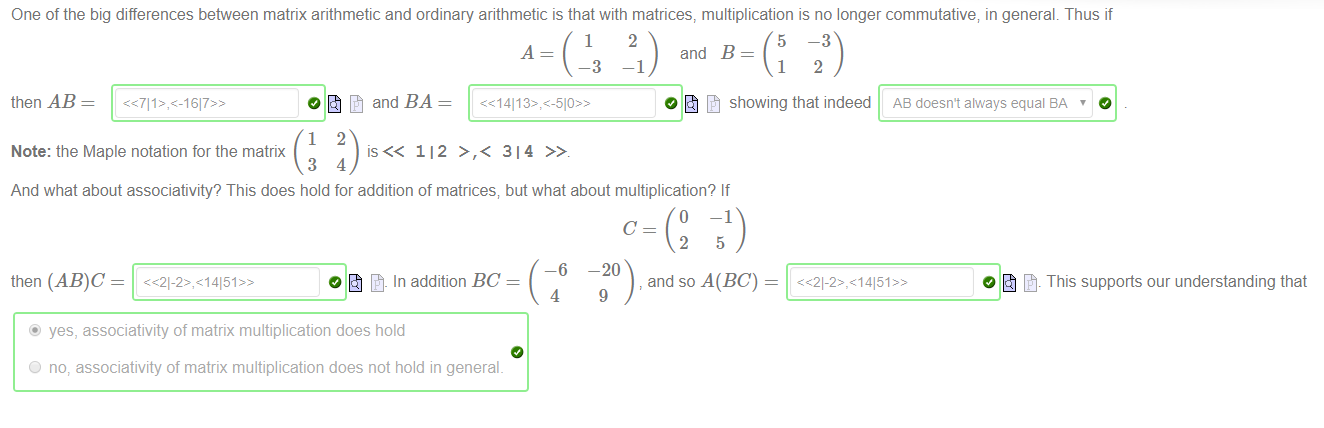
One of the big differences between matrix arithmetic and ordinary arithmetic is that with matrices, multiplication is no longer commutative; in general. Thus if 
—1 
then AB 
1 
2 
—3 
and BA 
5 
-3 
and B 
O Showing that indeed 
Note: the Maple notation for the matrix 
112 >,< 314 
And what about associativityQ This does hold for addition of matrices; but what about multiplication? If 
then 
—6 
In addition BC 
4 
O 
—1 
20) and so A(BC) 
9 
AB doesn't always equal SA ' 
O This supports our understanding that 
@ yes, associativity of matrix multiplication does hold 
O no: associativity of matrix multiplication does not hold in general.


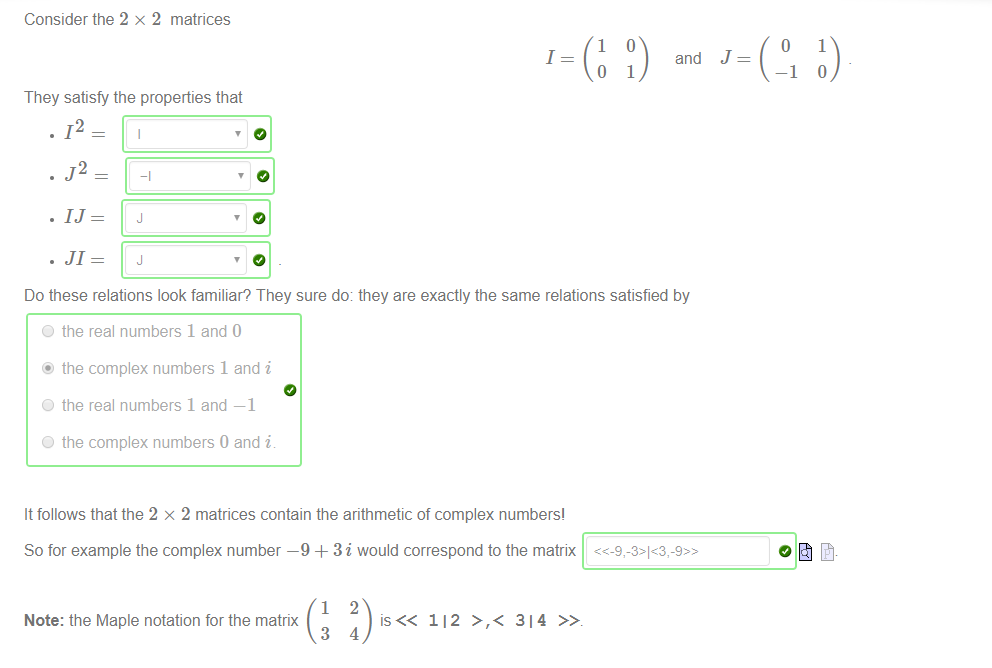
Consider the 2 x 2 matrices 
1 
1 
o 
They satisfy the properties that 
. 12 
and 
1 
o 
—1 
1 
Do these relations look familiar? They sure do: they are exactly the same relations satisfied by 
O the real numbers 1 and O 
@ the complex numbers 1 and i 
O the real numbers 1 and —1 
O the complex numbers 0 and i 
It follows that the 2 x 2 matrices contain the arithmetic of complex numbers' 
So for example the complex number —9 + 3i would correspond to the matrix 
1 
Note: the Maple notation for the matrix 
3 
2 
112 >,< 314 
4


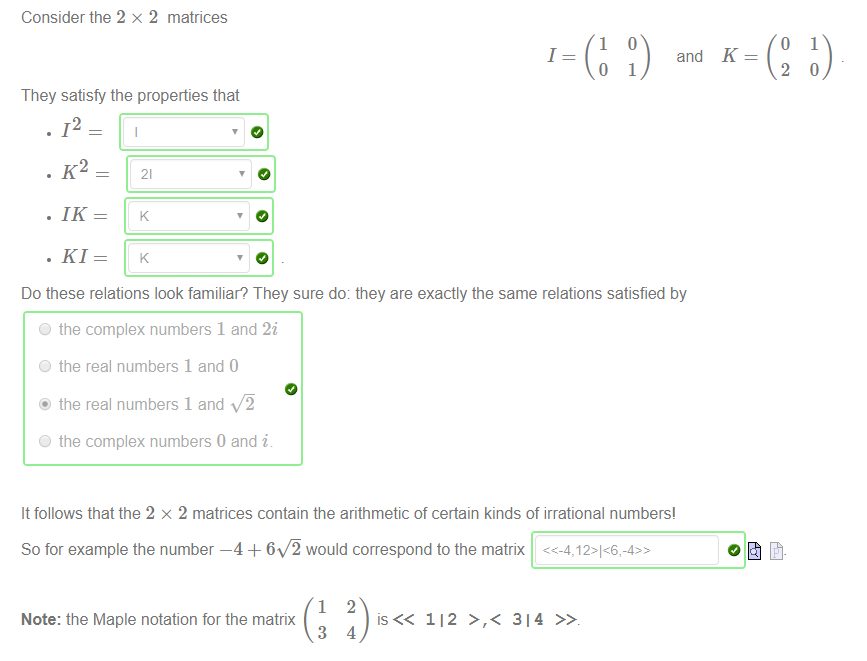
Consider the 2 x 2 matrices 
1 
1 
o 
They satisfy the properties that 
and 
1 
o 
2 
1 
. 12 
. K2 
. 1K 
21 
Do these relations look familiar? They sure do: they are exactly the same relations satisfied by 
O the complex numbers 1 and 2i 
O the real numbers 1 and O 
@ the real numbers 1 and 
O the complex numbers 0 and i 
It follows that the 2 x 2 matrices contain the arithmetic of certain kinds of irrational numbers' 
So for example the number —4 + 60 would correspond to the matrix 
1 
Note: the Maple notation for the matrix 
3 
2 
112 >,< 314 
4


a 
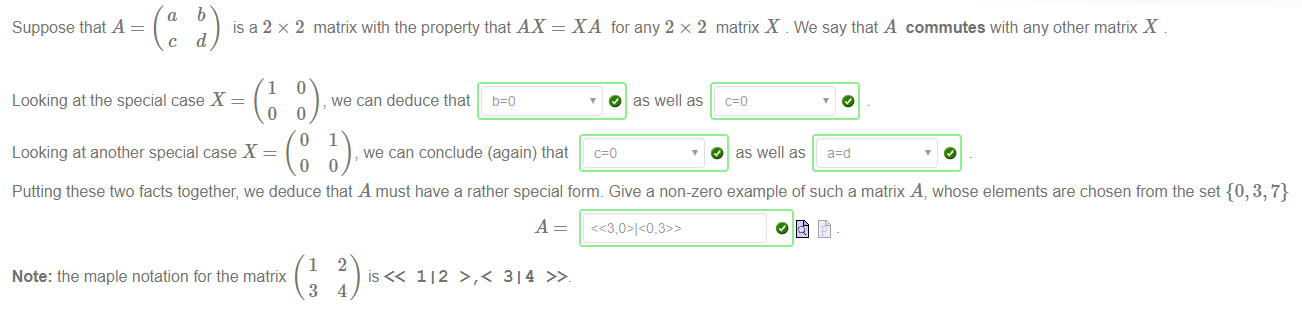
Suppose that A 
c 
b 
is a 2 x 2 
d 
1 
matrix with the property that AX 
we can deduce that 
we can conclude (again) that 
XA for any 2 x 2 matrix X We say that A commutes with any other matrix X 
O as well as 
Looking at the special case X 
o 
Looking at another special case X 
o 
Putting these ftvo facts together, we deduce that A must have a rather special form. Give a non-zero example of such a matrix A, whose elements are chosen from the set {0, 3, 7} 
1 
Note: the maple notation for the matrix 
3 
2 
112 >,< 314 
4


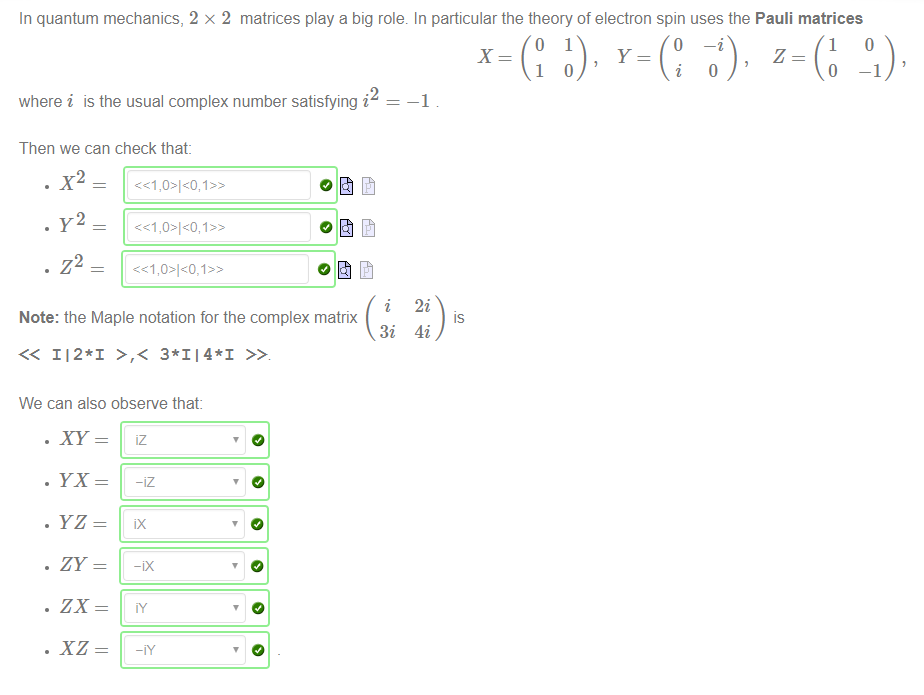
In quantum mechanics, 2 x 2 matrices play a big role. In particular the theory of electron spin uses the Pauli matrices 
where i is the usual complex number satisfying i 
Then we can check that: 
Note: the Maple notation for the complex matrix 
3i 
<< 112*1 >,< 
We can also observe that 
-iZ 
-iX 
• xz 
4i


Created with Microsoft OneNote 2016.