Alg1131W10T4 - Unknown right hand side

Monday, 14 May 2018

12:05 AM

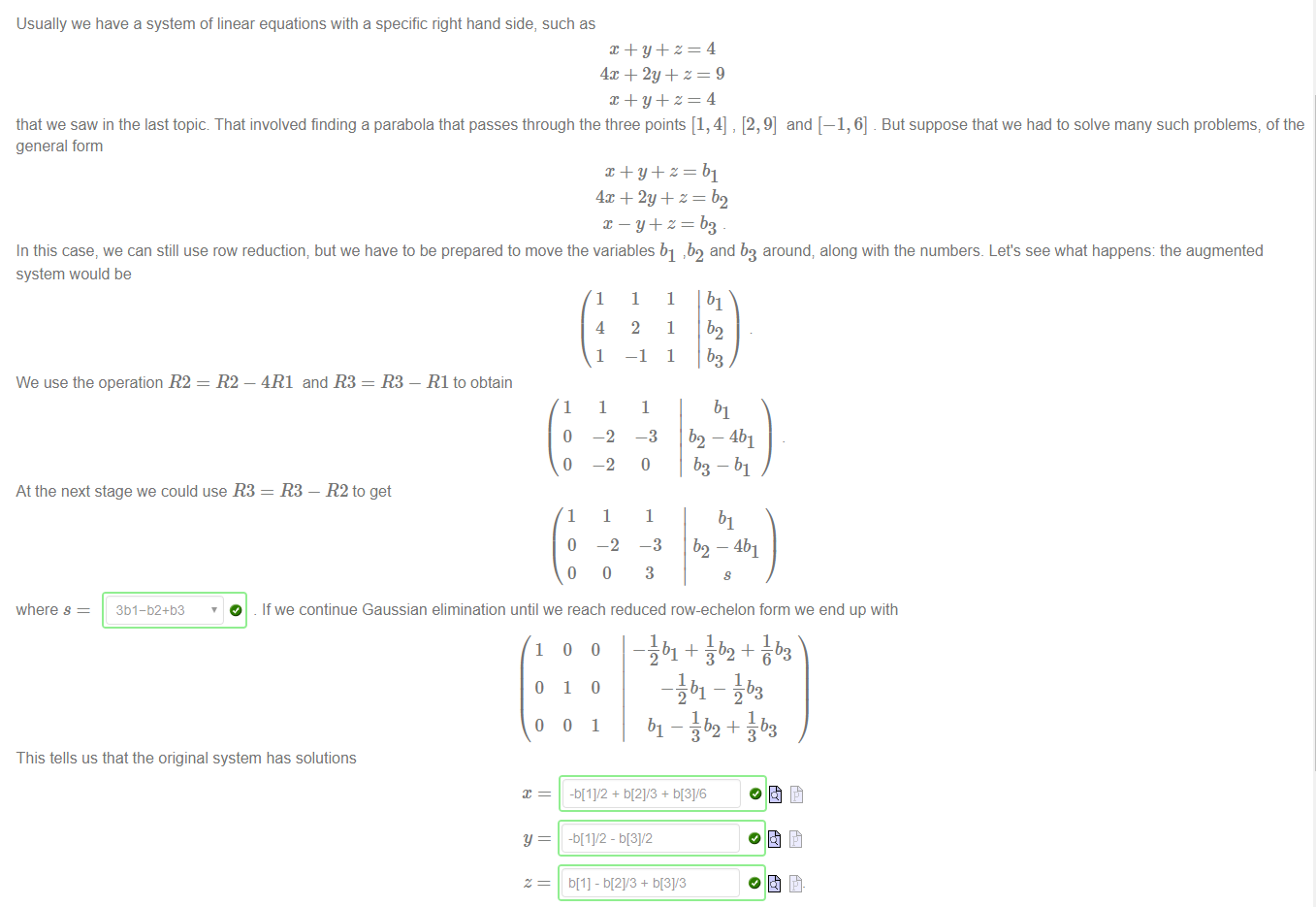
Usually we have a system of linear equations with a specific right hand side, such as 
that we saw in the last topic That involved finding a parabola that passes through the three points [1, 4] , [2, 9] and [—1, 6] But suppose that we had to solve many such problems, of the 
general form 
In this case, we can still use row reduction; but we have to be prepared to move the variables bl 7b2 and b3 around; along with the numbers. Let's see what happens: the augmented 
system would be 
We use the operation R2 
= - 4R1 and R3 
= R3 
RI to obtain 
1 
o 
o 
1 
O 
1 
4 
1 
1 
—2 
—2 
1 
-2 
O 
1 
2 
—1 
1 
—3 
1 
1 
1 
1 
b2 
b2 ¯ 4b1 
b3-bl 
At the next stage we could use R3 = R3 — R2 to get 
3 b2-4b1 
3 
where s 
3b I-b2+ö3 
O 
If we continue Gaussian elimination until we reach reduced row-echelon form we end up with 
1 
o 
o 
o 
1 
o 
o 
o 
1 
- äbl + + åb3 
—Jbl 
1 
bl — äb2 + åb3 
This tells us that the original system has solutions 
ö[l] - 5121/3 + 5131/3


Note: 
• the Maple syntax for bl — —b2 + —b3 iSb [1] -1/2*b [2] 
• you can use the preview button to preview your answer. 
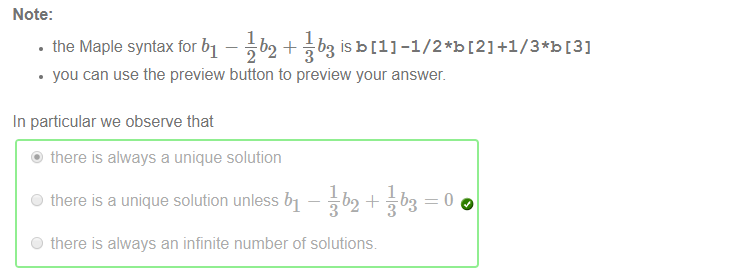
In particular we observe that 
@ there is always a unique solution 
Jb2 
O there is a unique solution unless bl — 
O there is always an infinite number of solutions 
1


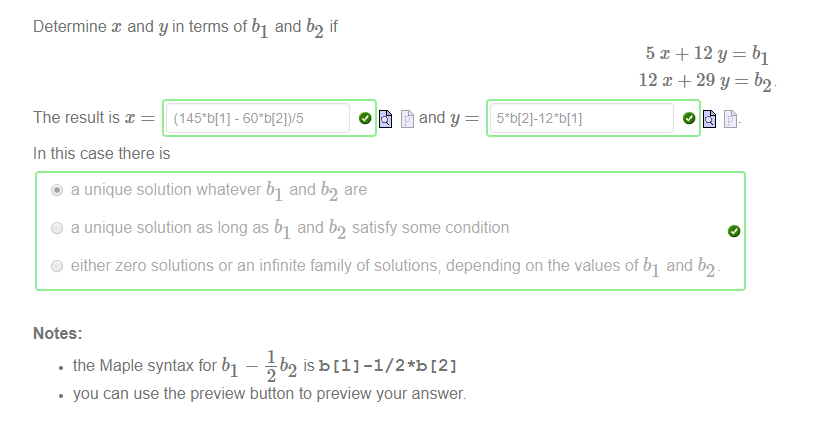
Determine x and y in terms of bl and b2 if 
The result is x 
In this case there is 
@ a unique solution whatever bl and b2 
are 
C) a unique solution as long as bl and b2 satisfy some condition 
5 x + 12 y = bl 
12 29 y = b2 
C) either zero solutions or an infinite family of solutions; depending on the values of bl and b2 
Notes: 
• the Maple syntax for bl — ub2 isb[l] -1/2*b [2] 
you can use the preview button to preview your answer


Machine generated alternative text:
Determine y and z in terms of bl, b2 and b3 if 
The result is 
In this case there is a 
@ a unique solution whatever bl and b2 
are 
C) unique solution as long as bl and b2 satisfy some condition 
y 
x—3y-3z 
x—2y-2z 
3x-10y-9z 
- 513] 
+ ö[21 + b[3] 
C) either zero solutions or an infinite family of solutions; depending on the values of bl and b2 
Notes: 
• the Maple syntax for bl — ub2 — äb3 iSb[1] 
you can use the preview button to preview your answer


Machine generated alternative text:
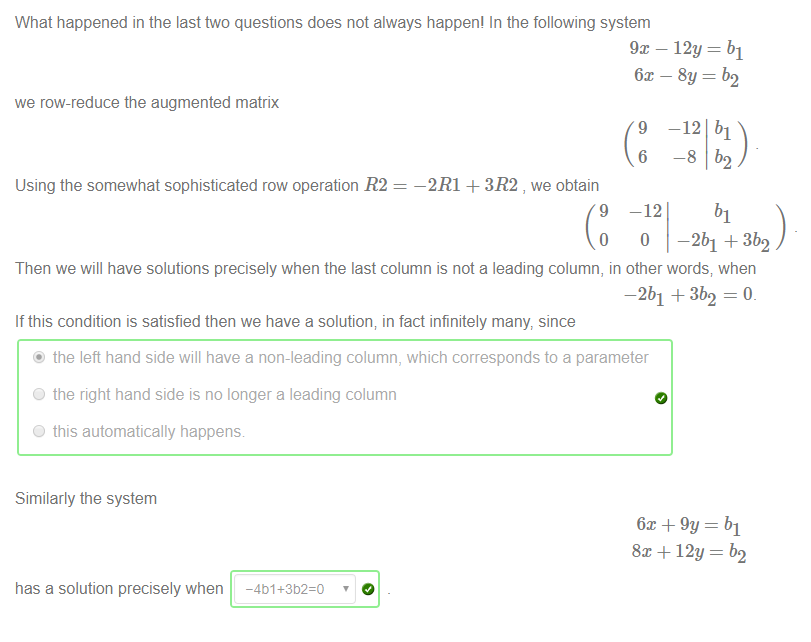
What happened in the last two questions does not always happen' In the following system 
we row-reduce the augmented matrix 
Using the somewhat sophisticated row operation R2 
—2R1 + 3R2 , we obtain 
9 
6m — 8y = b2 
—12 bl 
9 
6 
-12 
Then we will have solutions precisely when the last column is not a leading column, in other words; when 
—2b1 +3b2 = O. 
If this condition is satisfied then we have a solution; in fact infinitely many, since 
@ the left hand side will have a non-leading column, which corresponds to a parameter 
O the right hand side is no longer a leading column 
O this automatically happens 
Similarly the system 
has a solution precisely when 
6m + 9y 
8x + 12y 
-401+352=0


Machine generated alternative text:
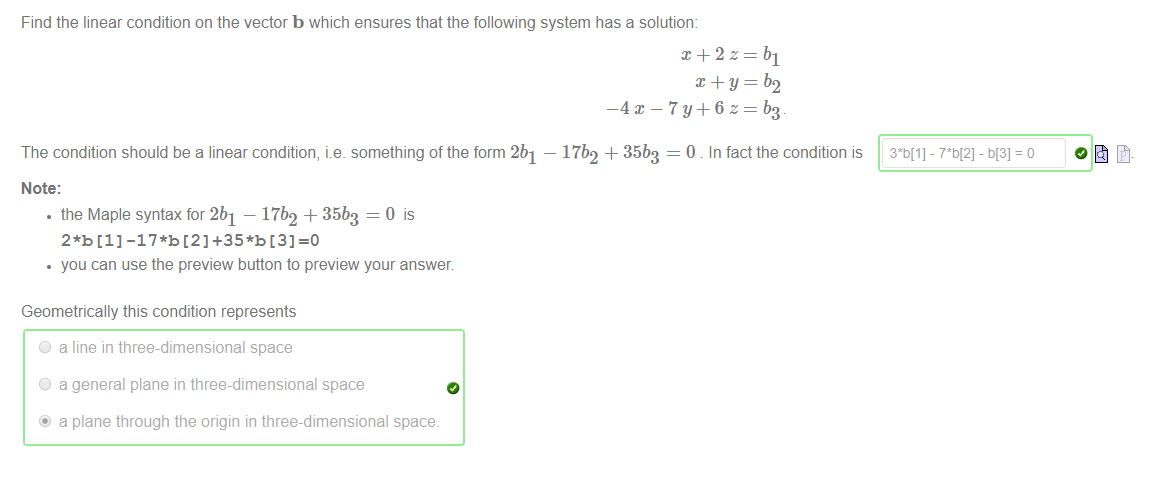
Find the linear condition on the vector b which ensures that the following system has a solution: 
The condition should be a linear condition, i.e. something of the form 2b1 — 17b2 + 35b3 = 0 . In fact the condition is 
Note: 
• the Maple syntax for 2b1 — 17b2 + 35b3 = 0 is 
you can use the preview button to preview your answer 
Geometrically this condition represents 
O 
O 
a line in three-dimensional space 
a general plane in three-dimensional space 
a plane through the origin in three-dimensional space.


Created with Microsoft OneNote 2016.