Alg1131W10T2 - Deductions based on row-echelon form

Sunday, 13 May 2018

11:46 PM

Machine generated alternative text:
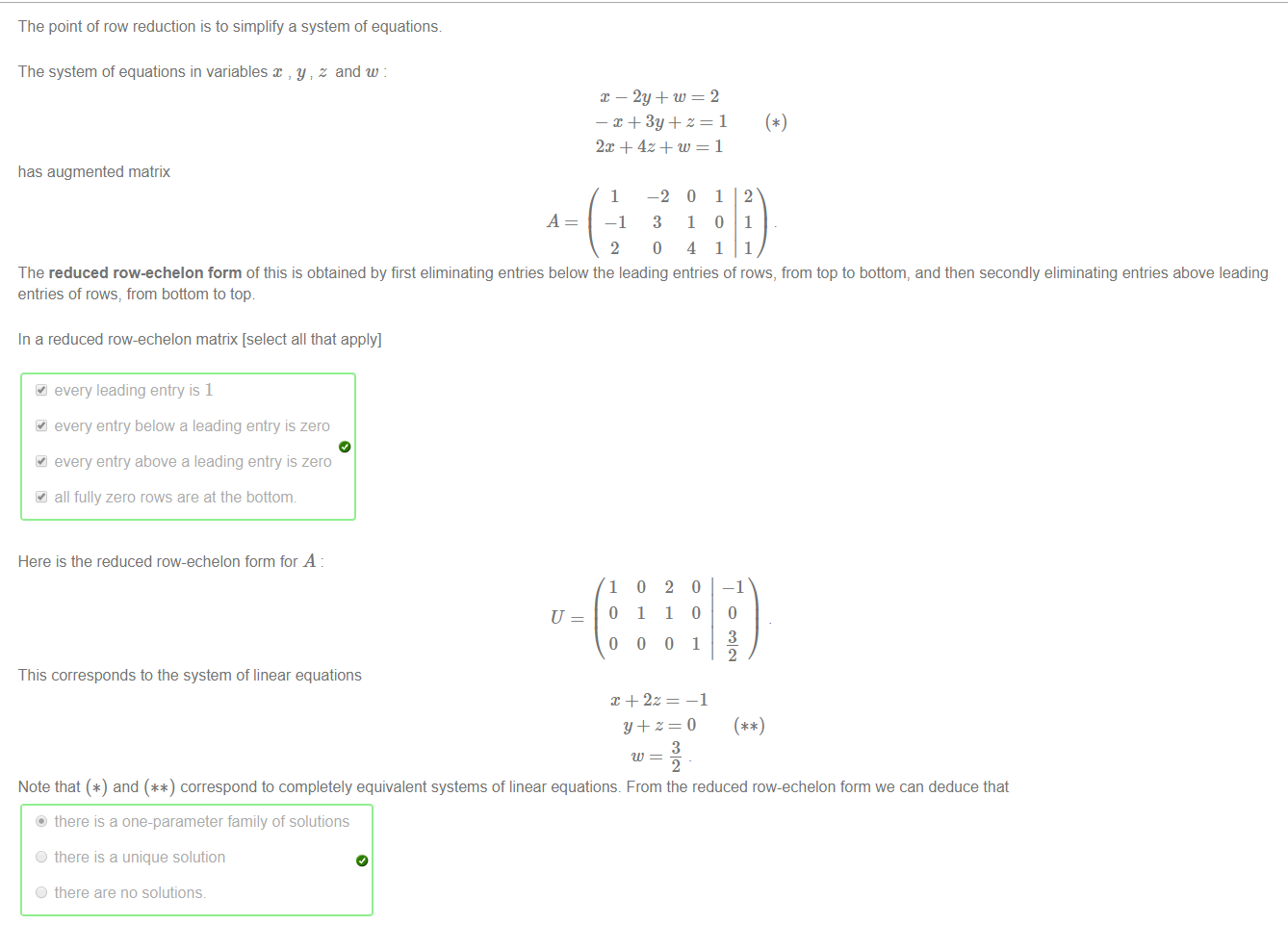
The point of row reduction is to simplify a system of equations 
The system of equations in variables x , y z and w 
has augmented matrix 
x — 2y + w 
1 
—1 
2 
—1 
1 
o 
1 
2 
1 
1 
The reduced row-echelon form of this is obtained by first eliminating entries below the leading entries of rows, from top to bottom, and then secondly eliminating entries above leading 
entries of rows, from bottom to top 
In a reduced row-echelon matrix [select all that apply] 
41 every leading entry is 1 
every entry below a leading entry is zero 
every entry above a leading entry is zero 
all fully zero rows are at the bottonm 
Here is the reduced row-echelon form for A 
This corresponds to the system of linear equations 
1 
o 
o 
o 
1 
o 
2 
1 
o 
3 
o 
0 
1 
—1 
—1 
3 
2 
Note that and correspond to completely equivalent systems of linear equations. From the reduced row-echelon form we can deduce that 
there is a one-parameter family of solutions 
O 
O 
there is a unique solution 
there are no solutions.


Machine generated alternative text:
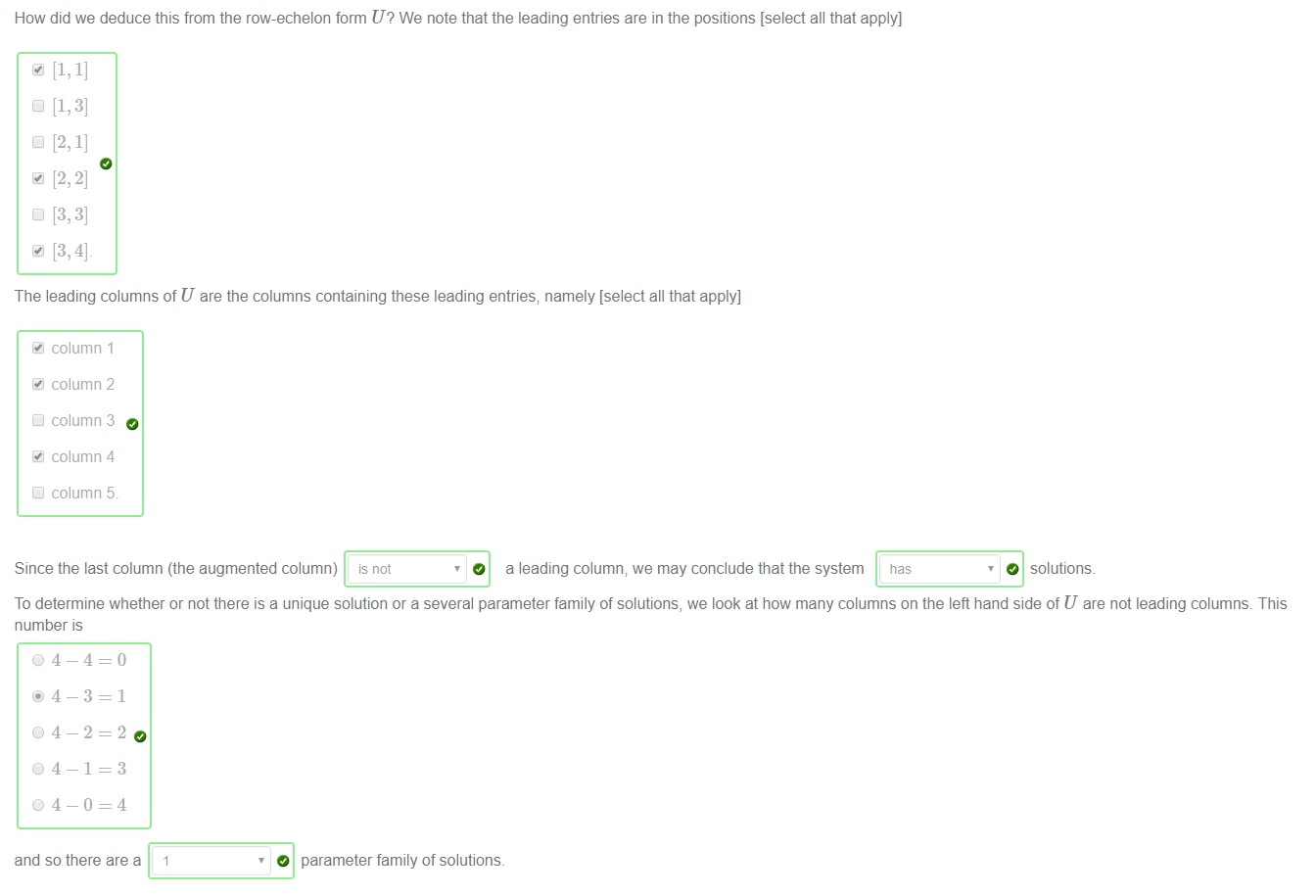
How did we deduce this from the row-echelon form U? We note that the leading entries are in the positions [select all that apply] 
The leading columns of U are the columns containing these leading entries; namely [select all that apply] 
column 1 
column 2 
column 3 
column 4 
column 5 
—3=1 
04-2=2 
Since the last column (the augmented column) is not 
O a leading column; we may conclude that the system has 
O solutions. 
To determine whether or not there is a unique solution or a several parameter family of solutions, we look at how many columns on the left hand side of U are not leading columns. This 
number is 
and so there are a 
O parameter family of solutions.


Machine generated alternative text:
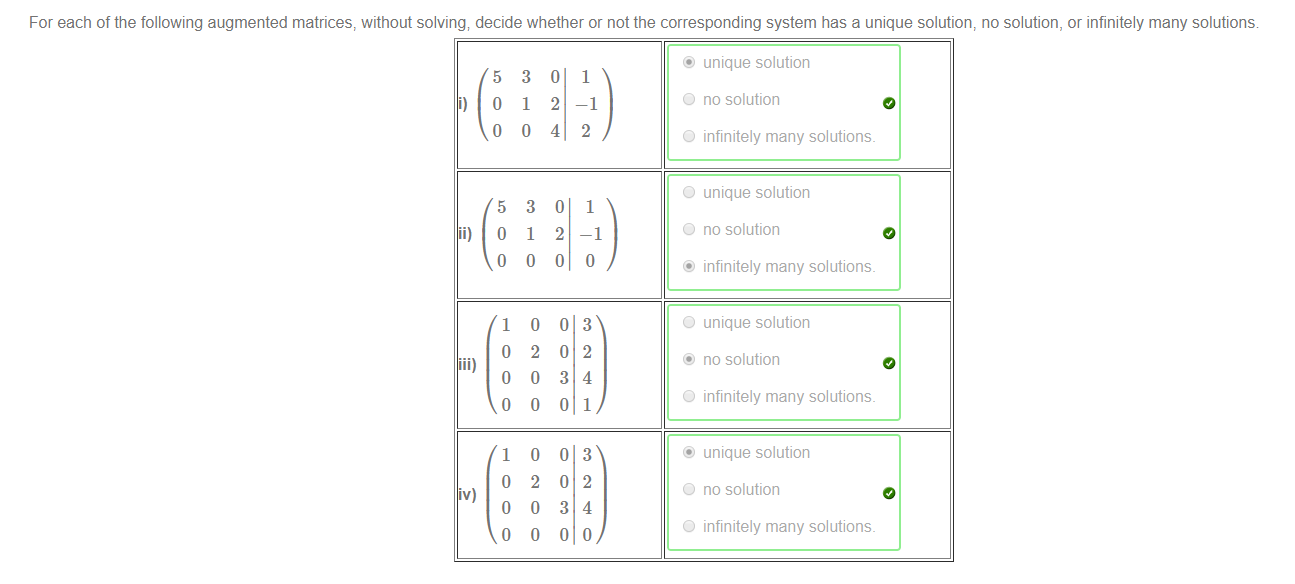
For each of the following augmented matrices, without solving; decide whether or not the corresponding system has a unique solution, no solution, or infinitely many solutions 
i) 
ii) 
5 
o 
o 
5 
o 
1 
o 
o 
o 
1 
o 
o 
o 
3 
1 
o 
3 
1 
o 
o 
2 
o 
o 
o 
2 
o 
o 
o 
2 
4 
o 
2 
o 
o 
o 
3 
o 
o 
o 
3 
o 
1 
—1 
2 
1 
—1 
o 
3 
2 
4 
1 
3 
2 
4 
o 
O 
O 
O 
O 
O 
O 
O 
O 
unique solution 
no solution 
infinitely many solutions. 
unique solution 
no solution 
infinitely many solutions. 
unique solution 
no solution 
infinitely many solutions. 
unique solution 
no solution 
infinitely many solutions.


Machine generated alternative text:
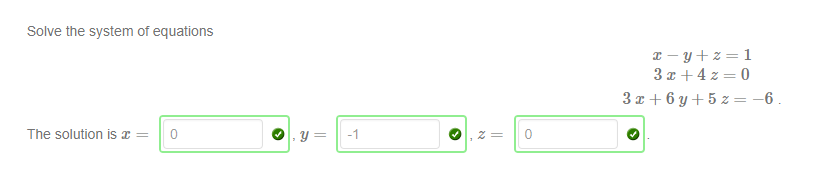
Solve the system ot equations 
The solution is = 
3x+6y+5z 
—6 
o 
a


Machine generated alternative text:
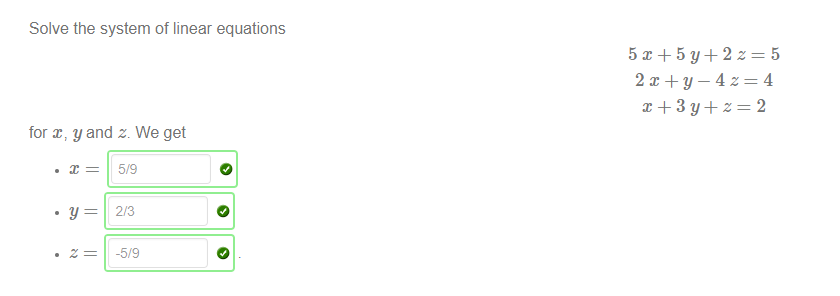
Solve the system of linear equations 
for y and z. We get


Machine generated alternative text:
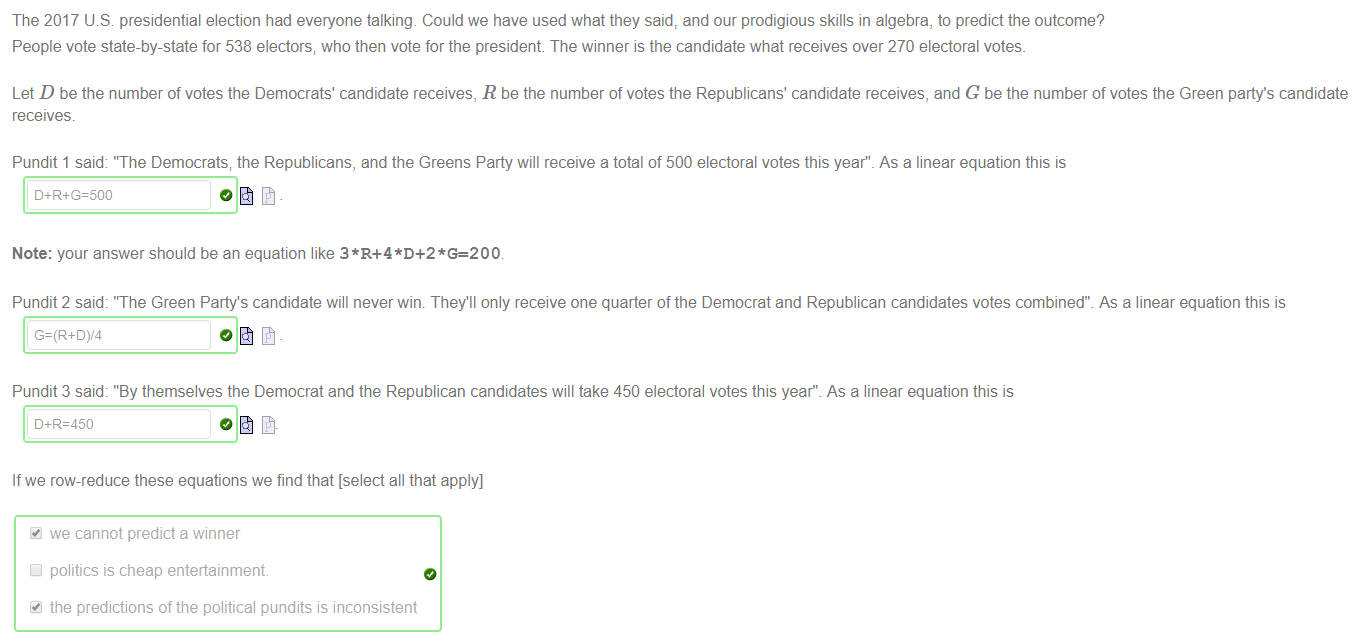
The 2017 US. presidential election had everyone talking. Could we have used what they said, and our prodigious skills in algebra, to predict the outcome? 
People vote state-by-state for 538 electors; who then vote for the president The winner is the candidate what receives over 270 electoral votes. 
Let D be the number of votes the Democrats' candidate receives, R be the number of votes the Republicans' candidate receives, and G be the number of votes the Green party's candidate 
receives 
Pundit 1 said 'The Democrats; the Republicans, and the Greens Party will receive a total of 500 electoral votes this year" _ As a linear equation this is 
D+R+G=500 
Note: your answer should be an equation like 3*R+4 *D+2 
Pundit 2 said: 'The Green Party's candidate will never wim They'll only receive one quarter of the Democrat and Republican candidates votes combined't As a linear equation this is 
Pundit 3 said "By themselves the Democrat and the Republican candidates will take 450 electoral votes this yeart As a linear equation this is 
D+R=450 
If we row-reduce these equations we find that [select all that apply] 
we cannot predict a winner 
politics is cheap entertainment. 
the predictions of the political pundits is inconsistent


Created with Microsoft OneNote 2016.