The Mean Value Theorem

Tuesday, 27 March 2018

9:05 PM

This theorem helps in:

  • Identifying whether a function is increasing or decreasing
  • Identifying stationary points
  • Determining the limits of  and


Theorem



For any suitable function, there must be a point at which the instantaneous rate of change is equal to the average (mean) rate of change over a whole interval


Example

With x-values ,

 

Machine generated alternative text:
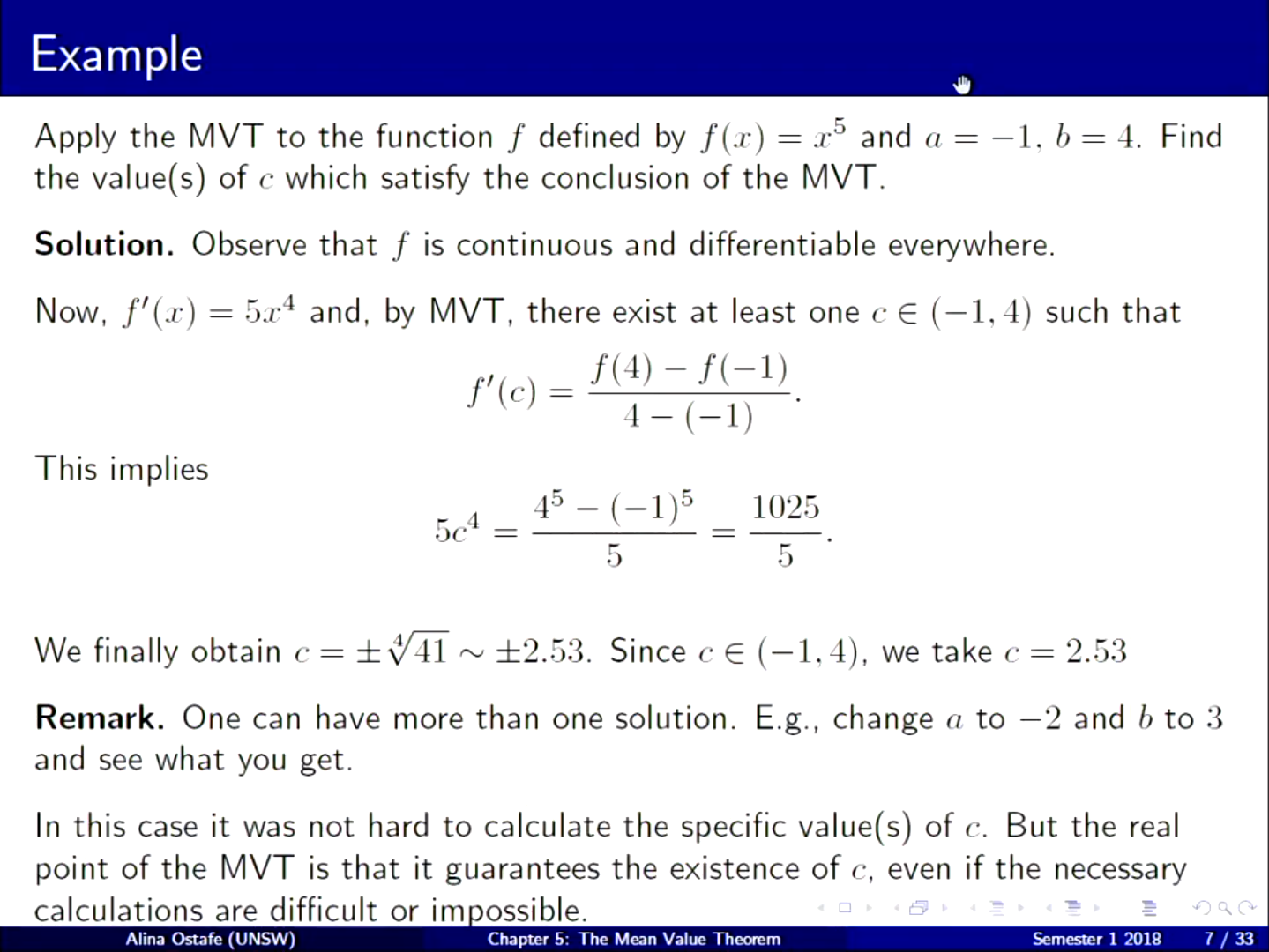
Example 
Apply the M VT to the function f defined by f (x) — 
x and a 
the value(s) of c which satisfy the conclusion of the MVT. 
Solution. Observe that f is continuous and differentiable everywhere. 
4. Find 
5x4 and, by M VT, there exist at least one c e (—1, 4) such that 
Now, f' (x) 
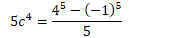
This implies 
45 - (-1)5 
1025 
oc 
5 
5 
We finally obtain c— ±2.53. Since c €- (—1, 4), we take c — 2.53 
Remark. One can have more than one solution. E.g., change a to —2 and b to 3 
and see what you get. 
In this case it was not hard to calculate the specific value(s) of c. But the real 
point of the M VT is that it guarantees the existence of c, even if the necessary 
calculations are difficult or im ossible. 
Alina Ostafe (UNSW) 
Chapter 5: The Mean Value The«em 
7/33 
Semesær 1 2018


Created with Microsoft OneNote 2016.