Sets, Inequalities and Functions // Alina Ostafe

Tuesday, 27 February 2018

12:09 PM

Sets
A set in a collection of distinct objects
Each object in a set is called an element or a member

Natural Numbers - 𝑁
𝑁={0, 1, 2, 3, …}

Integers - 𝑍
Ζ={…,−1, 0, 1, …}

Real Numbers - 𝑅
Basically every single number. Ever.

Rational Numbers - 𝑄
The set Q of rational numbers consists of numbers of the form ﷐𝑝﷮𝑞﷯ where p and q are integers, and 𝑞≠0
𝑄=﷐﷐𝑝﷮𝑞﷯:𝑝, 𝑞∈𝑍,𝑞≠0﷯

Irrational Numbers - 𝑅−𝑄
There are also numbers such as √2 which are not rational numbers
Proof for an irrational number
𝐴𝑠𝑠𝑢𝑚𝑒 𝑡ℎ𝑎𝑡 ﷐𝑥﷮2﷯=2 𝑎𝑛𝑑 𝑡ℎ𝑎𝑡 𝑥=﷐𝑝﷮𝑞﷯, 𝑞≠0, 𝑎𝑛𝑑 𝑝 𝑎𝑛𝑑 𝑞 𝑎𝑟𝑒𝑖𝑛𝑡𝑒𝑔𝑒𝑟𝑠 𝑤𝑖𝑡ℎ 𝑛𝑜 𝑓𝑎𝑐𝑡𝑜𝑟𝑠 𝑖𝑛 𝑐𝑜𝑚𝑚𝑜𝑛 𝑜𝑡ℎ𝑒𝑟 𝑡ℎ𝑎𝑛 1 𝑎𝑛𝑑 −1
﷐𝑥﷮2﷯=2=﷐﷐﷐𝑝﷮𝑞﷯﷯﷮2﷯

﷐﷐﷐𝑝﷮𝑞﷯﷯﷮2﷯=2
﷐𝑝﷮2﷯=2﷐𝑞﷮2﷯
𝑝= ﷐﷮2﷯𝑞

FIXME
Untitled picture.png Machine generated alternative text:
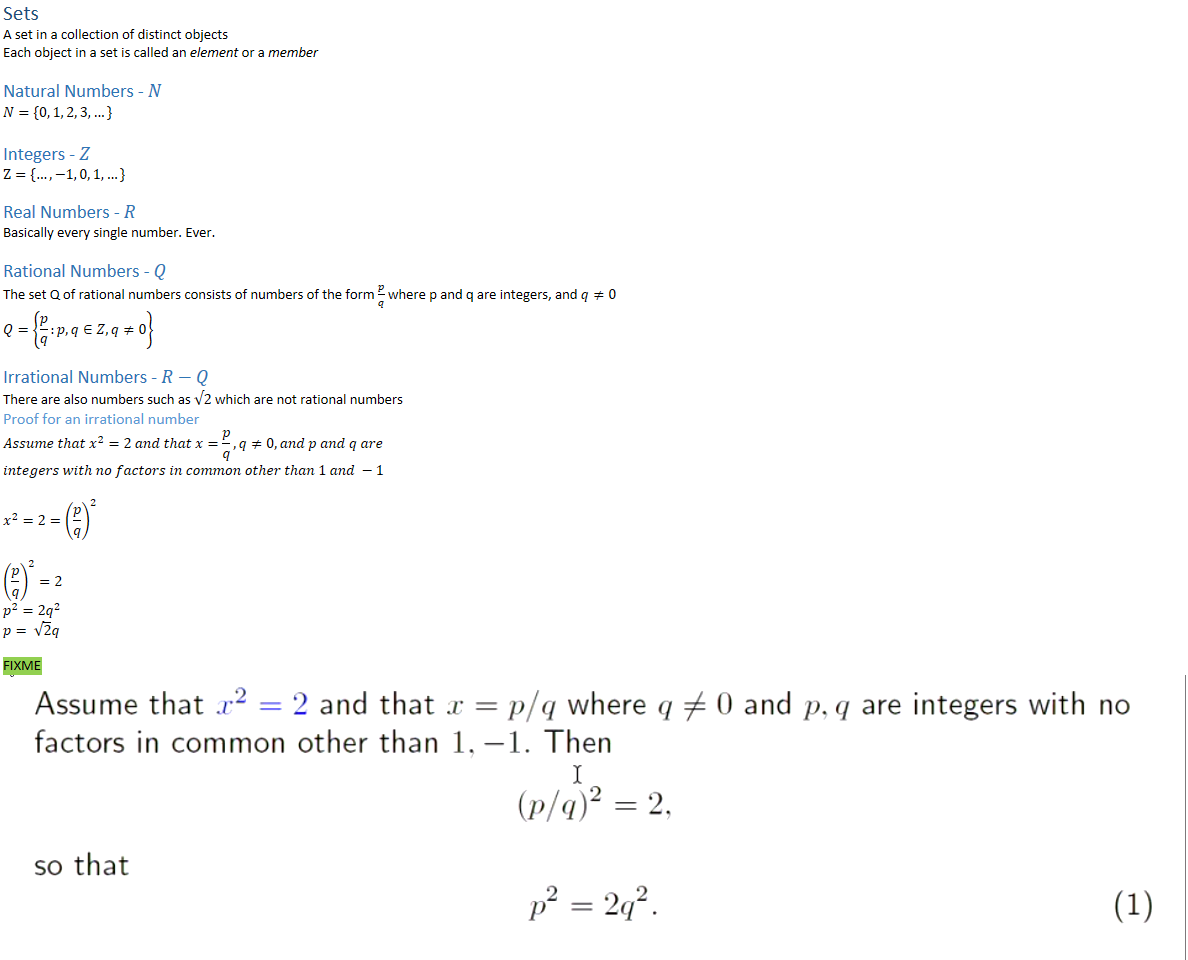
Assume that x2 
factors in common 
so that 
'2 and that p/q where q 0 and p, q are integers with no 
other than 1, —1. Then 
1 
(p/q)2 
201 . 
2 
(1) 
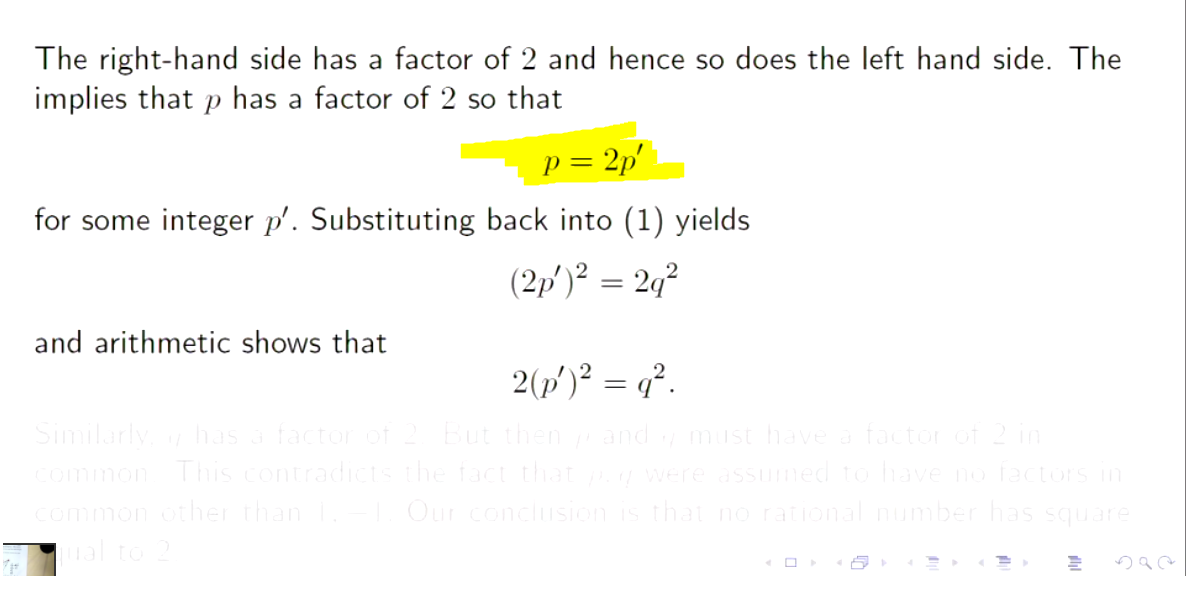
The right-hand side has a factor of 2 and hence so does the left hand side. The 
implies that p has a factor of 2 so that 
P '21/ 
for some integer p'. Substituting back into (1) yields 
(2P ) 
and arithmetic shows that 
2
Untitled picture.png Machine generated alternative text:
Assume that x2 
factors in common 
so that 
'2 and that p/q where q 0 and p, q are integers with no 
other than 1, —1. Then 
1 
(p/q)2 
201 . 
2 
(1) 
The right-hand side has a factor of 2 and hence so does the left hand side. The 
implies that p has a factor of 2 so that 
P '21/ 
for some integer p'. Substituting back into (1) yields 
(2P ) 
and arithmetic shows that 
2 

Ink Drawings


Created with Microsoft OneNote 2016.