General Strategy to Prove that a Limit Exists
Wednesday, 14 March 2018
1:24 AM
Given , we need to find a number , such that , whenever .
- Find a good upper
bound for

- Find a simple
action on such that the upper bound is less than .

- Use the condition
to state an appropriate value for (in terms of )

The value of is dependent on , and is not a unique value.
To define a limit, we do not need to find the value of the limit, but only prove that it exists.
(The definition of a limit does not reveal the value of the limit)
The definition of a limit is useful to prove theorems which allow us to justify the methods of finding limits
Note: The definition of a limit should not be needed, and should only be used if the theorems do not work, or if explicitly asked
If is a constant function [that is, ], then

If as , then

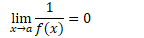
Suppose that






The Pinching Theorem
If a function lies between the graphs of two other functions heading to a limit, then that function must also heat to that same limit
"Suppose that ,, are three functions such that on an interval for some and 
Then 
Solving other limits
Given , where , , 
Divide both sides by the highest power term
Limits in the form 
To solve these problems, multiply the expression by its conjugate,
that is 