Geometric Vectors
Wednesday, 28 February 2018
12:18 AM
Definition
A point is a uniquely identified place in space.
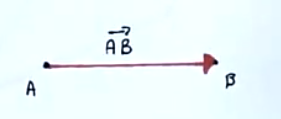
A vector is a directed line segment
from point A to point B.
It is directional, and its length can be denoted by |𝑣|
Drawing Vectors
NOTE: When drawing vectors, it is important to notate the direction of the line
Simple draw a line between two labelled points, and mark the direction
Joining Vectors (Geometrically)
Mark out an origin point.
For each item in the vector, draw a line from the previous point to the new location.
After each item has
been drawn, draw another line from the tail of the first line (origin) to the
head of the last line.
This newly drawn line is the resultant vector
Joining a Negative Vector
Turn that negative vector into something like + (-), where - is the same thing as , but in the opposite direction
Scalar Multiples of Vectors
The lambda symbol () is used to represent the scale of a
vector (ie how long it is)
When , the vector travels in the usual
direction
When , the vector travels in the opposite
direction
When , we get a zero vector, which is
just the original point. (???)
A co-ordinate vector (also known as a position vector) is the vector from the origin to a point.
When dealing with vectors in a relative space, we can make use of the origin as an absolute space.
Approaching Geometrical Vector Problems
Take detailed note of the keywords in the question
- What type of shape is it, does that shape have special properties that you will need to use?
- What is the order
of the defined points,

Pay attention to
both of these facts.
For example, consider the below parallelogram ABCD
, though 
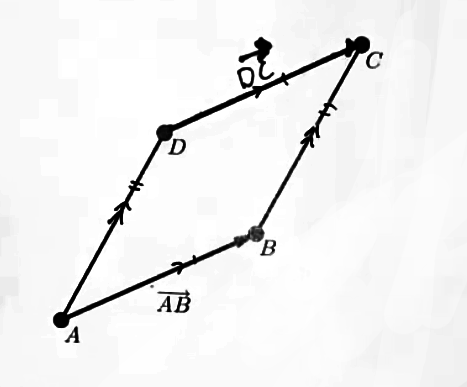
Other vectors exist like , , and their opposites